
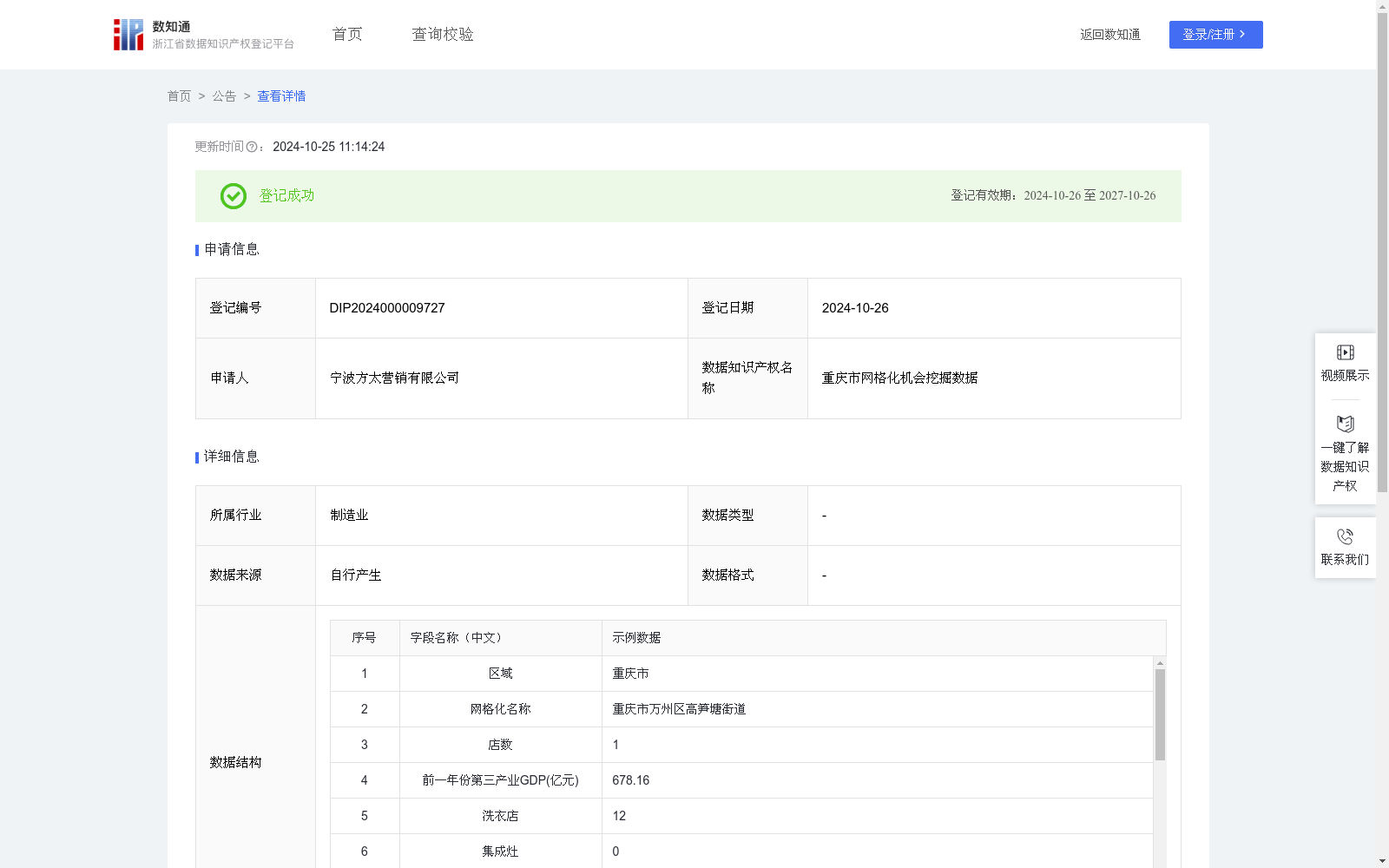
重庆市网格化机会挖掘数据
收藏浙江省数据知识产权登记平台2024-10-25 更新2024-10-26 收录
下载链接:
https://www.zjip.org.cn/home/announce/trends/75507
下载链接
链接失效反馈官方服务:
资源简介:
将重庆市所有街道(镇)称作网格,共计1031个网格。创建每个网格的宏观经济、商业氛围、厨电行业、住宅区等维度的数据集。创建并训练机器学习、深度学习算法模型。输出每个网格是否应该开店,开多少家店,并输出重庆市所有网格对开店机会的预测评分;实地操盘手可根据预测评分高低,进行网格化工作策略制定、资源分配优化及策略纠偏,同行业也可通过网格化机会挖掘算法预测开店机会。1、数据收集:整理并清洗重庆市所有网格(1031街道/镇)的前一年份第三产业GDP、洗衣店、集成灶、烟酒专卖店、房产中介、竞品、宠物诊所、商场、住宅区、区县_乡村总数量、格均社消额、格均土地面积等12个维度的所有数据。
2、模型建立:针对有店的网格数据,建立RF(随机森林)、LGBM(梯度提升决策树)、MLP(人工神经网络)模型并进行集成学习,训练出12个维度与店之间的得分模型:网格得分=前一年份第三产业GDP*7.5%+洗衣店*13.9%+集成灶*6.6%+烟酒专卖店*6.2%+房产中介*1.7%+竞品*30.1%+宠物诊所*13.7%+商场*7.0%+住宅区*2.4%+区县_乡村总数量*3.8%+格均社消额*2.8%+格均土地面积*4.3%
3、通过训练好的模型对全部网格进行预测评分并输出无店网格的开店机会及空间:
网格得分<51,则无开店机会;50<网格得分<108,则有1个开店机会;107<网格得分<164,则有2个开店机会;网格得分>163,则有多个开店机会。
All subdistricts and towns in Chongqing are defined as grid units, totaling 1031 grid units. Datasets for each grid unit are established across dimensions including macroeconomics, business atmosphere, kitchen appliance industry, and residential areas. Machine learning and deep learning algorithm models are developed and trained. The models output whether each grid unit should open a store, the number of stores to open, and the predicted store opening opportunity scores for all grid units in Chongqing. On-site operation practitioners can formulate grid-based work strategies, optimize resource allocation and adjust strategies based on the predicted scores, while peers in the same industry can also predict store opening opportunities via the grid-based opportunity mining algorithm.
1. Data Collection: Sort out and clean data covering 12 dimensions for all 1031 grid units (subdistricts/towns) in Chongqing from the previous year, including tertiary industry GDP, quantity of laundromats, quantity of integrated kitchen stoves retailers, quantity of tobacco and liquor specialty stores, quantity of real estate agencies, quantity of competitor stores, quantity of pet clinics, quantity of shopping malls, quantity of residential areas, total number of districts/counties and rural areas, average social consumer retail sales per grid unit, and average land area per grid unit.
2. Model Establishment: Establish and conduct ensemble learning with RF (Random Forest), LGBM (Light Gradient Boosting Machine) and MLP (Multi-Layer Perceptron, Artificial Neural Network) models based on the grid data with existing stores, and train a scoring model linking the 12 dimensions and store quantity: Grid Score = Previous Year's Tertiary Industry GDP * 7.5% + Quantity of Laundromats * 13.9% + Quantity of Integrated Kitchen Stoves Retailers * 6.6% + Quantity of Tobacco and Liquor Specialty Stores * 6.2% + Quantity of Real Estate Agencies * 1.7% + Quantity of Competitor Stores * 30.1% + Quantity of Pet Clinics * 13.7% + Quantity of Shopping Malls * 7.0% + Quantity of Residential Areas * 2.4% + Total Number of Districts/Counties and Rural Areas * 3.8% + Average Social Consumer Retail Sales per Grid Unit * 2.8% + Average Land Area per Grid Unit * 4.3%
3. Predict Store Opening Opportunities: Use the trained model to predict scores for all grid units and output store opening opportunities and space for grid units without existing stores: If Grid Score < 51, there is no store opening opportunity; If 50 < Grid Score < 108, there is 1 store opening opportunity; If 107 < Grid Score < 164, there are 2 store opening opportunities; If Grid Score > 163, there are multiple store opening opportunities.
提供机构:
宁波方太营销有限公司
创建时间:
2024-09-23
搜集汇总
数据集介绍
特点
该数据集包含重庆市1031个网格的12个维度数据,用于预测开店机会,每年更新一次,适用于制造业决策支持。
以上内容由遇见数据集搜集并总结生成



