rkaluzny/OCP
收藏资源简介:
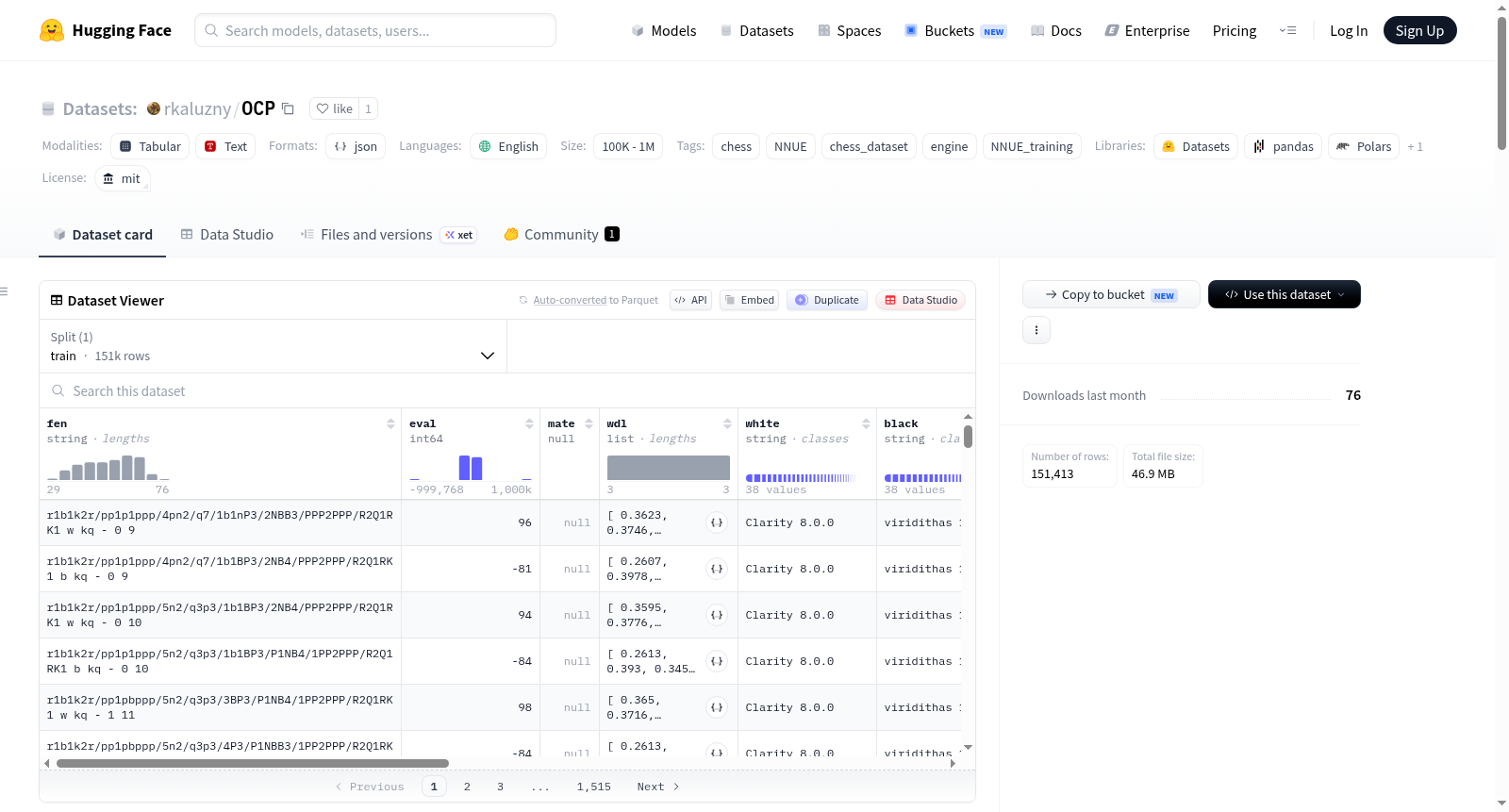
--- license: mit language: - en tags: - chess - NNUE - chess_dataset - engine - NNUE_training size_categories: - 100K<n<1M --- # The Open Chess Plies (OCP) A large-scale open chess dataset designed for machine learning, chess engine research, NNUE experimentation, and evaluation training. OCP combines: - engine self-play with UHO - Chess960 games - elite human openings - curated aggressive and asymmetric opening systems The goal of the project is to create high-density chess training data with broader structural diversity than traditional engine-only datasets. ## Overview Traditional chess datasets often suffer from one or more of the following issues: - excessive repetition of equal positions - overrepresentation of opening theory - limited structural diversity - noisy human annotations - insufficient imbalance coverage OCP attempts to address these limitations through controlled filtering and hybrid data generation pipelines. ## Key Features - Monthly dataset releases - Engine-vs-engine self-play - Chess960 support - Ply-level extraction - Evaluation + WDL labels - Curated opening diversity - Human + engine hybrid sources ## Data Formats Depending on the release, OCP may provide: - JSONL - PGN - FEN | EVAL | WDL - BINPACK-compatible formats Example JSONL Entry ``` { "fen": "r1bqkbnr/pppp1ppp/2n5/4p3/4P3/5N2/PPPP1PPP/RNBQKB1R w KQkq - 2 3", "eval": 92, "wdl": [0.41, 0.53, 0.06], "depth": 14, "ply": 8, "white": "Stockfish", "black": "Lc0", "event": "OCP-V014" } ``` ## Project Philosophy OCP is not intended to function as: - an engine rating list - a benchmark suite - a pure opening book Instead, the project focuses on: - structured training data generation - diverse positional coverage - long-term dataset evolution The project intentionally includes positions with: - initiative - imbalance - tactical pressure - asymmetrical structures - black-side counterplay rather than only near-equal engine positions. ## Chess960 OCP includes Chess960 data in order to reduce overfitting to classical opening theory and increase structural diversity. ## Engine Participation OCP works with a curated ecosystem of open source chess engines. Participation is selective and inclusion is not guaranteed. Requirements generally include: - open source licensing - UCI compatibility - stability during large-scale self-play ## Intended Use Cases - NNUE training - Evaluation research - Chess representation learning - Policy/value experiments - Search/evaluation analysis - Chess AI prototyping - Dataset research ## Limitations OCP is an experimental and evolving dataset project. Potential limitations include: - evaluation noise - opening-source imbalance - duplicated structural motifs - too few positions Users are encouraged to apply additional filtering and validation depending on their use case. # Citation ``` @dataset{ocp_dataset, title={The Open Chess Plies (OCP)}, year={2026}, note={Large-scale open chess dataset for machine learning and chess engine research} } ```
A large-scale open chess dataset designed for machine learning, chess engine research, NNUE experimentation, and evaluation training. OCP combines engine self-play with UHO, Chess960 games, elite human openings, and curated aggressive and asymmetric opening systems. The goal is to create high-density chess training data with broader structural diversity than traditional engine-only datasets, addressing issues like excessive repetition of equal positions, overrepresentation of opening theory, limited structural diversity, noisy human annotations, and insufficient imbalance coverage. It provides formats such as JSONL, PGN, and FEN | EVAL | WDL, with data including positions, evaluations, win-draw-loss probabilities, depth, ply, and focuses on structured training data generation, diverse positional coverage, and long-term evolution, rather than functioning as an engine rating list, benchmark suite, or pure opening book.