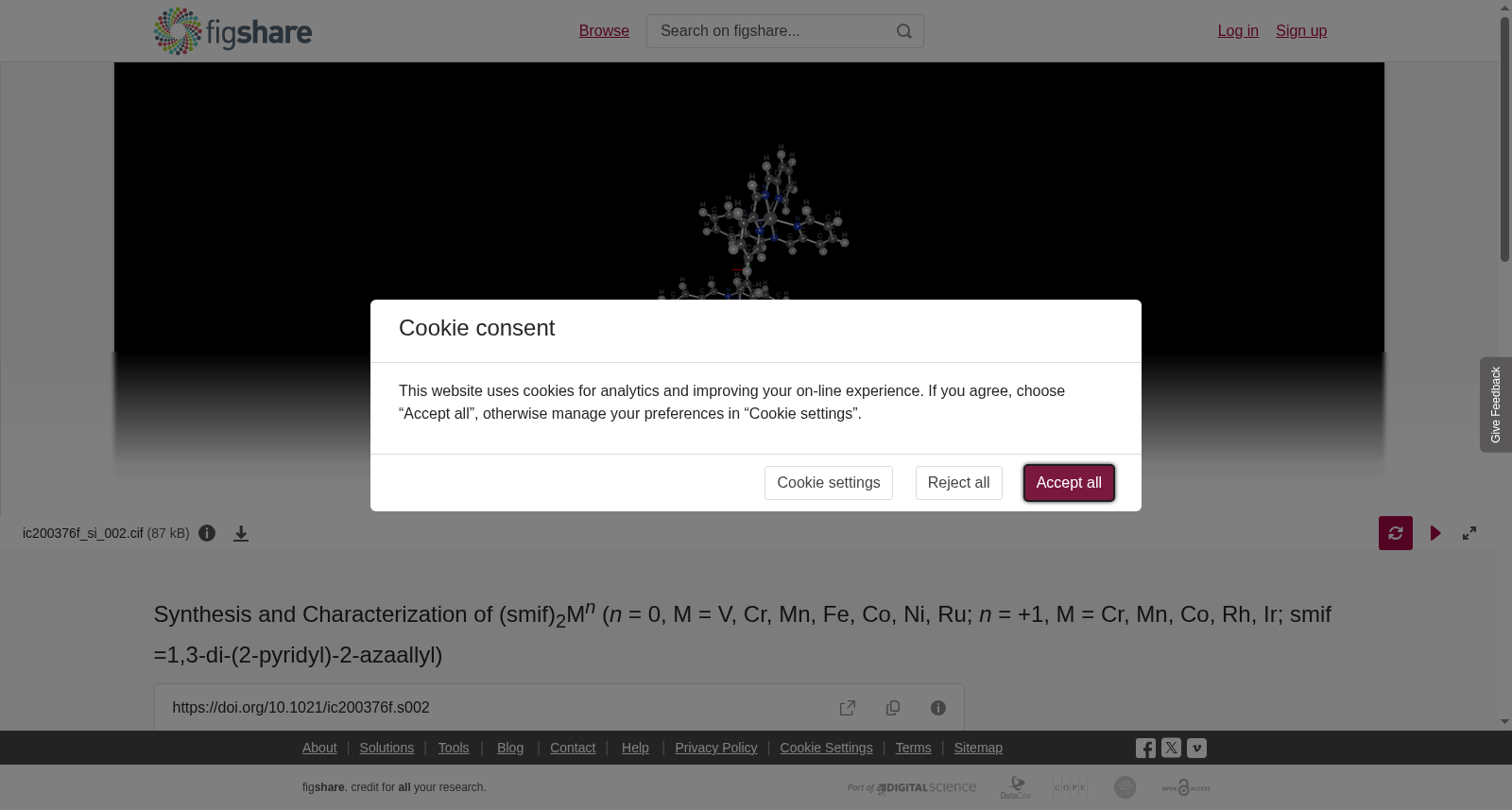
Synthesis and Characterization of (smif)2Mn (n = 0, M = V, Cr, Mn, Fe, Co, Ni, Ru; n = +1, M = Cr, Mn, Co, Rh, Ir; smif =1,3-di-(2-pyridyl)-2-azaallyl)
收藏资源简介:
A series of Werner complexes featuring the tridentate ligand smif, that is, 1,3-di-(2-pyridyl)-2-azaallyl, have been prepared. Syntheses of (smif)2M (1-M; M = Cr, Fe) were accomplished via treatment of M(NSiMe3)2(THF)n (M = Cr, n = 2; Fe, n = 1) with 2 equiv of (smif)H (1,3-di-(2-pyridyl)-2-azapropene); ortho-methylated (oMesmif)2Fe (2-Fe) and (oMe2smif)2Fe (3-Fe) were similarly prepared. Metatheses of MX2 variants with 2 equiv of Li(smif) or Na(smif) generated 1-M (M = Cr, Mn, Fe, Co, Ni, Zn, Ru). Metathesis of VCl3(THF)3 with 2 Li(smif) with a reducing equiv of Na/Hg present afforded 1-V, while 2 Na(smif) and IrCl3(THF)3 in the presence of NaBPh4 gave [(smif)2Ir]BPh4 (1+-Ir). Electrochemical experiments led to the oxidation of 1-M (M = Cr, Mn, Co) by AgOTf to produce [(smif)2M]OTf (1+-M), and treatment of Rh2(O2CCF3)4 with 4 equiv Na(smif) and 2 AgOTf gave 1+-Rh. Characterizations by NMR, EPR, and UV–vis spectroscopies, SQUID magnetometry, X-ray crystallography, and DFT calculations are presented. Intraligand (IL) transitions derived from promotion of electrons from the unique CNCnb (nonbonding) orbitals of the smif backbone to ligand π*-type orbitals are intense (ε ≈ 10 000–60 000 M–1cm–1), dominate the UV–visible spectra, and give crystals a metallic-looking appearance. High energy K-edge spectroscopy was used to show that the smif in 1-Cr is redox noninnocent, and its electron configuration is best described as (smif(−))(smif(2−))Cr(III); an unusual S = 1 EPR spectrum (X-band) was obtained for 1-Cr.
本研究合成了一系列以三齿配体smif(即1,3-二(2-吡啶基)-2-氮杂烯丙基,1,3-di-(2-pyridyl)-2-azaallyl)为配体的维尔纳配合物(Werner complexes)。通过将M(NSiMe3)2(THF)n(M=Cr,n=2;M=Fe,n=1)与2当量的(smif)H(即1,3-二(2-吡啶基)-2-氮杂丙烯)反应,成功合成了(smif)2M(1-M;M=Cr、Fe);类似地还制备了邻位甲基化产物(oMesmif)2Fe(2-Fe)与(oMe2smif)2Fe(3-Fe)。通过MX₂型前驱体与2当量的Li(smif)或Na(smif)发生复分解反应,可得到1-M(M=Cr、Mn、Fe、Co、Ni、Zn、Ru)。以Na/Hg为还原剂,将VCl₃(THF)₃与2当量Li(smif)进行复分解反应,得到1-V;而在四苯硼酸钠(NaBPh4)存在下,2当量Na(smif)与IrCl₃(THF)₃反应可生成[(smif)₂Ir]BPh₄(1+-Ir)。电化学实验中,利用三氟甲磺酸银(AgOTf)对1-M(M=Cr、Mn、Co)进行氧化,得到[(smif)₂M]OTf(1+-M);将Rh₂(CF₃COO)₄与4当量Na(smif)及2当量AgOTf反应,同样得到1+-Rh。本研究通过核磁共振波谱(NMR, Nuclear Magnetic Resonance)、电子顺磁共振波谱(EPR, Electron Paramagnetic Resonance)、紫外-可见(UV–vis)光谱、超导量子干涉仪(SQUID)磁测量、X射线晶体学以及密度泛函理论(DFT, Density Functional Theory)计算对所有产物进行了表征。配体内(IL, intraligand)电荷跃迁源于电子从smif骨架独特的CNC非键(nonbonding)轨道跃迁至配体π*型轨道,该跃迁具有较高摩尔吸光系数(ε≈10 000~60 000 M⁻¹cm⁻¹),主导了体系的紫外-可见光谱,并使晶体呈现金属光泽外观。通过高能K边光谱表征证实,1-Cr中的smif配体为氧化还原活性配体(redox noninnocent ligand),其电子组态最优描述为(smif(−))(smif(2−))Cr(III);1-Cr的X波段电子顺磁共振谱呈现出罕见的S=1信号。