
Aridity and grazing regulate the effects of grassland biodiversity on the synergies/tradeoffs among ecosystem functions in drylands
收藏DataCite Commons2025-06-01 更新2025-05-07 收录
下载链接:
https://figshare.com/articles/dataset/Aridity_and_grazing_regulate_the_effects_of_grassland_biodiversity_on_the_synergies_tradeoffs_among_ecosystem_functions_in_drylands/28877042/2
下载链接
链接失效反馈官方服务:
资源简介:
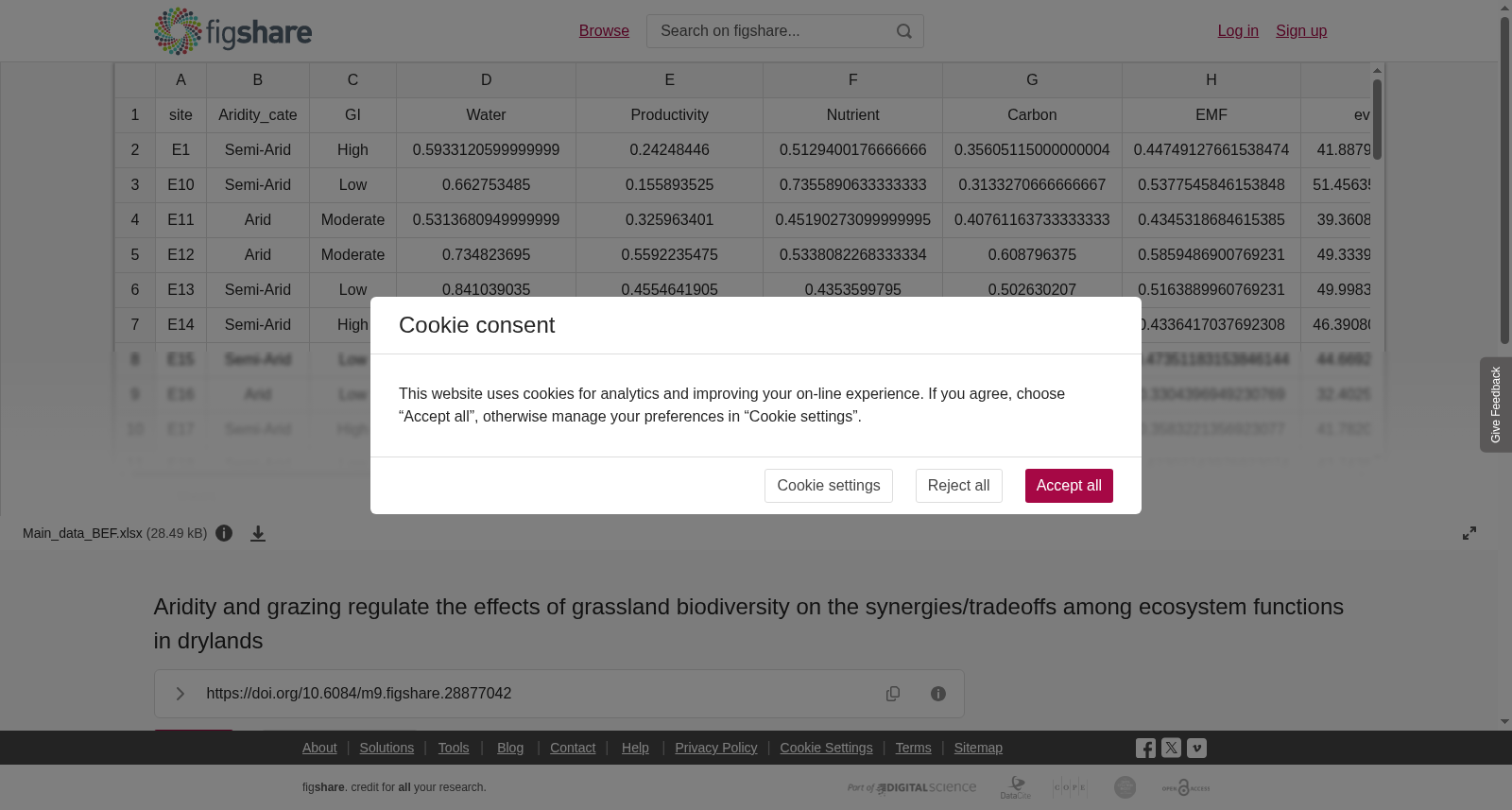
Grassland is the crucial ecosystem that supports biodiversity and multiple ecosystem functions in drylands, with their relationship heavily regulated by both aridity and grazing. However, it is not clear under which aridity conditions and what grazing intensity can maximize the positive effect of biodiversity on enhancing multiple ecosystem functions. Here, we related biodiversity (plant and soil microbial diversity) to ecosystem functions (ecosystem multifunctionality [EMF], individual ecosystem function, and the tradeoffs and synergies among ecosystem functions) across 91 sites along aridity and grazing gradients in natural grasslands in drylands. We showed that the positive correlation between plant diversity and ecosystem functions and their synergies was overall stronger in arid regions than in semi-arid regions. Aridity and grazing interactively affected the biodiversity-ecosystem function (BEF) relationships. In arid regions, ecosystem functions and their synergies were positively correlated with plant diversity under low and moderate grazing intensity, and were negatively related to microbial diversity under high grazing intensity. In arid regions, the tradeoff between productivity and carbon storage was positively related to soil microbial diversity under low and moderate grazing intensity, but showed the opposite change under high grazing intensity. In semi-arid regions, the tradeoff was positively related to soil microbial diversity under high grazing intensity. Moreover, we found that greater aridity and increased grazing intensity directly and indirectly affected the tradeoffs and synergies among ecosystem functions mainly by altering soil properties (e.g., soil clay content and pH) and plant diversity. Together, we reveal that under the predicted intensified aridity scenario, the conservation of plant diversity is pivotal for facilitating the synergistic enhancement of multiple ecosystem functions under less stress conditions, whereas the regulation of soil microbial diversity becomes increasingly critical under more stress conditions in drylands with long grazing history. We emphasize the importance of designing targeted management plans based on aridity levels and grazing intensity to enhance ecosystem functions. It provides a reasonable basis for decision-making on how to optimize the grassland management to coordinate ecosystem functions.
草原是干旱区支撑生物多样性与多重生态系统功能的核心生态系统,其关联受干旱度与放牧活动的双重显著调控。然而,目前尚不清楚在何种干旱度条件与放牧强度下,能够最大化生物多样性对提升多重生态系统功能的积极效应。本研究针对干旱区天然草原中沿干旱度与放牧梯度分布的91个样地,将生物多样性(植物与土壤微生物多样性)与生态系统功能(生态系统多功能性(ecosystem multifunctionality, EMF)、单种生态系统功能,以及生态系统功能间的权衡与协同关系)建立关联分析。研究结果显示,植物多样性与生态系统功能及其协同关系之间的正相关关系,在干旱区整体上要强于半干旱区。干旱度与放牧活动对生物多样性-生态系统功能(biodiversity-ecosystem function, BEF)关系存在交互调控效应。在干旱区,低、中度放牧强度下,生态系统功能及其协同关系与植物多样性呈正相关;而在高强度放牧下,则与微生物多样性呈负相关。在干旱区,生产力与碳储量之间的权衡关系在低、中度放牧强度下与土壤微生物多样性呈正相关,但在高强度放牧下则呈现相反的变化趋势。在半干旱区,高强度放牧下的该权衡关系与土壤微生物多样性呈正相关。此外,本研究发现,更高的干旱度与增强的放牧强度主要通过改变土壤属性(如土壤黏粒含量与pH值)与植物多样性,直接或间接影响生态系统功能间的权衡与协同关系。综合来看,本研究揭示:在预测的干旱加剧情景下,对于放牧历史悠久的干旱区,在胁迫程度较低的条件下,保护植物多样性是推动多重生态系统功能协同提升的关键;而在胁迫程度更高的条件下,调控土壤微生物多样性则变得愈发重要。本研究强调,需基于干旱度等级与放牧强度制定针对性管理方案,以提升生态系统功能。该研究为优化草原管理以协调生态系统功能的决策提供了科学依据。
提供机构:
figshare
创建时间:
2025-05-06
搜集汇总
数据集介绍
以上内容由遇见数据集搜集并总结生成


