
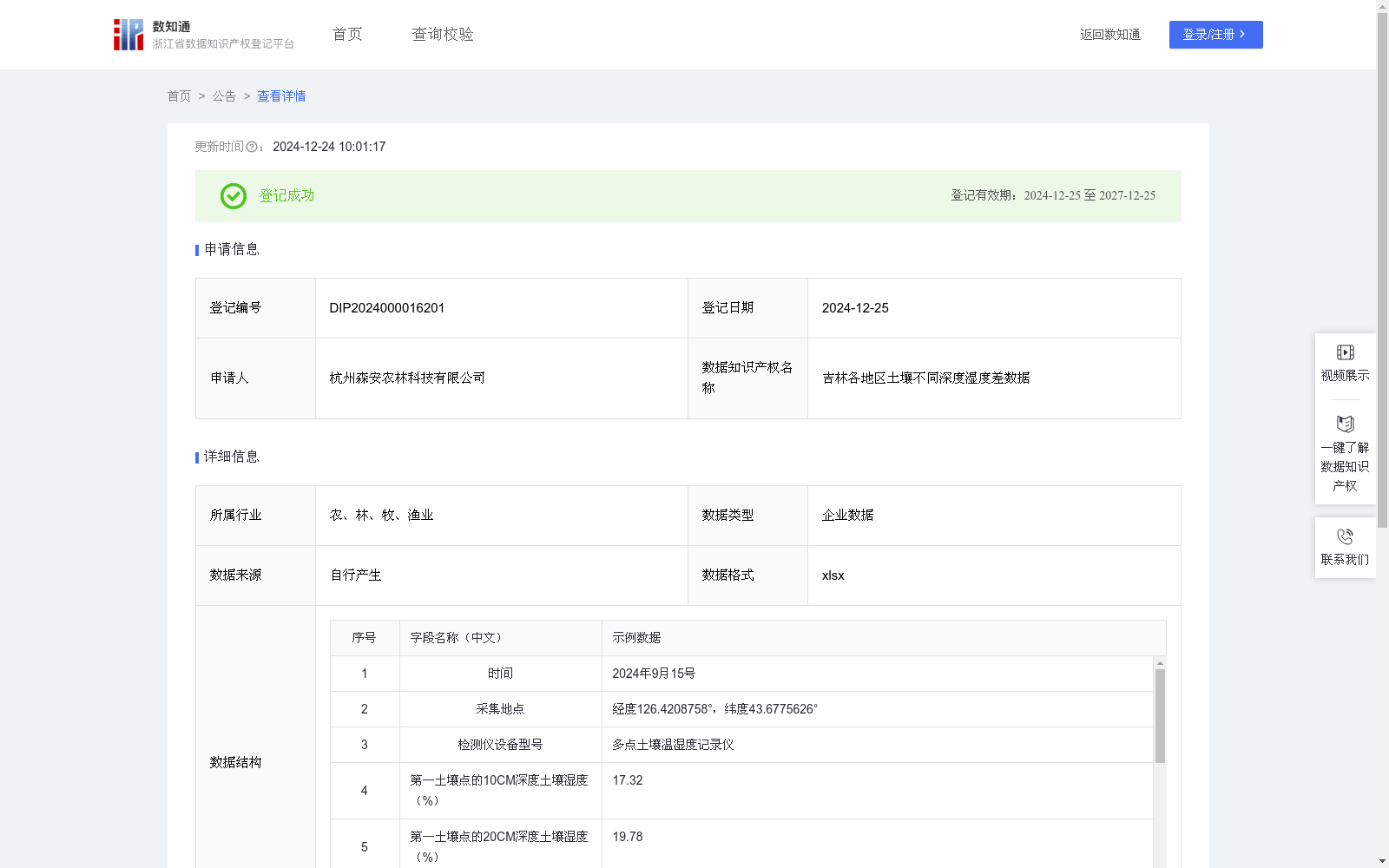
吉林各地区土壤不同深度湿度差数据
收藏浙江省数据知识产权登记平台2024-12-24 更新2024-12-25 收录
下载链接:
https://www.zjip.org.cn/home/announce/trends/107980
下载链接
链接失效反馈官方服务:
资源简介:
研究10CM及20CM深度的土壤湿度差,可以揭示该层土壤湿度的垂直分布规律。这种湿度梯度对于理解土壤热传递过程、土壤水分蒸发、土壤微生物活动等具有重要意义。大多数作物的根系主要分布在土壤表层以下的一定深度范围内,研究该层土壤湿度差有助于了解作物根系活动层的湿度状况。通过调节土壤湿度,可以优化作物生长环境,提高作物产量和品质。另外可结合地理信息系统(GIS)技术,将吉林各地区各地点的土壤地理数据和湿度差信息进行深度整合和分析,绘制位置-湿度差地图,以直观的可视化形式呈现给用户。1数据采集:每天中午12:00对吉林各地区不同的地点,随机在方圆1米直径内选3个土壤点,3个土壤点各采集10CM及20CM深度土壤湿度数据;2数据处理:将数据去噪、优化、补全;3数据加工:通过将20CM深度土壤湿度与10CM深度土壤湿度数据进行相减,得出3个采样点的土壤湿度差,分别为RH1、RH2和RH3,则该地点的土壤湿度差平均值RH4=(RH1+RH2+RH3)/3;3数据应用:根据土壤湿度差平均值RH4有助于了解作物根系活动层的湿度状况。
Studying the soil moisture differences between 10 cm and 20 cm soil depths can reveal the vertical distribution pattern of soil moisture in this depth interval. Such moisture gradients are of great significance for understanding soil heat transfer processes, soil water evaporation, soil microbial activities, and other related ecological and agricultural processes. The root systems of most crops are mainly distributed within a certain depth range below the soil surface; thus, investigating the soil moisture difference in this interval helps to understand the moisture status of the crop root activity zone. Adjusting soil moisture can optimize the crop growth environment and enhance crop yield and quality. In addition, by combining with Geographic Information System (GIS) technology, we can conduct in-depth integration and analysis of soil geographic data and soil moisture difference information of various locations across Jilin Province, and generate a location-soil moisture difference map to present the results to users in an intuitive visual format.
1. Data Collection: At 12:00 noon every day, at different locations across Jilin Province, three soil sampling points are randomly selected within a 1-meter diameter circle. Soil moisture data at depths of 10 cm and 20 cm are collected from each of the three sampling points.
2. Data Preprocessing: The collected data will be denoised, optimized, and gap-filled.
3. Data Processing: Subtract the soil moisture data at 10 cm depth from that at 20 cm depth to obtain the soil moisture differences of the three sampling points, denoted as RH1, RH2 and RH3 respectively. The average soil moisture difference of the location is then calculated as RH4 = (RH1 + RH2 + RH3)/3.
3. Data Application: The average soil moisture difference RH4 is helpful for understanding the moisture status of the crop root activity zone.
提供机构:
杭州森安农林科技有限公司
创建时间:
2024-11-20
搜集汇总
数据集介绍
特点
该数据集包含吉林各地区不同地点10CM和20CM深度的土壤湿度数据,通过计算湿度差来研究土壤湿度的垂直分布规律,适用于农业优化和GIS技术应用。数据规模为7700条,每日更新,由企业自行产生并以xlsx格式存储。
以上内容由遇见数据集搜集并总结生成



