
<b>Social conditions alter the growth, metabolic rate, behavioral traits, and food-shelter preferences in the qingbo </b><b><i>Spinibarbus sinensis</i></b>
收藏DataCite Commons2025-06-01 更新2024-11-06 收录
下载链接:
https://figshare.com/articles/dataset/_b_Social_conditions_alter_the_growth_metabolic_rate_behavioral_traits_and_food-shelter_preferences_in_the_qingbo_b_b_i_Spinibarbus_sinensis_i_b_/27078718/1
下载链接
链接失效反馈官方服务:
资源简介:
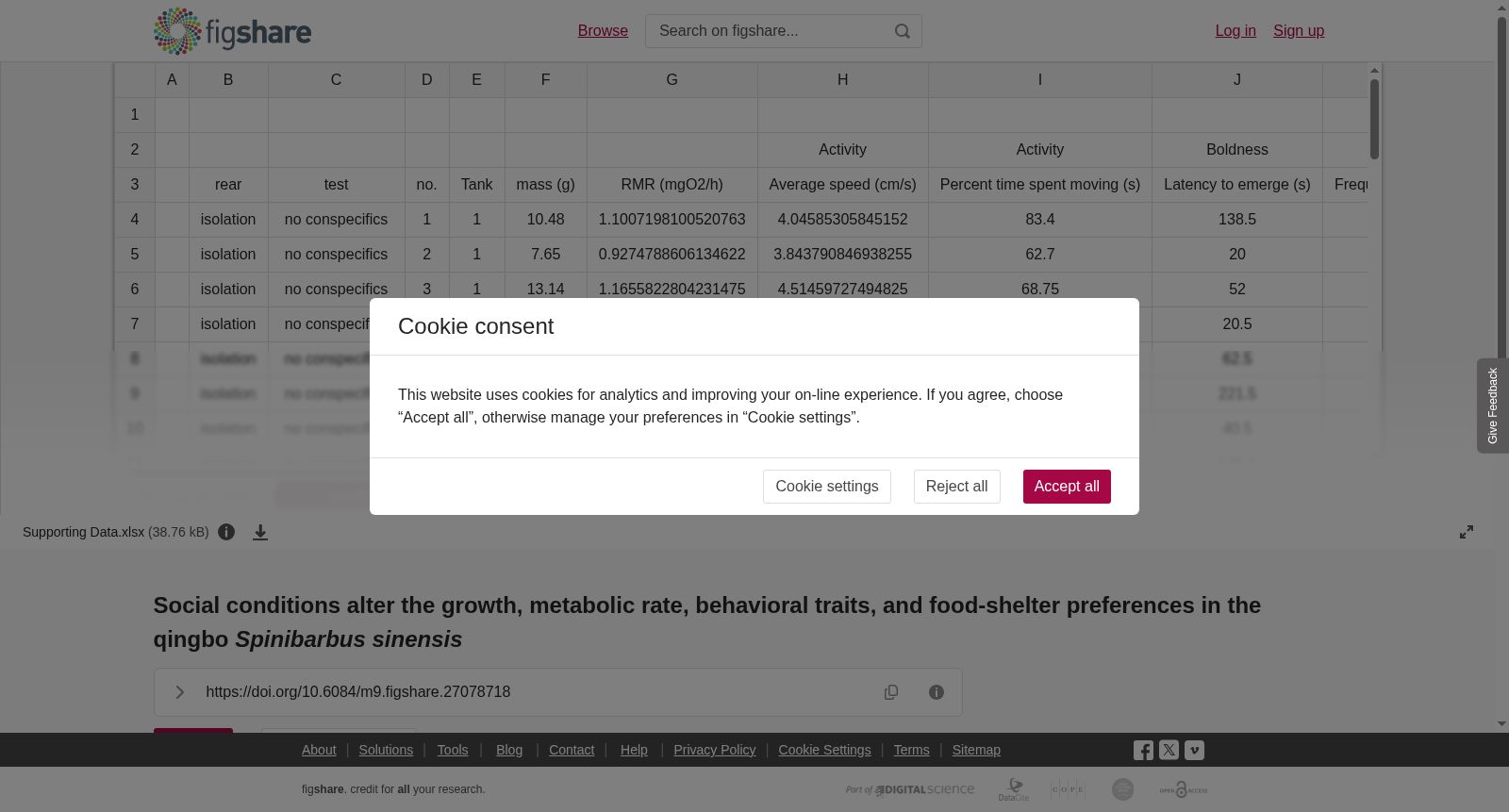
<b>Abstract</b>For social animals, conspecifics within a group can influence an individual’s physiology and behavior, but whether these group effects alter the trade-offs between foraging and defense remains unclear. In this study, we investigated the social fish species, the qingbo (<i>Spinibarbus sinensis</i>), to examine how group effects during both past social experiences (rearing conditions) and current social conditions (test environments) influence routine metabolic rate (RMR), behavioral traits (activity, boldness, and sociability), and preferences for food versus shelter, and how rearing conditions (isolation or group rearing) specifically affect growth. Our results revealed that the qingbo reared in social isolation exhibited both higher growth and RMR than did the individuals reared in groups, potentially through compensatory feeding. Group effects from conspecifics during rearing and testing led to increased activity and decreased sociability in qingbo, whereas the presence of conspecifics during testing increased boldness. Isolation-reared qingbo showed a preference for shelter over both an open field and food in the absence of conspecifics, whereas group-reared qingbo preferred food over shelter when conspecifics were present. These findings suggest that visual social isolation may not be a significant stressor for qingbo, as the isolation-reared qingbo exhibited improved growth. This could be because the presence of conspecific olfactory cues in the rearing environment mitigated the stress associated with visual isolation. Interactions with conspecifics and the associated reduction in predation risk with group effects may enhance activity and boldness. Additionally, the qingbo’s food and shelter preferences can dynamically adjust in response to group effects, reflecting high behavioral plasticity that allows social fishes to optimize foraging efficiency in risky situations.
**摘要**
对于社会性动物而言,种群内的同种个体可对个体的生理状态与行为模式产生影响,但这类群体效应是否会改变觅食与防御间的权衡关系,目前仍不明确。本研究以社会性鱼类——清波鱼(*Spinibarbus sinensis*)为研究对象,旨在探究过往社会经历(饲养环境)与当前社会环境(试验环境)中的群体效应,如何影响其静止代谢率(RMR)、行为性状(活动量、胆量与社交性)以及食物与遮蔽物的偏好,同时明确饲养条件(单独饲养或群养)对其生长的特异性影响。
研究结果显示,单独饲养的清波鱼,其生长速率与静止代谢率均显著高于群养个体,这一现象可能通过补偿性摄食实现。饲养与试验阶段中同种个体带来的群体效应,会提升清波鱼的活动量并降低其社交性;而试验阶段存在同种个体时,清波鱼的胆量则会升高。在无同种个体的环境中,单独饲养的清波鱼更偏好遮蔽物而非开阔区域与食物;而当存在同种个体时,群养的清波鱼则更倾向于选择食物而非遮蔽物。
上述结果表明,视觉层面的社会隔离可能并不会对清波鱼构成显著应激源,因为单独饲养的清波鱼展现出了更优的生长表现。这可能是由于饲养环境中存在同种个体的嗅觉信号,缓解了视觉隔离所带来的应激反应。与同种个体的社交互动,以及群体效应所带来的捕食风险降低,可能会提升清波鱼的活动量与胆量。此外,清波鱼对食物与遮蔽物的偏好可随群体效应发生动态调整,这反映出其较高的行为可塑性,使得社会性鱼类能够在风险情境下优化觅食效率。
提供机构:
figshare创建时间:
2024-09-21
搜集汇总
数据集介绍
背景与挑战
背景概述
该数据集研究了社交条件(包括隔离饲养和群体饲养)对青鱼(Spinibarbus sinensis)生长、代谢率、行为特征和食物-庇护所偏好的影响。研究发现隔离饲养的青鱼生长和代谢率更高,而群体效应增强了活动性和胆量但降低了社交性,同时食物-庇护所偏好会根据社交环境动态调整,体现了较高的行为可塑性。
以上内容由遇见数据集搜集并总结生成

暂无相关数据集


