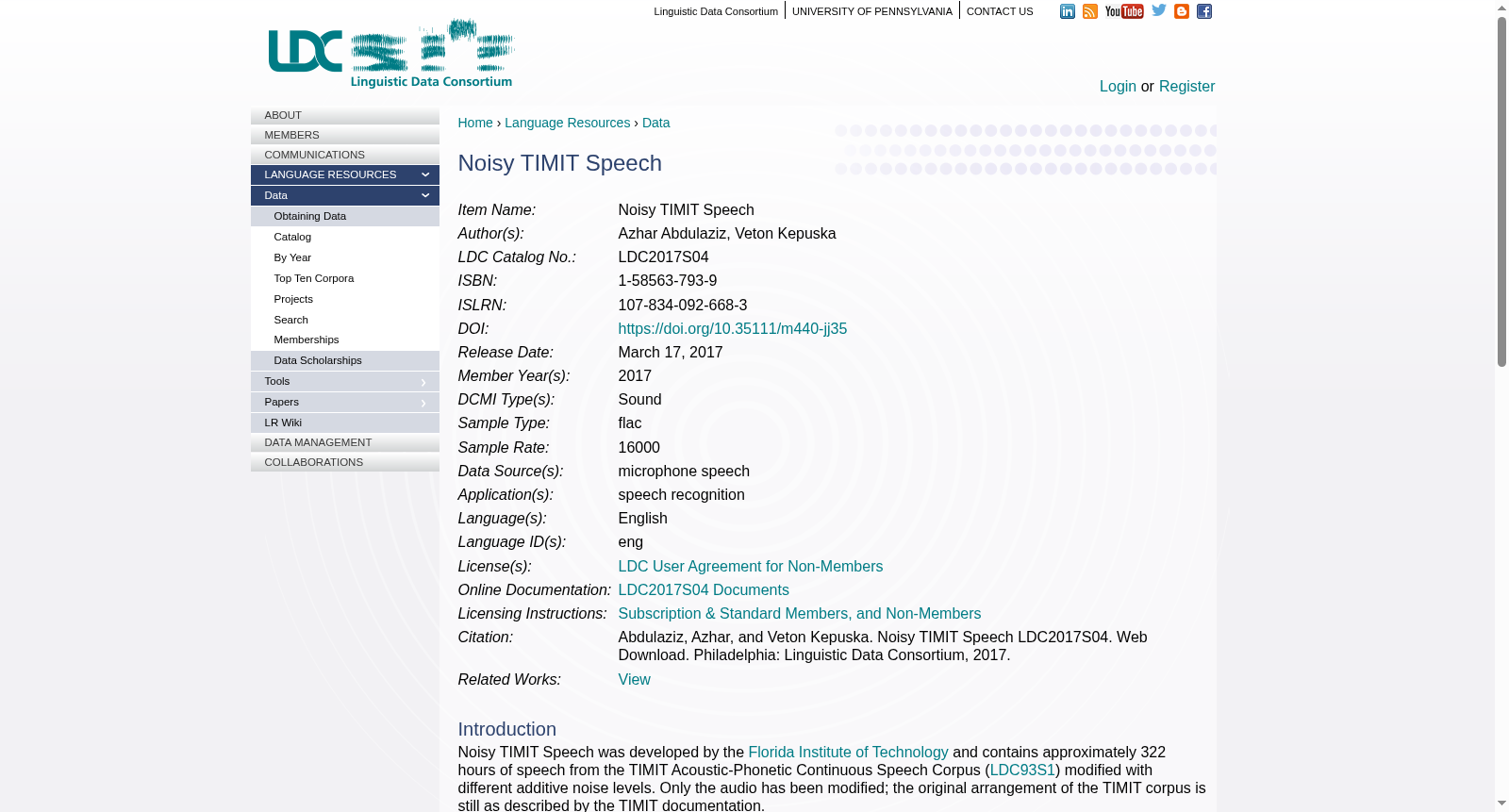
Noisy TIMIT Speech
收藏资源简介:
Introduction Noisy TIMIT Speech was developed by the Florida Institute of Technology and contains approximately 322 hours of speech from the TIMIT Acoustic-Phonetic Continuous Speech Corpus (LDC93S1) modified with different additive noise levels. Only the audio has been modified; the original arrangement of the TIMIT corpus is still as described by the TIMIT documentation. Data The additive noise are white, pink, blue, red, violet and babble noise with noise levels varying in 5 dB (decibel) steps and ranges from 5 to 50 dB. The color of noise refers to the power spectrum of a noise signal. Sound waves have two characteristics: frequency, which describes how fast the waveform vibrates per second; and amplitude, the size of the waveform. Colored noises are named in an analogy to the colors of light. For instance, white noise contains all audible frequencies just as white light contains all frequencies in the visible range. Non-white colored noises have more energy concentrated at the high or low end of the sound spectrum. White, pink and blue noise are officially defined in the federal telecommunications standard. The white, pink, blue, red and violet noise types added to the TIMIT data in this release were generated artificially using MATLAB. For the babble noise, a random segment of recorded babble speech was selected and scaled relative to the power of the original TIMIT audio signal. All audio files are presented as single channel 16kHz 16-flac. Samples Please listen to the following samples: 5db Babble 15db Blue 25db Pink 35db Red 45db Violet 50db White Updates None at this time. Related Works incorporating TIMIT TIMIT was designed to provide speech data for acoustic-phonetic studies and for the development and evaluation of automatic speech recognition systems. Since its release in 1993, several corpora have been developed using the TIMIT database: NTIMIT (LDC93S2): transmitting TIMIT recordings through a telephone handset and over various channels in the NYNEX telephone network CTIMIT (LDC96S30): passing TIMIT files through cellular telephone circuits FFMTIMIT (LDC96S32): re-recording TIMIT files with a free-field microphone HTIMIT (LDC98S67): re-recording a subset of TIMIT files throgh different telephone handsets STC-TIMIT (LDC2008S03): passing TIMIT files through an actual telephone channel in a single call WTIMIT 1.0 (LDC2010S02): wideband mobile telephony TIMIT version Portions © 2017 Florida Institute of Technology, © 1993, 2017 Trustees of the University of Pennsylvania
## 带噪TIMIT语音(Noisy TIMIT Speech)数据集简介 本数据集由佛罗里达理工学院开发,包含约322小时的语音数据,源自TIMIT声学-语音连续语音语料库(TIMIT Acoustic-Phonetic Continuous Speech Corpus,LDC93S1),并通过添加不同等级的加性噪声进行处理。仅对音频文件进行修改,TIMIT语料库的原始结构仍遵循TIMIT官方文档的描述。 ## 数据详情 本次使用的加性噪声包括白噪声(white noise)、粉噪声(pink noise)、蓝噪声(blue noise)、红噪声(red noise)、紫噪声(violet noise)以及喋声噪声(babble noise),噪声等级以5分贝(dB)为步长,覆盖5至50分贝的区间。噪声的色彩指代噪声信号的功率谱特性。声波具备两项核心特征:频率(描述波形每秒振动的速率)与振幅(描述波形的幅度大小)。有色噪声的命名类比于可见光的色彩分类,例如白噪声包含所有可听频段的频率,正如白光包含可见光全频段的光谱。非白的有色噪声的能量更多集中在声频谱的高频或低频端。白噪声、粉噪声与蓝噪声的定义已纳入美国联邦电信标准。本数据集所添加的白噪声、粉噪声、蓝噪声、红噪声及紫噪声均通过MATLAB人工生成。对于喋声噪声,则选取一段录制的多人交谈语音片段,并根据原始TIMIT音频信号的功率进行幅度缩放。所有音频文件均采用单声道、16kHz采样率、16位FLAC格式存储。 ## 示例音频 请试听以下示例音频:5分贝喋声噪声、15分贝蓝噪声、25分贝粉噪声、35分贝红噪声、45分贝紫噪声、50分贝白噪声。 ## 更新说明 暂无更新。 ## 相关衍生语料库 TIMIT语料库最初旨在为声学-语音研究以及自动语音识别系统的开发与评估提供语音数据。自1993年发布以来,基于TIMIT数据库衍生出了多款语料库: 1. NTIMIT(LDC93S2):通过电话听筒及NYNEX电话网络的多类信道传输TIMIT录音 2. CTIMIT(LDC96S30):将TIMIT文件通过蜂窝电话电路传输 3. FFMTIMIT(LDC96S32):使用自由场麦克风重新录制TIMIT文件 4. HTIMIT(LDC98S67):使用不同型号的电话听筒对部分TIMIT文件进行重新录制 5. STC-TIMIT(LDC2008S03):在单次通话中通过实际电话信道传输TIMIT文件 6. WTIMIT 1.0(LDC2010S02):宽带移动电话版TIMIT语料库 ## 版权声明 部分内容 © 2017 佛罗里达理工学院,© 1993、2017 宾夕法尼亚大学董事会