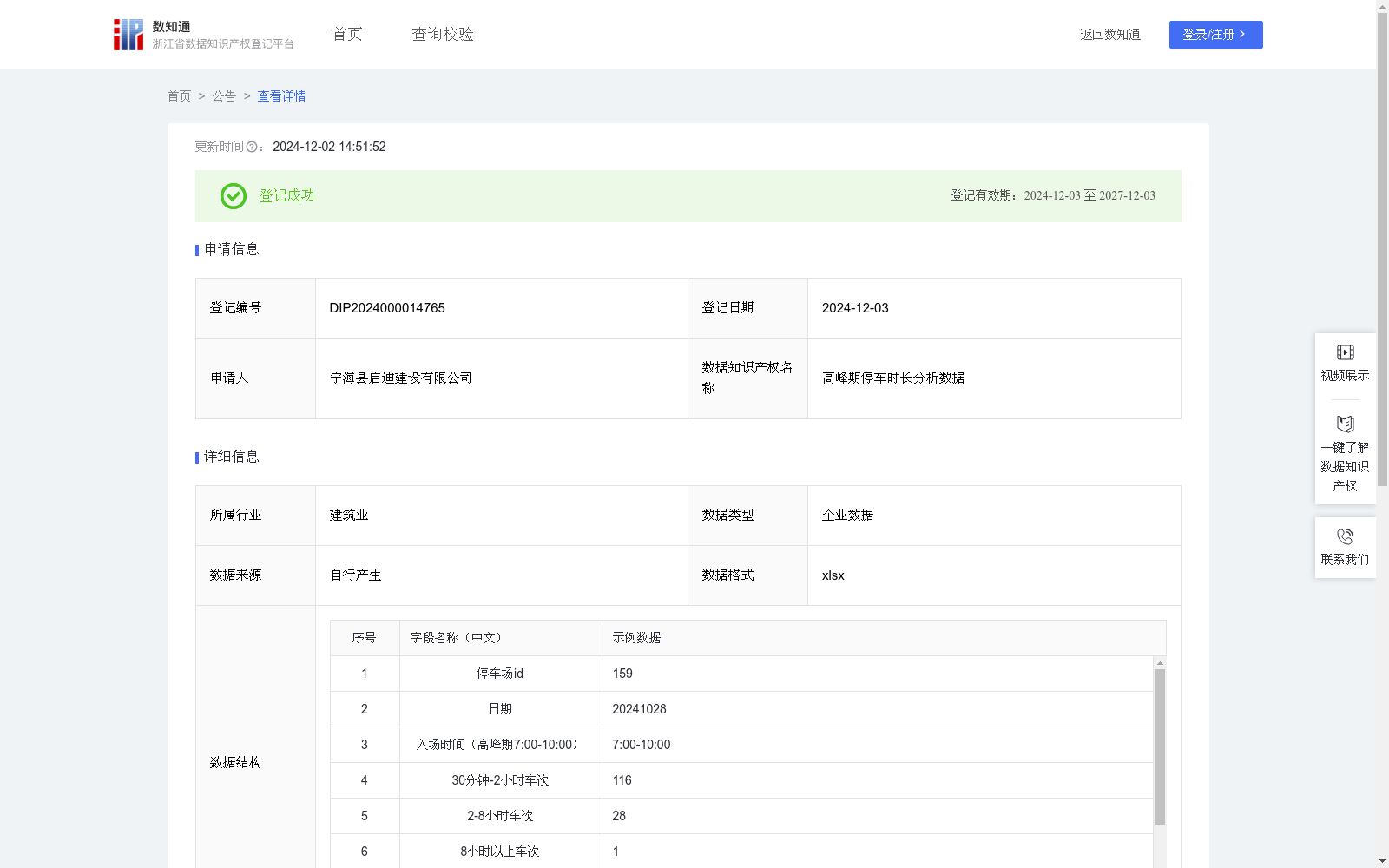
高峰期停车时长分析数据
收藏资源简介:
随着城市化进程的加速和汽车保有量的增加,城市停车问题日益严重,尤其在高峰时段,停车场的管理和车位分配成为城市管理中的一个难题。通过分析高峰期停车时长,分析高峰期和低峰期时段的订单时长分布,找到短订单、中订单、长订单所占的比例,可以优化停车资源配置,减少因寻找停车位而产生的额外车流,从而缓解城市交通拥堵。了解不同时间段的停车需求和车位使用情况,有助于停车场管理者合理分配车位资源,提高停车场的运营效率。 政府和相关部门可以依据停车时长分析数据,制定或调整停车政策,如停车费用、停车时间限制等,以实现交通流量的合理调控。 停车场管理者通过对停车时长的分析,可以发现停车资源的利用效率,增加经济效益,例如如果在高峰期短时订单占比较高,可以考虑通过提高短时停车费来控制车位占用率,鼓励用户选择其他出行方式或短时停车。如果长期订单占比高,可以考虑通过提前预约或预留车位的方式优化车位使用率,同时为长期停放的车辆提供更有吸引力的套餐。1、数据采集:通过智能停车的道闸系统采集车辆进出停车场的数据,包括停车场id,车辆id,日期,入场时间(高峰期),30分钟-2小时车次,2-8小时车次,8小时以上车次,总订单数等;2、数据处理:对停车场进行编码,用id码指向唯一停车场,对数据进行清洗、去噪、补全;3、数据加工:停车场id指向告警的具体停车场,日期代表数据记录的时间,入场时间(高峰期)代表车辆当天在高峰期进入该停车场的时间,30分钟-2小时车次代表高峰期入场车辆中停车时间在30分钟到2小时以内的车次,2-8小时车次代表高峰期入场车辆中停车时间在2-8小时的车次,8小时以上车次代表高峰期入场车辆中停车时间在8小时以上的车次,总订单数代表该停车场当天高峰期入场车次合计,短订单比例代表停车30分钟以上-2小时以内车次占总订单的比例,算法为短订单比例=30分钟-2小时车次/总订单数,中订单比例=2-8小时车次/总订单数,长订单比例=8小时以上车次/总订单数。
With the acceleration of urbanization and the growth of vehicle ownership, urban parking issues have grown increasingly severe. Particularly during peak hours, parking lot management and space allocation have emerged as key challenges in urban governance. By analyzing parking duration during peak periods, the distribution of order durations across peak and off-peak hours, and quantifying the proportions of short-, medium-, and long-duration parking orders, parking resource allocation can be optimized, reducing excess traffic flow generated by drivers searching for available parking spaces and thereby alleviating urban traffic congestion. Understanding parking demand and space utilization patterns across different time periods enables parking lot managers to rationally allocate parking resources and enhance operational efficiency. Governments and relevant departments can formulate or adjust parking policies, such as parking fees and time limits, based on parking duration analysis data to achieve reasonable regulation of traffic flow. Parking lot managers can also evaluate the utilization efficiency of parking resources and boost economic benefits through parking duration analysis: for instance, if short-duration orders account for a high share during peak hours, managers may consider raising short-term parking fees to control space occupancy, encouraging users to select alternative travel modes or opt for shorter parking stays. If long-duration orders dominate, managers can optimize space utilization via advance reservations or reserved parking spaces, while offering more attractive packages for long-term parking vehicles. 1. Data Collection: Collect vehicle entry and exit data from parking lots via intelligent parking barrier systems, including parking lot ID, vehicle ID, date, entry time (during peak hours), number of trips with parking duration of 30 minutes to 2 hours, number of trips with parking duration of 2 to 8 hours, number of trips with parking duration over 8 hours, total number of orders, and other related metrics. 2. Data Processing: Encode parking lots, use unique ID codes to uniquely identify each parking lot, and conduct data cleaning, denoising and imputation. 3. Data Refinement: Map parking lot IDs to specific alarmed parking lots. Date represents the time when the data record was created. Entry time (during peak hours) refers to the time when a vehicle entered the target parking lot during peak hours on the same day. Number of trips with parking duration of 30 minutes to 2 hours refers to the count of peak-hour entry vehicles with parking duration ranging from 30 minutes to 2 hours. Number of trips with parking duration of 2 to 8 hours refers to the count of peak-hour entry vehicles with parking duration ranging from 2 to 8 hours. Number of trips with parking duration over 8 hours refers to the count of peak-hour entry vehicles with parking duration exceeding 8 hours. Total number of orders refers to the total count of peak-hour entry vehicles in the target parking lot on that day. Short-order ratio refers to the proportion of trips with parking duration of 30 minutes to 2 hours in the total orders, calculated as: Short-order ratio = (number of trips with 30 mins-2 hrs duration) / total number of orders; Medium-order ratio = (number of trips with 2-8 hrs duration) / total number of orders; Long-order ratio = (number of trips with over 8 hrs duration) / total number of orders.