
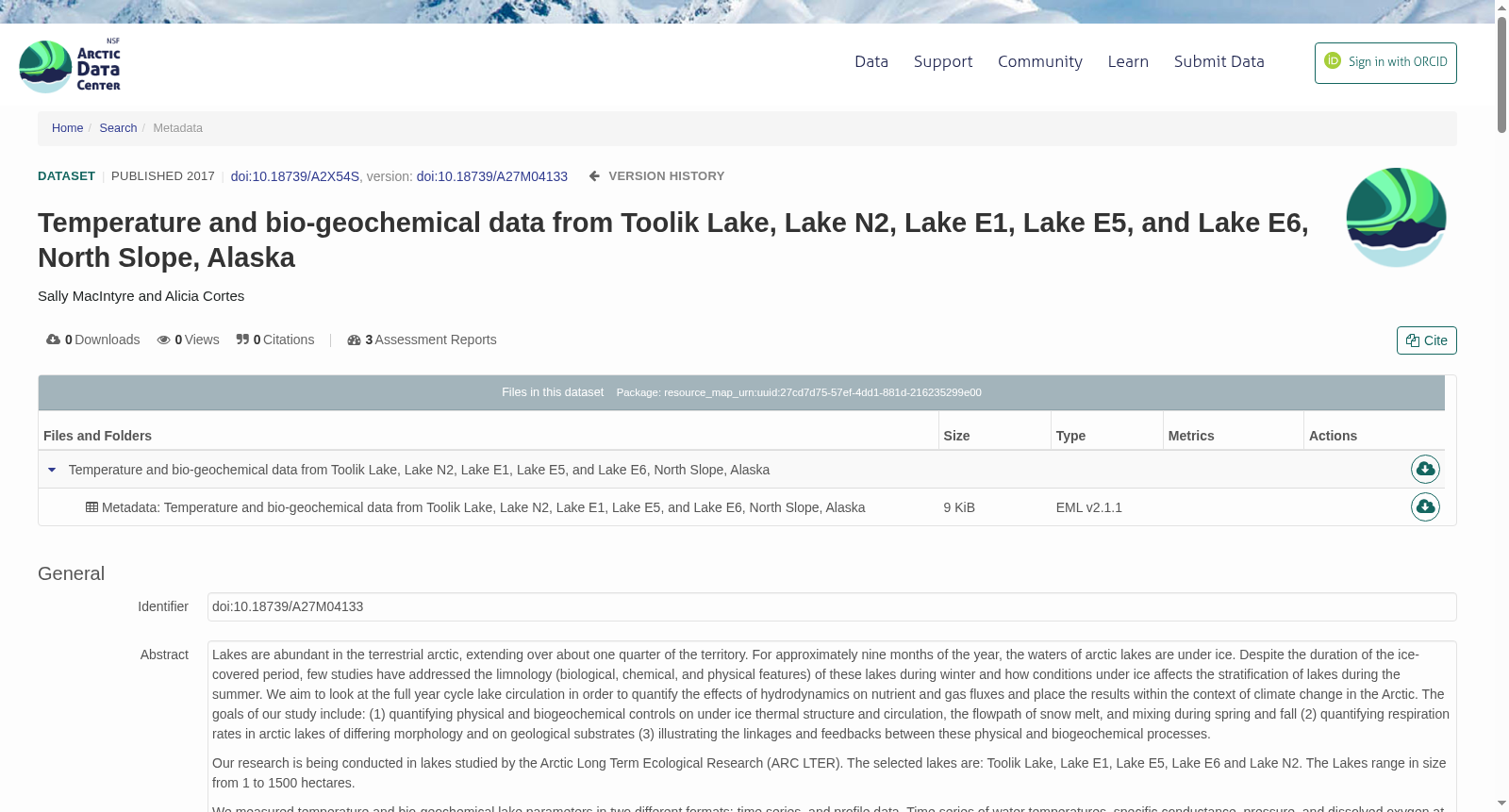
Temperature and bio-geochemical data from Toolik Lake, Lake N2, Lake E1, Lake E5, and Lake E6, North Slope, Alaska
收藏DataCite Commons2025-02-06 更新2025-04-16 收录
下载链接:
https://arcticdata.io/catalog/view/doi:10.18739/A2X54S
下载链接
链接失效反馈官方服务:
资源简介:
Lakes are abundant in the terrestrial arctic, extending over about one quarter of the territory. For approximately nine months of the year, the waters of arctic lakes are under ice. Despite the duration of the ice-covered period, few studies have addressed the limnology (biological, chemical, and physical features) of these lakes during winter and how conditions under ice affects the stratification of lakes during the summer. We aim to look at the full year cycle lake circulation in order to quantify the effects of hydrodynamics on nutrient and gas fluxes and place the results within the context of climate change in the Arctic. The goals of our study include: (1) quantifying physical and biogeochemical controls on under ice thermal structure and circulation, the flowpath of snow melt, and mixing during spring and fall (2) quantifying respiration rates in arctic lakes of differing morphology and on geological substrates (3) illustrating the linkages and feedbacks between these physical and biogeochemical processes.
Our research is being conducted in lakes studied by the Arctic Long Term Ecological Research (ARC LTER). The selected lakes are: Toolik Lake, Lake E1, Lake E5, Lake E6 and Lake N2. The Lakes range in size from 1 to 1500 hectares.
We measured temperature and bio-geochemical lake parameters in two different formats: time series, and profile data. Time series of water temperatures, specific conductance, pressure, and dissolved oxygen at several depths were obtained from a taut-line mooring in different seasons (summer and winter) across multiple years (between fall 2012 and fall 2016). We measured profiles of temperature and bio-geochemical lake parameters at the deepest site (and occasionally other sites) in all lakes during the same time coverage as the time series.
陆地北极地区湖泊广布,总面积约占该区域的四分之一。北极湖泊的水体每年约有九个月处于冰封状态。尽管冰封期漫长,但针对冬季北极湖泊的湖沼学(limnology,涵盖生物学、化学与物理特征研究)以及冰封期水下环境如何影响夏季湖水分层的研究仍较为匮乏。
本研究旨在探究湖泊全年环流周期,以量化水动力学(hydrodynamics)过程对营养盐与气体通量的影响,并将研究结果置于北极气候变化的背景下进行分析。本研究的目标包括:
(1) 量化冰封期热结构与环流、融雪径流路径以及春秋季混合过程的物理与生物地球化学调控机制;
(2) 量化不同形态学特征且赋存于不同地质基底的北极湖泊的呼吸速率;
(3) 阐明上述物理与生物地球化学过程之间的关联与反馈机制。
本研究依托北极长期生态研究(Arctic Long Term Ecological Research, ARC LTER)计划的观测湖泊开展,选定的研究湖泊包括图利克湖(Toolik Lake)、E1湖、E5湖、E6湖与N2湖,湖泊面积介于1至1500公顷之间。
本研究通过两种方式采集湖泊温度与生物地球化学参数:时序数据(time series)与剖面数据(profile data)。研究团队于2012年秋季至2016年秋季的多个年份,在夏季与冬季等不同季节,通过张紧式锚系设备(taut-line mooring)获取了多深度点位的水温、比电导率(specific conductance)、压强与溶解氧(dissolved oxygen)时序数据。在与时序数据一致的时间覆盖范围内,团队在所有湖泊的最深测点(偶尔也会在其他测点)采集了温度与生物地球化学参数的剖面数据。
提供机构:
NSF Arctic Data Center
创建时间:
2017-10-25
搜集汇总
数据集介绍
背景与挑战
背景概述
该数据集记录了阿拉斯加北坡五个湖泊(Toolik湖、N2湖、E1湖、E5湖和E6湖)的温度和生物地球化学数据,由研究人员Sally MacIntyre和Alicia Cortes于2017年发布,可通过DOI访问。
以上内容由遇见数据集搜集并总结生成


