
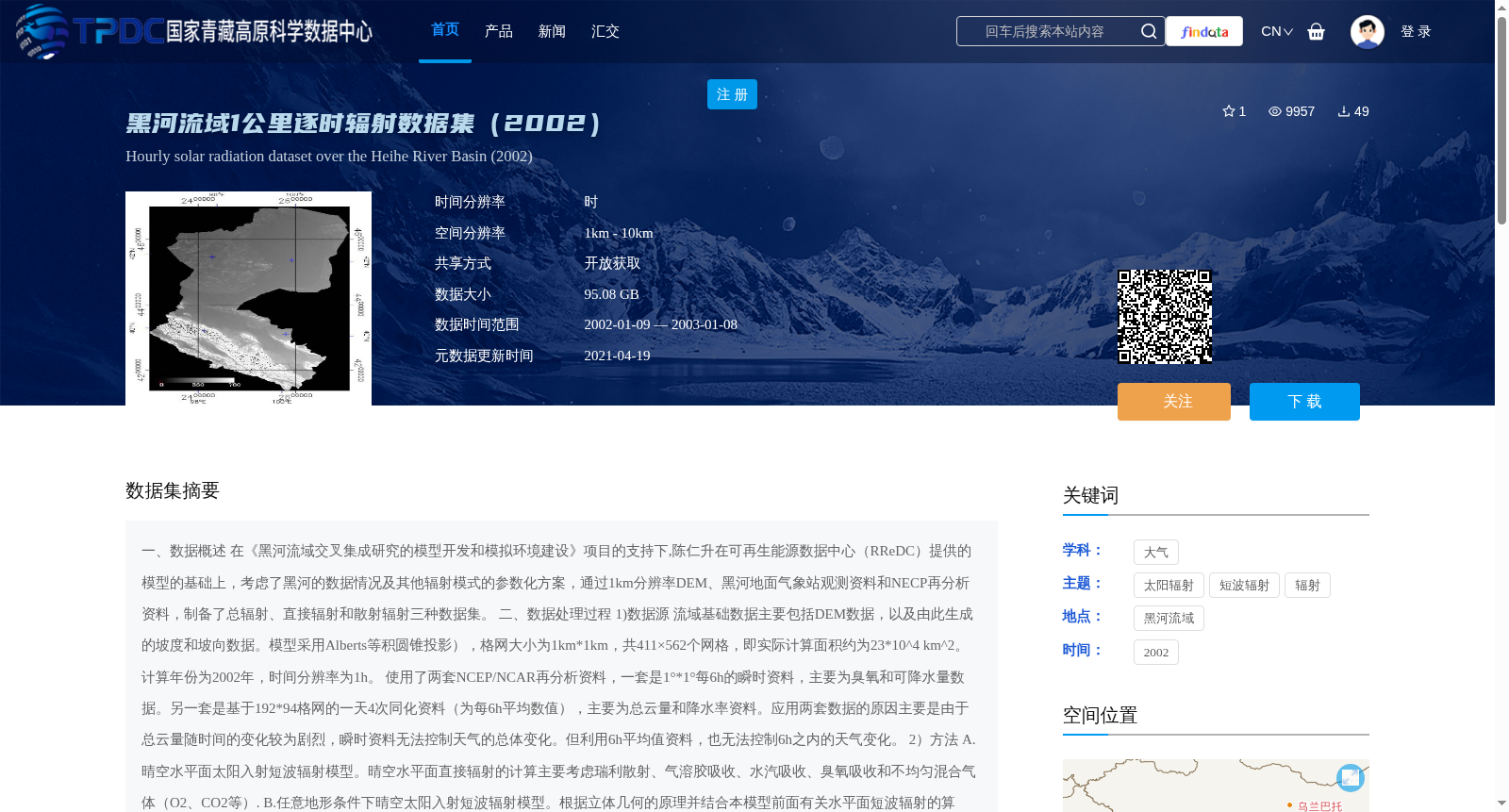
黑河流域1公里逐时辐射数据集(2002)
收藏国家青藏高原科学数据中心2021-04-19 更新2024-03-01 收录
下载链接:
https://data.tpdc.ac.cn/zh-hans/data/211c6b99-1570-41f4-b7c1-b00322d3680a
下载链接
链接失效反馈官方服务:
资源简介:
一、数据概述
在《黑河流域交叉集成研究的模型开发和模拟环境建设》项目的支持下,陈仁升在可再生能源数据中心(RReDC)提供的模型的基础上,考虑了黑河的数据情况及其他辐射模式的参数化方案,通过1km分辨率DEM、黑河地面气象站观测资料和NECP再分析资料,制备了总辐射、直接辐射和散射辐射三种数据集。
二、数据处理过程
1)数据源
流域基础数据主要包括DEM数据,以及由此生成的坡度和坡向数据。模型采用Alberts等积圆锥投影),格网大小为1km*1km,共411×562个网格,即实际计算面积约为23*10^4 km^2。计算年份为2002年,时间分辨率为1h。
使用了两套NCEP/NCAR再分析资料,一套是1°*1°每6h的瞬时资料,主要为臭氧和可降水量数据。另一套是基于192*94格网的一天4次同化资料(为每6h平均数值),主要为总云量和降水率资料。应用两套数据的原因主要是由于总云量随时间的变化较为剧烈,瞬时资料无法控制天气的总体变化。但利用6h平均值资料,也无法控制6h之内的天气变化。
2)方法
A.晴空水平面太阳入射短波辐射模型。晴空水平面直接辐射的计算主要考虑瑞利散射、气溶胶吸收、水汽吸收、臭氧吸收和不均匀混合气体(O2、CO2等).
B.任意地形条件下晴空太阳入射短波辐射模型。根据立体几何的原理并结合本模型前面有关水平面短波辐射的算法,设计了一个考虑山坡自身遮蔽效应的短波辐射的简单算法。
C.实际天气任意地形条件下太阳入射短波辐射计算。利用希腊气象与大气物理研究所的Harry D K博士提供的Ver4Fortran源代码的基础上计算获得。
D.空间插值采用基于三角网格的立体插值法,第一套资料的时间插值采用线性插值,对第二套资料随时间变化的处理,统一概化为6h以内数值一致。
具体算法描述请参阅:陈仁升, 康尔泗, et al. (2006). "任意地形实际天气条件下小时入射短波辐射模型――以黑河流域为例." 中国沙漠(05).
3)数据验证
采用位于山区的西水、中游临泽和下游额济纳旗3个自动气象站的总辐射观测资料对模拟结果进行了验证,西水总辐射计算结果相对较差,实测值与计算值的R2=0.71,在实测总辐射较小的情况下,计算值多数偏大。临泽和额济纳旗总辐射实测与计算对比结果较好,R2分别为0.90和0.91。
4)结论
采用辐射传输参数化方案和遥感信息相结合的方法,计算任意地形实际天气条件下,大范围、长时间、高时空分辨率的太阳入射短波辐射,是一种较为可行的方法,尤其是在西北干旱区。所建立的模型仅仅利用流域的DEM数据,以及由此生成的坡度和坡向数据,其他资料均为再分析资料,因而极易推广应用。高山区天气随时变化,模型在高山区计算效果不好的主要原因仍然是总云量资料时空分辨率较低的缘故,同时计算值与实测值的时空尺度不一致也部分导致对比结果较差。
1. Data Overview
Supported by the project *Model Development and Simulation Environment Construction for Cross-Integrated Research in the Heihe River Basin*, Chen Rensheng, based on the model provided by the Renewable Energy Data Center (RReDC), considered the local data conditions of the Heihe River Basin and parameterization schemes of other radiation models, and generated three radiation datasets: total solar radiation, direct solar radiation, and diffuse solar radiation using 1km-resolution DEM, ground meteorological station observation data from the Heihe River Basin, and NECP reanalysis data.
2. Data Processing Procedures
1) Data Sources
The basic watershed data mainly include DEM data, as well as slope and aspect data derived from DEM. The model adopts the Albers Equal-Area Conic Projection, with a grid size of 1km×1km, totaling 411×562 grids, with an actual calculated area of approximately 23×10^4 km². The calculation year is 2002, and the temporal resolution is 1 hour.
Two sets of NCEP/NCAR reanalysis data were used: one set is 1°×1° 6-hourly instantaneous data, mainly including ozone and precipitable water data; the other set is 4-times-daily assimilated data (6-hourly average values) based on a 192×94 grid, mainly including total cloud cover and precipitation rate data. The reason for using two sets of data is that total cloud cover changes drastically over time: instantaneous data cannot capture the overall weather changes, while 6-hourly average data cannot control weather changes within 6 hours.
2) Methods
A. Clear-sky Incident Shortwave Radiation Model for Horizontal Surfaces
The calculation of clear-sky direct horizontal solar radiation mainly considers Rayleigh scattering, aerosol absorption, water vapor absorption, ozone absorption, and well-mixed gases (O₂, CO₂, etc.).
B. Clear-sky Incident Shortwave Radiation Model for Complex Terrain
Based on solid geometry principles and the aforementioned horizontal surface shortwave radiation algorithm, a simple shortwave radiation algorithm considering the self-shielding effect of hillslopes was developed.
C. Calculation of Incident Shortwave Solar Radiation Under Actual Weather Conditions for Complex Terrain
The calculation was performed based on the Ver4 Fortran source code provided by Dr. Harry D. K from the Hellenic Institute of Meteorology and Climatology.
D. Spatiotemporal Interpolation
Spatial interpolation adopted a triangular grid-based stereoscopic interpolation method. Temporal interpolation for the first set of data used linear interpolation. For the temporal variation of the second set of data, it was uniformly generalized to keep the value consistent within 6 hours.
For a detailed description of the algorithm, please refer to: Chen Rensheng, Kang Ersi, et al. (2006). *Hourly Incident Shortwave Radiation Model under Actual Weather Conditions for Complex Terrain: A Case Study of the Heihe River Basin*. *Journal of Desert Research*(05).
3) Data Validation
The simulation results were validated using total solar radiation observation data from three automatic meteorological stations: Xishui located in the mountainous area, Linze in the middle reaches, and Ejina Banner in the lower reaches of the Heihe River Basin. The calculation results for Xishui showed relatively poor performance: the coefficient of determination (R²) between measured and calculated values was 0.71, and calculated values were mostly overestimated when the measured total solar radiation was low. The comparison results for Linze and Ejina Banner were good, with R² values of 0.90 and 0.91, respectively.
4) Conclusions
Combining radiative transfer parameterization schemes with remote sensing information, calculating large-scale, long-term, high spatiotemporal resolution incident shortwave solar radiation under actual weather conditions for complex terrain is a feasible approach, especially in arid regions of northwest China. The established model only requires DEM data of the watershed and the derived slope and aspect data, with all other data sourced from reanalysis data, making it highly easy to promote and apply. The main reason for the poor performance of the model in high mountain areas is the low spatiotemporal resolution of total cloud cover data, while the inconsistency in spatiotemporal scales between calculated and measured values also partially contributes to the poor comparison results.
提供机构:
陈仁升
创建时间:
2013-07-22
搜集汇总
数据集介绍
背景与挑战
背景概述
该数据集是2002年黑河流域的1公里逐时太阳辐射数据,包含总辐射、直接辐射和散射辐射三种类型,时间分辨率为1小时,空间分辨率为1-10公里,数据量达95.08 GB。数据集基于DEM、地面观测和再分析资料,采用辐射传输模型制备,适用于西北干旱区的大范围、高时空分辨率太阳辐射研究,并通过了地面站验证(R2最高达0.91)。
以上内容由遇见数据集搜集并总结生成


