
实验室衍生的表面反照率数据库
收藏资源简介:
该数据集由康奈尔大学等机构联合创建,是一个基于实验室测量的表面反照率数据库,旨在促进地质学与系外行星科学的交叉研究。数据集包含按地质分类组织的方向-半球反射率数据,并附有补充表格以支持未来合作。通过JWST等观测设备的红外光谱数据,该数据集可用于分析岩石行星的表面地质组成,例如区分花岗岩与玄武岩表面,为研究太阳系外类地行星的地质演化提供新途径。
This dataset was jointly created by Cornell University and other institutions. It is a laboratory-measured surface albedo database aimed at promoting interdisciplinary research between geology and exoplanet science. The dataset contains directional-hemispherical reflectance data organized by geological classifications, with supplementary tables provided to support future collaborative work. Leveraging infrared spectral data from observation facilities such as the James Webb Space Telescope (JWST), this dataset can be used to analyze the surface geological compositions of rocky planets—for example, distinguishing between granite and basalt surfaces—providing new pathways for studying the geological evolution of extrasolar terrestrial planets.
根据您提供的README文件内容,以下是该数据集的详情总结:
数据集概述
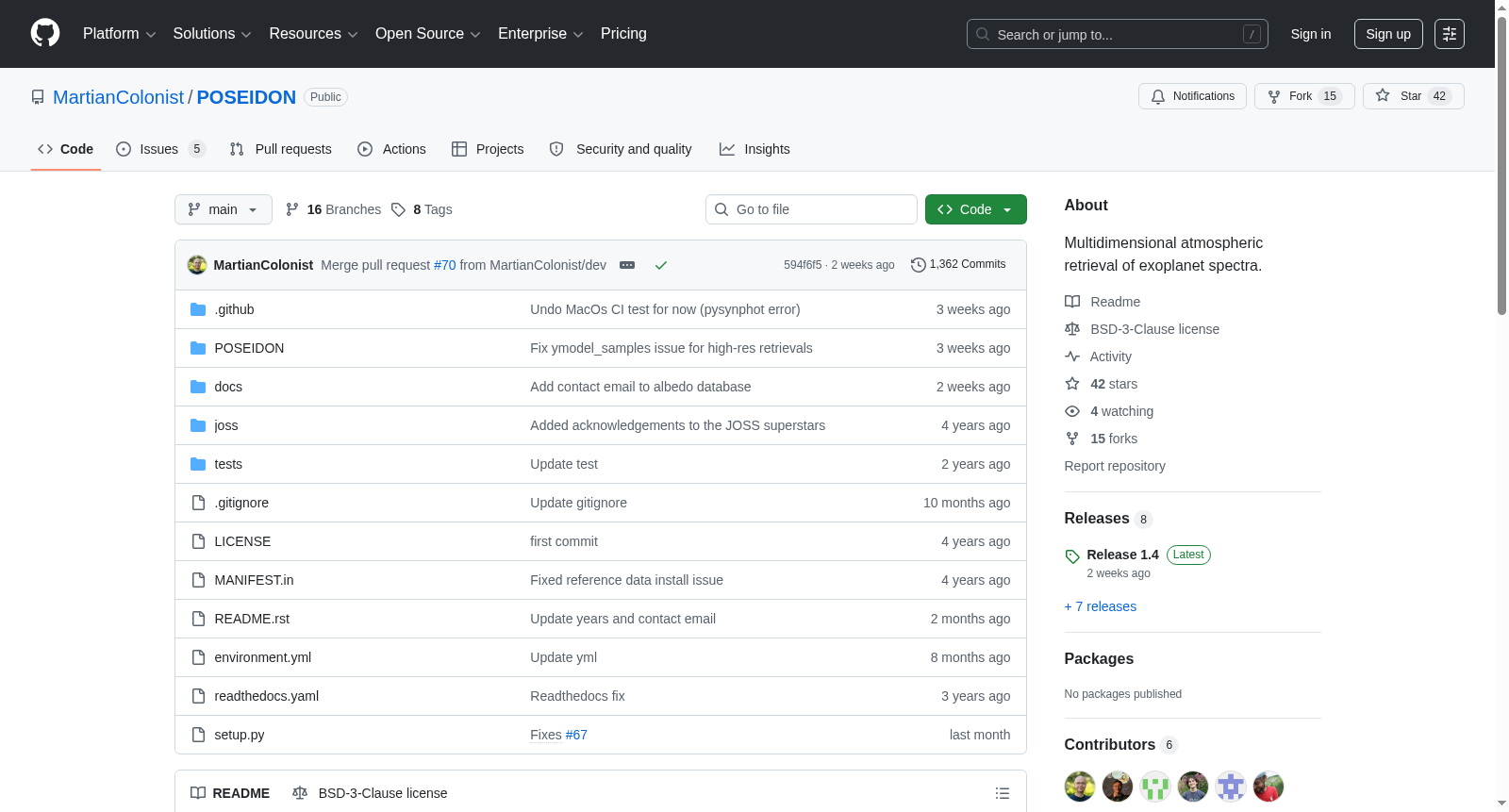
项目名称:POSEIDON
仓库地址:https://github.com/MartianColonist/POSEIDON
核心功能
POSEIDON 是一个用于系外行星光谱多维大气反演的 Python 软件包。其核心功能包括:
- 光谱建模与反演:基于空间或地面望远镜观测到的系外行星光谱数据,利用贝叶斯技术推断行星的大气属性。
- 支持的光谱类型:可建模和反演系外行星的透射光谱、发射光谱、反射光谱,以及褐矮星的发射光谱。
- 新增功能:支持针对地面高色散仪器的高分辨率交叉相关反演。
文档与教程
详细的安装指南及适用于不同应用场景的教程,可在 POSEIDON 文档中获取:https://poseidon-retrievals.readthedocs.io/en/latest/
引用信息
若在研究中使用了 POSEIDON,请引用以下文献:
- MacDonald & Madhusudhan (2017),链接:https://ui.adsabs.harvard.edu/abs/2017MNRAS.469.1979M/abstract
- MacDonald (2023),链接:https://joss.theoj.org/papers/69710c0498d02fd1c6a0cfa4b01af7c5
许可协议
POSEIDON 采用 BSD 3-Clause License 开源许可,详情见 LICENSE 文件。
贡献与支持
- 问题报告与功能请求:请在 GitHub 仓库中提交 Issue。
- 贡献指南:详见贡献指南:https://poseidon-retrievals.readthedocs.io/en/latest/content/contributing.html
- 联系与支持:可联系 Ryan MacDonald(Ryan.MacDonald@st-andrews.ac.uk)或 Elijah Mullens(eem85@cornell.edu)。
- 1The Rocky Planet Picture Show: Implementation of Surface Reflection and Emission in $\texttt{POSEIDON}$ with Application to and Interpretation of JWST Data康奈尔大学·卡尔萨根研究所; 圣安德鲁斯大学物理与天文学院; 密歇根大学天文系; 美国自然历史博物馆·天体物理系; 美国自然历史博物馆·地球与行星科学系; 加州理工学院/IPAC; 康奈尔大学·地球与大气科学系 · 2026年


