
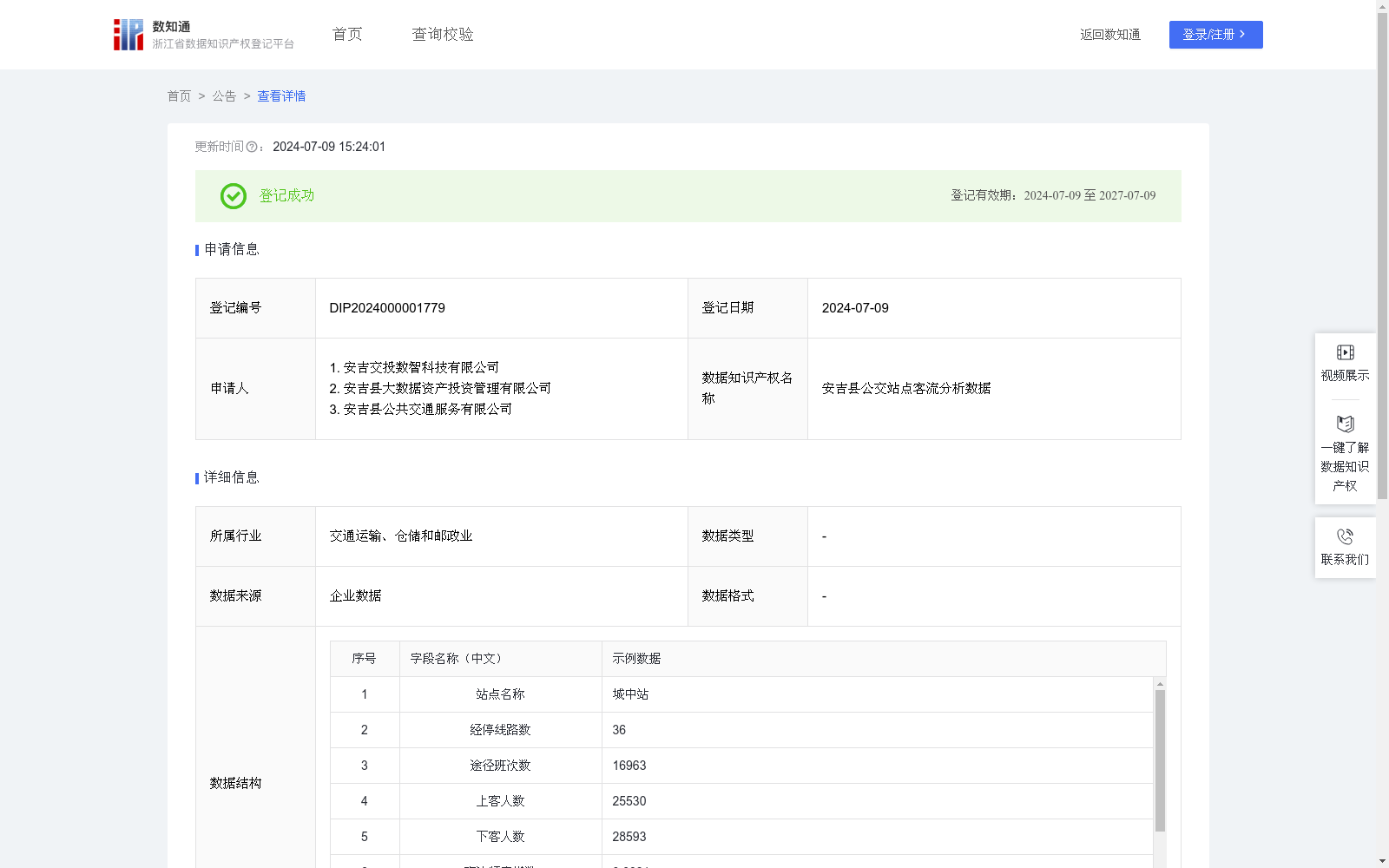
安吉县公交站点客流分析数据
收藏浙江省数据知识产权登记平台2024-07-09 更新2024-07-10 收录
下载链接:
https://www.zjip.org.cn/home/announce/trends/37132
下载链接
链接失效反馈官方服务:
资源简介:
记录了站点运营的关键信息,如公交站点,站点途径线路数,途径班次数,及统计站点上下客人数,计算班次频率指数、客流强度指数,线路覆盖指数。通过算法推导出站点热门指数。数据分析不仅为公交企业提供了优化运营策略的依据,帮助提升服务质量和运营效率。同时,客流数据也为安全管理提供了重要参考。站点数据不仅限于当前运营优化,还具有深入挖掘的潜力。政府部门可据此评估公交政策效果,商业机构可挖掘市场潜力,研究机构可进行城市交通研究。此外,这些数据也是智慧城市建设的重要支撑。公交站点数据的可用范围广泛,适用于公交企业、政府部门、研究机构、商业机构和公众。这些数据不仅有助于提升城市交通服务水平,还能为各类决策提供科学依据,推动城市交通的智能化发展。1.通过每日公交车运行的流水趟次,需要收集每个站点的相关数据:站点名称、经停线路数量、途经班次数量、上客人数、下客人数等。再通过聚合相加将数据汇总成月度数据。2.计算上下客总人数=上客人数+下客人数;每个站点的班次频率指数=本站点途径班次数据/所有途径班次求和;客流强度指数=本站点上下客总人数/所有站点上下客总人数求和;线路覆盖指数=本站点经停线路数/所有经停线路数求和;3.站点热门指数=(0.3*班次频率指数+0.5*客流强度指数+0.2*线路覆盖指数)*10000;4.通过站点热门指数的数值,给站点进行标签分配:大于30的为高热门度站点,15-30的中高热门度站点,8.07-15为中低热门度站点、小于8.07的为低热门度站点等。
This dataset records key operational information of bus stops, including the stop name, the number of routes serving the stop, the number of trips passing through the stop, as well as the passenger boarding and alighting counts at the stop. It also calculates three indices: trip frequency index, passenger flow intensity index and route coverage index, and derives the stop popularity index via algorithms.
The data analysis not only provides a basis for bus enterprises to optimize their operation strategies, helping improve service quality and operational efficiency, but also offers important references for safety management. Moreover, the passenger flow data has in-depth mining potential beyond current operational optimization. Government departments can use the data to evaluate the effectiveness of public transit policies; commercial institutions can explore market potential; and research institutions can conduct urban traffic studies. Additionally, such data serves as an important support for smart city construction. The bus stop data has a wide range of application scenarios, covering bus enterprises, government departments, research institutions, commercial institutions and the general public. These data not only help enhance urban traffic service levels, but also provide scientific basis for various decision-making, promoting the intelligent development of urban transportation.
1. Data collection and monthly aggregation: Collect relevant data for each stop based on daily bus trip records, including stop name, number of routes stopping at the stop, number of trips passing through the stop, number of boarding passengers, number of alighting passengers, etc. Then aggregate the daily data into monthly totals.
2. Index calculation:
- Total passenger volume = number of boarding passengers + number of alighting passengers
- Trip frequency index of a single stop = (number of trips passing through the stop) / (sum of trips of all stops in the dataset)
- Passenger flow intensity index of a single stop = (total passenger volume of the stop) / (sum of total passenger volumes of all stops in the dataset)
- Route coverage index of a single stop = (number of routes serving the stop) / (sum of routes of all stops in the dataset)
3. Stop popularity index calculation: Stop popularity index = (0.3 * trip frequency index + 0.5 * passenger flow intensity index + 0.2 * route coverage index) * 10000
4. Stop popularity labeling: Assign popularity labels to stops based on their calculated popularity index: stops with index > 30 are classified as high-popularity stops, stops with index between 15 and 30 as medium-high popularity stops, stops with index between 8.07 and 15 as medium-low popularity stops, and stops with index < 8.07 as low-popularity stops.
提供机构:
安吉交投数智科技有限公司,安吉县大数据资产投资管理有限公司,安吉县公共交通服务有限公司
创建时间:
2024-06-17
搜集汇总
数据集介绍
特点
该数据集包含安吉县公交站点的客流分析数据,涵盖1208条记录,每季度更新,提供站点运营关键信息和多个计算指数,适用于公交运营优化、政策评估和商业分析等多种场景。
以上内容由遇见数据集搜集并总结生成



