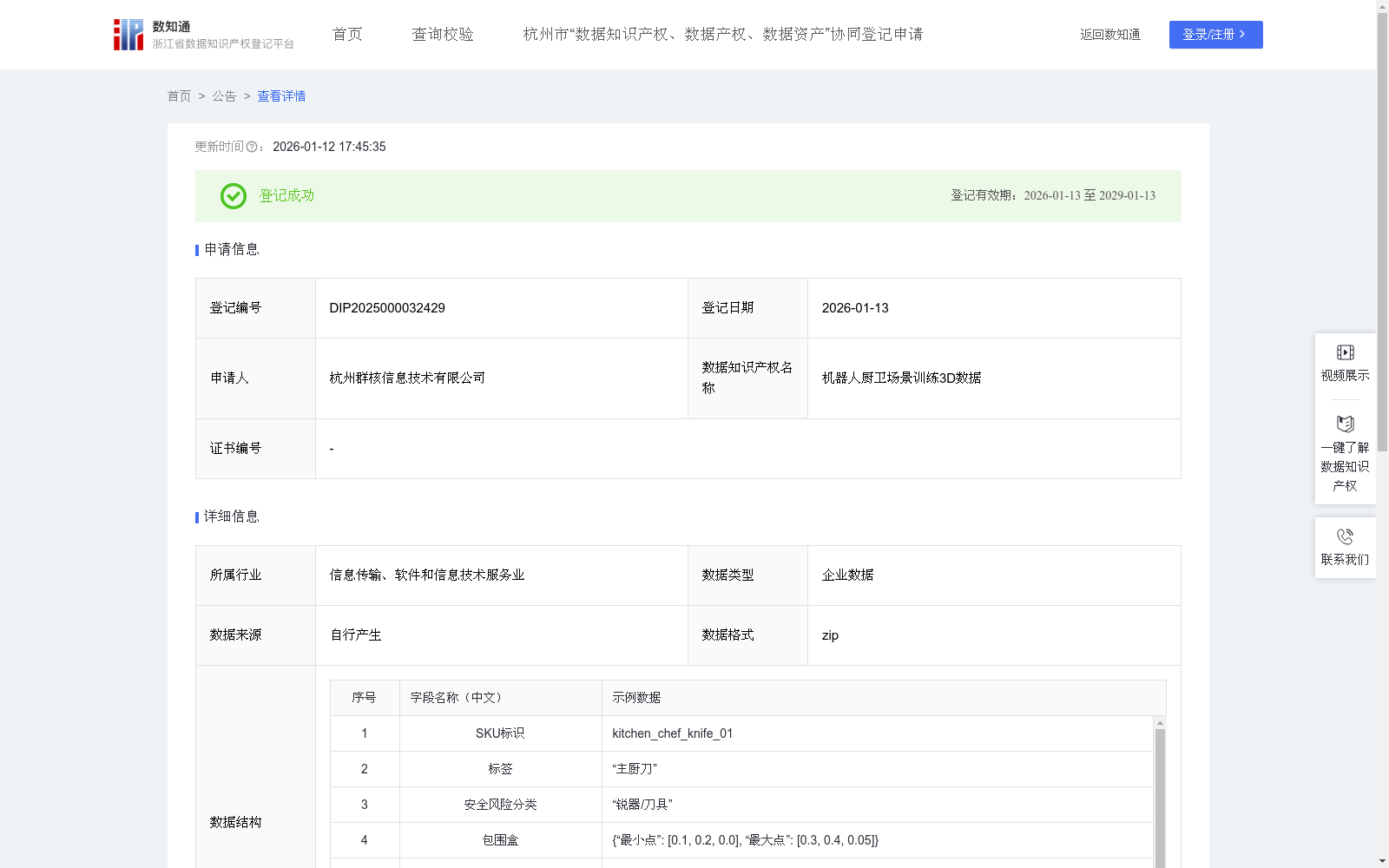
机器人厨卫场景训练3D数据
收藏资源简介:
本数据集专注于提升服务机器人在厨房和卫生间这两个高复杂度、高任务密度区域的精细化操作与安全导航能力。数据集覆盖厨房与卫生间两大典型功能区域。厨房场景包含橱柜、灶台、水槽、冰箱、烤箱等固定设施,以及锅碗瓢盆、刀叉、瓶装调料等大量小型、可移动物体,布局涵盖L型、U型等。卫生间场景包含马桶、洗手台、淋浴间/浴缸、镜柜等,并特别模拟了潮湿环境、镜面反光、地面水渍等挑战性视觉特征。所有场景均设计了不同的物体摆放状态(如橱柜开闭、水龙头开关),以高度还原真实家居环境中厨卫空间的复杂性与动态性。本算法旨在处理三维模型,通过一系列步骤实现模型的分割、实例重组及格式转换,以生成新的实例模型,用于场景渲染和机器人训练等应用。 1.模型分割:本步骤接收任意初始三维模型作为输入,三维模型包括位置、尺寸、材质、顶点信息、法相信息、面片信息字段,运用拓扑连通性聚类算法将该组合模型拆分为多个面片组(face group),获取模型类型字段。此步骤有效提取模型的结构特征,有助于后续的实例重组。 2.模型实例重组:在此步骤中,对三维模型的位置、尺寸、材质、顶点信息、法相信息、面片信息字段进行分割,再利用Qwen-VL-Max和GroundingDino算法对分割后的部件进行组合,形成独立的模型实例,并获取其中的标签字段。标签字段能够使每个模型实例能够基于原模型的结构和信息进行识别和应用。 3.模型格式转换:本步骤将拆分获得的实例模型及其对应的材质信息转换为OpenUSD格式,并获取其中的碰撞体设置信息字段和动画约束信息字段,以使模型能够在场景中动起来。 通过以上步骤,将原本数据库中的模型进行重组,生成新的实例模型,并被组装成一个完整的场景,以满足场景渲染、机器人训练等多个应用需求。
This dataset focuses on enhancing the precise manipulation and safe navigation capabilities of service robots in two highly complex and task-dense areas: kitchens and bathrooms. The dataset covers these two typical functional areas. The kitchen scenario includes fixed fixtures such as cabinets, stoves, sinks, refrigerators, and ovens, as well as numerous small movable objects like cookware, tableware, knives, forks, and bottled condiments. Its layouts cover L-shaped and U-shaped configurations. The bathroom scenario includes toilets, sinks, shower rooms/bathtubs, mirror cabinets, etc., and specially simulates challenging visual features such as humid environments, mirror reflections, and water stains on the floor. All scenarios are designed with different object placement states (such as open/closed cabinets and on/off faucets) to highly restore the complexity and dynamics of kitchen and bathroom spaces in real home environments. The supporting algorithm of this dataset is designed to process 3D models, and complete model segmentation, instance recombination and format conversion via a series of steps to generate new instance models for applications such as scene rendering and robot training. 1. Model Segmentation: This step takes any initial 3D model as input. The 3D model includes fields such as position, size, material, vertex information, normal information, and face information. It uses the topological connectivity clustering algorithm to split the combined model into multiple face groups, and obtains the model type field. This step effectively extracts the structural features of the model, which facilitates subsequent instance recombination. 2. Model Instance Recombination: In this step, the position, size, material, vertex information, normal information and face information fields of the 3D model are first segmented, then the segmented components are combined using the Qwen-VL-Max and GroundingDino algorithms to form independent model instances, and the label field is obtained. The label field enables each model instance to be identified and applied based on the structure and information of the original model. 3. Model Format Conversion: This step converts the split instance models and their corresponding material information into the OpenUSD format, and obtains the collider setting information field and animation constraint information field, so that the models can move in the scene. Through the above steps, the models originally stored in the database are recombined to generate new instance models, which are then assembled into a complete scene to meet multiple application requirements such as scene rendering and robot training.