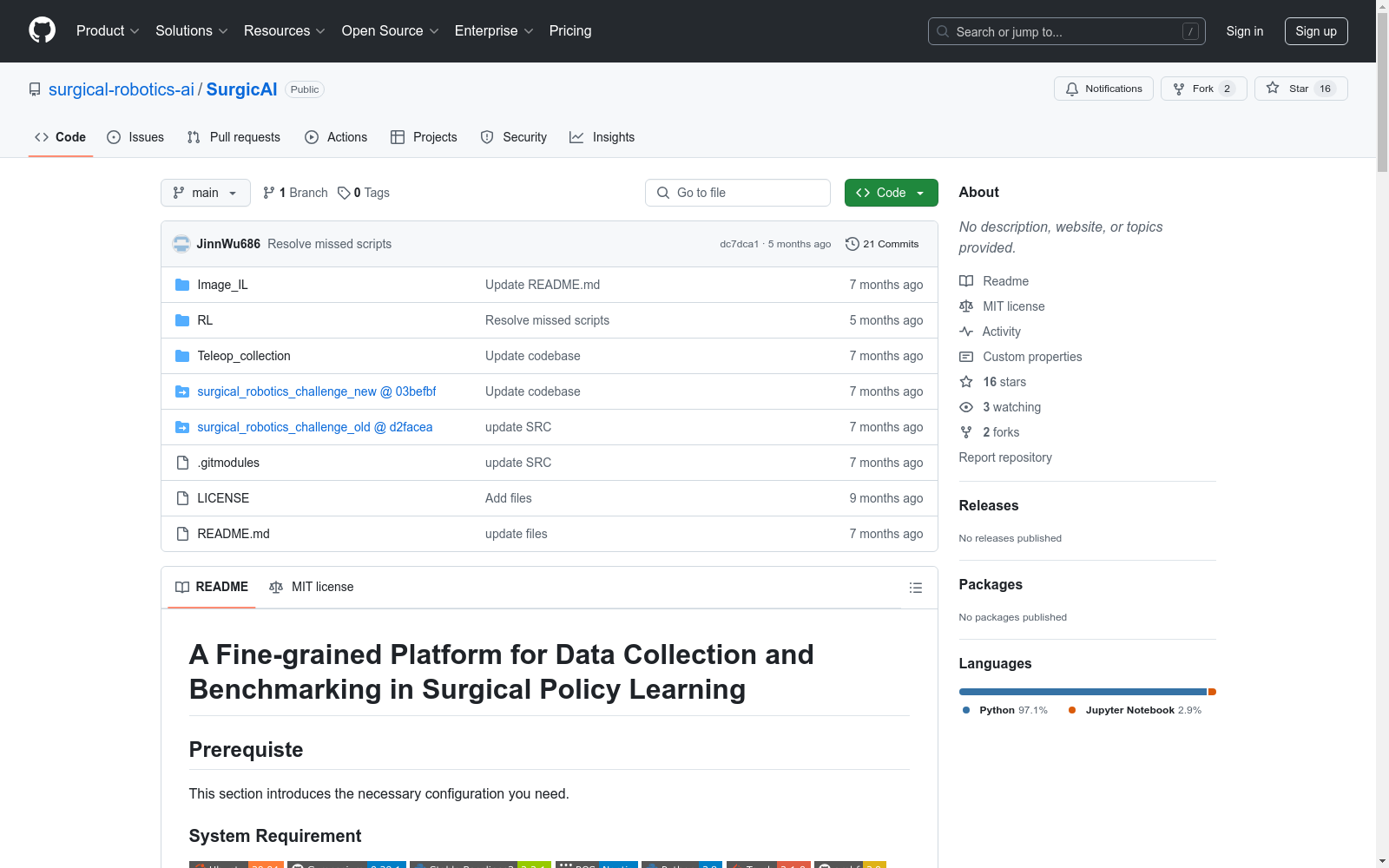
SurgicAI
收藏资源简介:
SurgicAI是由约翰霍普金斯大学开发的一个精细化的数据收集和基准测试平台,专注于外科手术策略学习。该数据集支持多种复杂手术任务,特别是缝合场景中的高灵巧性和模块化操作。SurgicAI通过集成标准化流程、先进的分层学习框架、多样化的任务套件和基准性能指标,提升了其在机器人手术自动化领域的应用能力。数据集的创建过程涉及专家演示的收集和预处理,以及使用强化学习和模仿学习方法训练代理。SurgicAI的应用领域主要集中在解决机器人辅助手术中的自动化挑战,尤其是提高手术任务的适应性和精确性。
SurgicAI is a refined data collection and benchmarking platform developed by Johns Hopkins University, focused on surgical strategy learning. This dataset supports a wide range of complex surgical tasks, especially highly dexterous and modular manipulation in suturing scenarios. By integrating standardized workflows, cutting-edge hierarchical learning frameworks, diverse task suites, and benchmark performance metrics, SurgicAI enhances its applicability in the domain of robotic surgical automation. The creation of this dataset entails the collection and preprocessing of expert demonstrations, as well as the training of agents via reinforcement learning and imitation learning approaches. The primary application scope of SurgicAI lies in addressing automation-related challenges in robot-assisted surgery, specifically improving the adaptability and precision of surgical tasks.
A Fine-grained Platform for Data Collection and Benchmarking in Surgical Policy Learning
系统要求
- Ubuntu 20.04
- Gymnasium 0.29.1
- Stable Baselines3 2.2.1
- ROS Noetic
- Python 3.8
- Torch 2.1.0
- ambf 2.0
安装步骤
-
安装Gymnasium: bash pip install gymnasium
-
配置Pytorch和CUDA(如有NVIDIA显卡)。
-
安装Stable Baselines3: bash pip install stable-baselines3
安装验证
运行以下脚本以验证安装: python import gymnasium import stable_baselines3
env = gymnasium.make(CartPole-v1) model = stable_baselines3.PPO(MlpPolicy, env, verbose=1) model.learn(total_timesteps=10000)
RL训练
运行SRC环境
确保ROS和SRC运行后,执行以下命令: bash roscore
bash ~/ambf/bin/lin-x86_64/ambf_simulator --launch_file ~/ambf/surgical_robotics_challenge/launch.yaml -l 0,1,3,4,13,14 -p 200 -t 1 --override_max_comm_freq 120
注册Gymnasium环境
python import gymnasium as gym from stable_baselines3.common.evaluation import evaluate_policy from Approach_env import SRC_approach import numpy as np from stable_baselines3.common.callbacks import CheckpointCallback from stable_baselines3.common.env_checker import check_env from RL_algo.PPO import PPO from stable_baselines3.common.utils import set_random_seed gym.envs.register(id="TD3_HER_BC", entry_point=SRC_approach) env = gym.make("TD3_HER_BC", render_mode="human",reward_type = "sparse")
初始化和训练模型
使用Proximal Policy Optimization (PPO)算法: python model = PPO("MlpPolicy", env, verbose=1,tensorboard_log="./First_version/",) checkpoint_callback = CheckpointCallback(save_freq=10000, save_path=./First_version/Model_temp, name_prefix=SRC) model.learn(total_timesteps=int(1000000), progress_bar=True,callback=checkpoint_callback,) model.save("SRC")
加载模型
python model = PPO("MlpPolicy", env, verbose=1,tensorboard_log="./First_version/",) model_path = "./Model/SRC_10000_steps.zip" model = PPO.load(model_path) model.set_env(env=env)
测试模型预测
python obs,info = env.reset() print(obs) for i in range(10000): action, _state = model.predict(obs, deterministic=True) print(action) obs, reward, terminated,truncated, info = env.step(action) print(info) env.render() if terminated or truncated: obs, info = env.reset()