路内停车的支付数据
收藏资源简介:
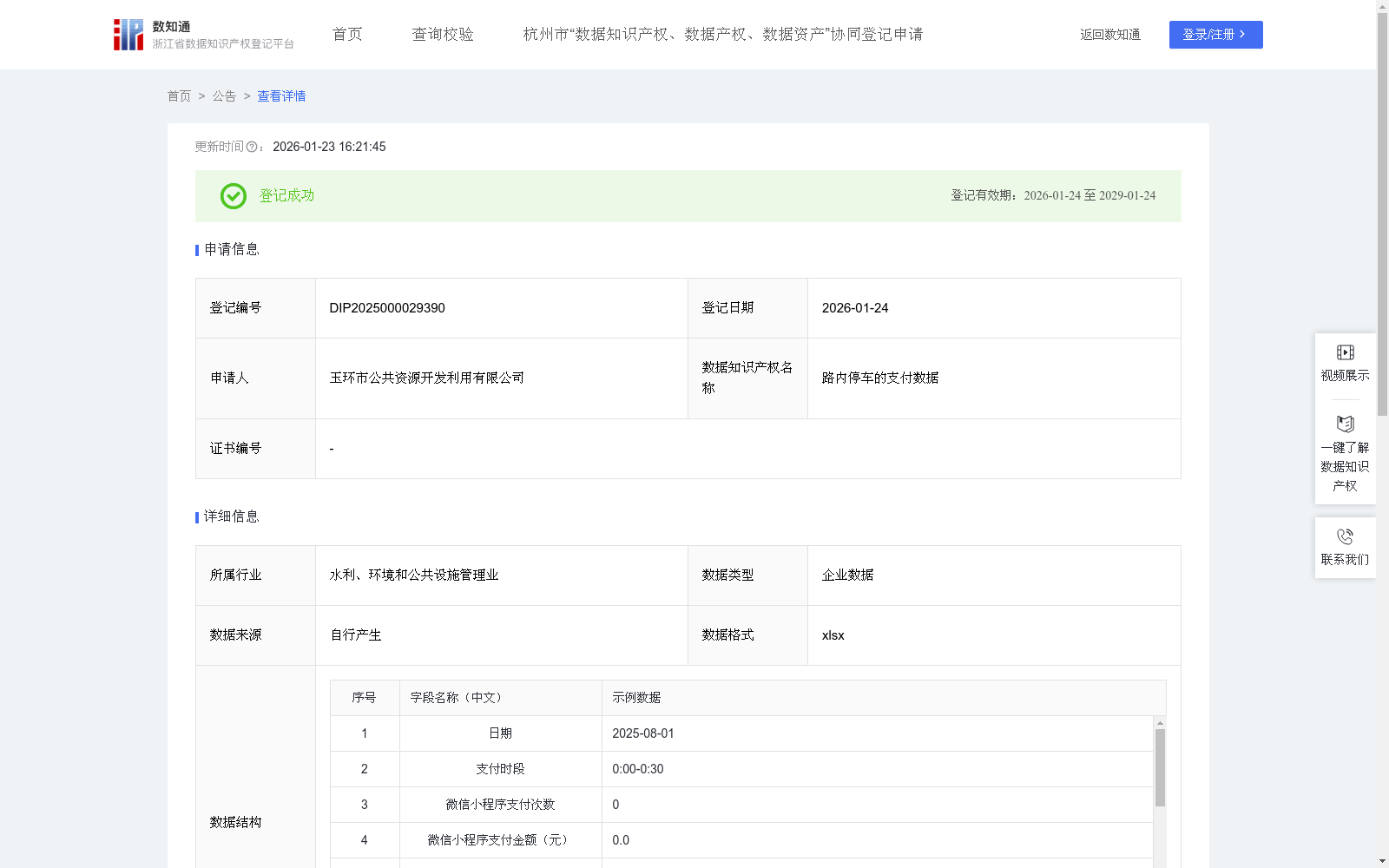
该数据在城市智慧停车管理中具有重要的应用价值和战略意义,用于支撑支付行为的多维度数据分析。通过对路内停车交易数据的实时采集和整合,并依托数据分析得到以每半小时为时间粒度的支付指数、支付方式占比(小票码、微信小程序、无感支付)及支付得分指标,一方面可方便管理方优化定价策略,提升运营效率,实现收益最大化,另一方面也可优化城市治理、提升市民幸福感、激活商业活力,以将传统的、独立的路内停车管理,升级为一个以数据为核心驱动的、智能化的城市公共服务生态系统。数据预处理:采集停车管理系统中实时监测的路内支付原始数据,并对原始数据进行整合得到以每半小时为时间粒度的微信小程序支付次数、微信小程序支付金额(元)、无感支付次数、无感支付金额(元)、小票码支付次数、小票码支付金额(元)、总支付次数、总支付金额(元),并剔除整合得到的0付费总次数数据,其中总支付次数和总支付金额(元)含手持PDA的支付情况。数据再处理:①计算每半小时各类支付的支付指数,其中支付指数=付费金额/(付费次数*0.5),且为四舍五入的取整整数;②计算每半小时各类支付的次数占比,其中次数占比=支付次数/总支付次数,且为保留小数点后两位的百分比数;③计算每半小时各类支付的金额占比,其中金额占比=支付金额/总支付金额,且为保留小数点后两位的百分比数;④计算支付得分,其中支付得分=((小票码支付次数占比+小票码支付金额占比+微信小程序支付次数占比+微信小程序支付金额占比)×0.3+(无感支付次数占比+无感支付金额占比)×0.7)×50。数据分析:①通过支付得分分析小票码、微信小程序、无感支付的综合情况,当50≤支付得分≤70时,用户支付偏好于无感支付,当30≤支付得分〈50时,对比小票码和微信小程序支付的综合情况,当小票码支付次数占比+小票码支付金额占比大于或等于微信小程序支付次数占比+微信小程序支付金额占比时,用户偏好小票码支付,当小票码支付次数占比+小票码支付金额占比小于微信小程序支付次数占比+微信小程序支付金额占比时,用户偏好微信小程序支付;②分析各类支付的支付指数情况,当0《支付指数《8时,临时车辆多,支付指数〉8时,固定车辆多。
This dataset holds significant application value and strategic importance for urban smart parking management, as it supports multi-dimensional data analysis of parking payment behaviors. Through real-time collection and integration of on-street parking transaction data, and relying on data analysis, indicators including 30-minute time-granularity payment index, payment method proportion (ticket code, WeChat Mini Program, contactless payment) and payment score are obtained. On one hand, this facilitates parking managers to optimize pricing strategies, improve operational efficiency and maximize revenue; on the other hand, it helps optimize urban governance, enhance citizens' well-being and activate commercial vitality, thereby upgrading the traditional and isolated on-street parking management into a data-driven, intelligent urban public service ecosystem. Data Preprocessing: Collect raw on-street payment data monitored in real time by the parking management system, integrate the raw data to obtain 30-minute time-granularity indicators including WeChat Mini Program payment times, WeChat Mini Program payment amount (yuan), contactless payment times, contactless payment amount (yuan), ticket code payment times, ticket code payment amount (yuan), total payment times and total payment amount (yuan), and remove the integrated datasets with total zero-payment transactions. Note that the total payment times and total payment amount (yuan) include payments made via handheld PDA. Data Post-processing: ① Calculate the payment index for each payment type at 30-minute granularity, where payment index = payment amount / (payment times * 0.5), and the result is rounded to the nearest integer; ② Calculate the proportion of payment times for each payment type at 30-minute granularity, where the proportion = payment times / total payment times, and the result is a percentage value rounded to two decimal places; ③ Calculate the proportion of payment amount for each payment type at 30-minute granularity, where the proportion = payment amount / total payment amount, and the result is a percentage value rounded to two decimal places; ④ Calculate the payment score, where payment score = ((ticket code payment times proportion + ticket code payment amount proportion + WeChat Mini Program payment times proportion + WeChat Mini Program payment amount proportion) × 0.3 + (contactless payment times proportion + contactless payment amount proportion) × 0.7) × 50. Data Analysis: ① Analyze the comprehensive performance of ticket code, WeChat Mini Program and contactless payments using payment scores: when 50 ≤ payment score ≤ 70, users prefer contactless payment; when 30 ≤ payment score < 50, compare the comprehensive situation of ticket code and WeChat Mini Program payments: if (ticket code payment times proportion + ticket code payment amount proportion) ≥ (WeChat Mini Program payment times proportion + WeChat Mini Program payment amount proportion), users prefer ticket code payment; otherwise, users prefer WeChat Mini Program payment; ② Analyze the payment index of each payment type: when 0 < payment index < 8, there are more transient vehicles; when payment index > 8, there are more regular long-term parking vehicles.