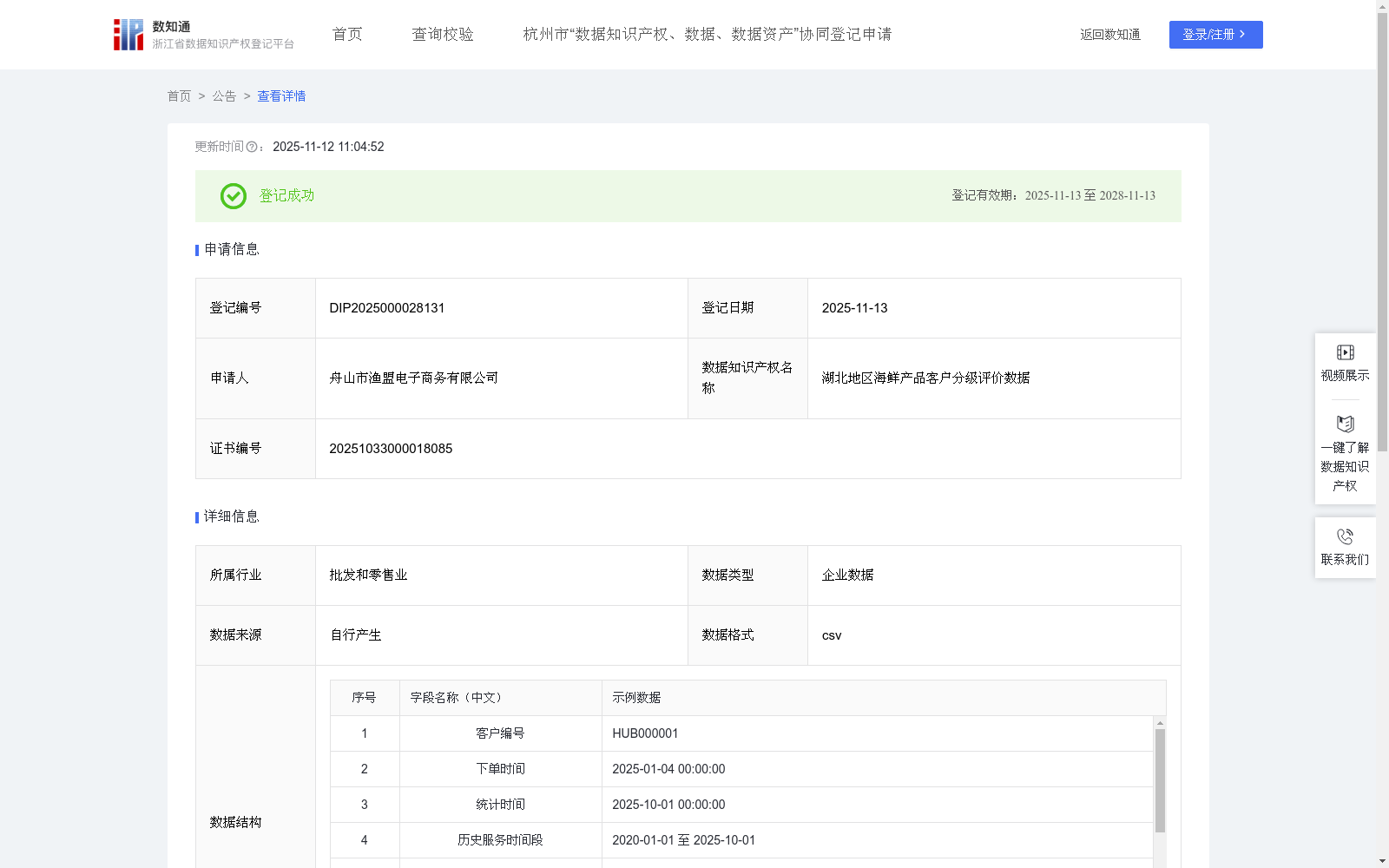
湖北地区海鲜产品客户分级评价数据
收藏资源简介:
通过收集和分析湖北省客户对海鲜产品的交易数据,运用RFM客户价值模型,对客户的购买力水平与消费偏好进行量化分析与等级划分,实现客户的精细化分层与精准化运营。通过对R(最近一次购买时间)、F(购买频率)和M(消费金额)三项指标的综合评估,系统可识别出高价值客户、中等价值客户与潜在客户群体,为企业提供差异化的客户管理策略支持。针对不同等级客户,可实施分层沟通与维护策略:对A级客户,每月保持1至2次重点沟通与回访,巩固合作关系、提升复购率;对B级客户,每季度进行1至2次沟通,关注其需求变化,促进持续购买;对C级客户,每半年沟通1至2次,通过活动或优惠提升其活跃度。此外,该分析模型还可为区域内客户群体高度重叠的相关企业提供个性化的数据支撑服务,帮助他们依据客户等级开展精准营销、产品推荐与客户价值提升管理。1. 数据采集: 采集湖北地区客户对海鲜产品的相关交易数据。其中,采集数据中"下单时间"为距离统计时间最近的一次订单时间,"订单金额"指的是距离统计时间最近的这次订单金额,"区域"指的是客户所在的城市或省份,客户数据已进行脱敏转换处理。 2. 数据处理:对采集到的销售金额(元)、产品名称等数据进行分类、合并、累加,便于分析使用。其中客户编号已进行脱敏转换处理,销售区域按省份进行统计,时间数据统一转换为标准格式。 3. 算法加工:(1)R评分: 根据用户下单时间距离统计时间的天数(D)划分为5个等级: 0≤D≤7为5分;8≤D≤15为4分 ; 16≤D≤30为3分;31≤D≤60为2分;D>60为1分。 (2)F评分:消费频率评分根据历史购买总次数(S)划分为5个等级:S=1为1分; S=2为2分;3≤S≤4为3分;5≤S≤9为4分;S≥10为5分。(3)M评分:根据历史购买总金额(Z)划分为5个等级:Z<100元为1分;100≤Z<200元为2分;200≤Z<300元为3分;300≤Z<500元为4分;Z≥500元为5分;(4)RFM综合评分(X)=0.4×R+0.3×F+0.3×M。 (3)会员等级分为ABC三级:X≥4.0为A级(高价值客户);2.5≤X<4.0为B级(中等价值客户);X<2.5为C级(低价值客户)。
This dataset is developed by collecting and analyzing transaction data of seafood products from customers in Hubei Province, and applying the RFM customer value model to quantitatively analyze and grade customers' purchasing power and consumption preferences, so as to achieve refined customer segmentation and precise operational management. Through the comprehensive evaluation of three indicators: R (Recency, time since the most recent purchase), F (Frequency, purchase frequency) and M (Monetary, total consumption amount), the system can identify high-value customers, medium-value customers and potential customer groups, providing differentiated customer management strategy support for enterprises. For customers of different grades, layered communication and maintenance strategies can be implemented: For Grade A customers, maintain 1 to 2 key communications and return visits per month to consolidate cooperative relationships and improve repurchase rates; For Grade B customers, conduct 1 to 2 communications per quarter to pay attention to their changing needs and promote sustained purchases; For Grade C customers, communicate 1 to 2 times every six months to enhance their activity through activities or preferential policies. In addition, this analysis model can also provide personalized data support services for relevant enterprises with highly overlapping customer groups in the region, helping them carry out precision marketing, product recommendation and customer value enhancement management based on customer grades. 1. Data Collection Relevant transaction data of seafood products from customers in Hubei Province is collected. Specifically, the "order time" in the collected data refers to the time of the most recent order relative to the statistical time, the "order amount" refers to the amount of this most recent order, the "region" refers to the city or province where the customer is located, and all customer data has been anonymized and transformed. 2. Data Processing The collected data including sales amount (in RMB), product names and other relevant information are classified, merged and accumulated to facilitate analysis. The customer IDs have been anonymized and transformed, sales regions are counted by province, and all time data is uniformly converted to standard format. 3. Algorithm Processing (1) R Score: Divided into 5 levels based on the number of days (D) between the user's order time and the statistical time: 5 points for 0≤D≤7; 4 points for 8≤D≤15; 3 points for 16≤D≤30; 2 points for 31≤D≤60; 1 point for D>60. (2) F Score: The consumption frequency score is divided into 5 levels based on the total number of historical purchases (S): 1 point for S=1; 2 points for S=2; 3 points for 3≤S≤4; 4 points for 5≤S≤9; 5 points for S≥10. (3) M Score: Divided into 5 levels based on the total historical purchase amount (Z): 1 point for Z<100 RMB; 2 points for 100≤Z<200 RMB; 3 points for 200≤Z<300 RMB; 4 points for 300≤Z<500 RMB; 5 points for Z≥500 RMB. (4) Comprehensive RFM Score (X) = 0.4×R + 0.3×F + 0.3×M. (5) Customer Membership Levels: Divided into three grades A, B and C: Grade A (high-value customers) for X≥4.0; Grade B (medium-value customers) for 2.5≤X<4.0; Grade C (low-value customers) for X<2.5.