---
annotations_creators: []
language_creators: []
language:
- en
license:
- cc-by-sa-4.0
multilinguality:
- monolingual
paperswithcode_id: beir
pretty_name: BEIR Benchmark
size_categories:
msmarco:
- 1M<n<10M
trec-covid:
- 100k<n<1M
nfcorpus:
- 1K<n<10K
nq:
- 1M<n<10M
hotpotqa:
- 1M<n<10M
fiqa:
- 10K<n<100K
arguana:
- 1K<n<10K
touche-2020:
- 100K<n<1M
cqadupstack:
- 100K<n<1M
quora:
- 100K<n<1M
dbpedia:
- 1M<n<10M
scidocs:
- 10K<n<100K
fever:
- 1M<n<10M
climate-fever:
- 1M<n<10M
scifact:
- 1K<n<10K
source_datasets: []
task_categories:
- text-retrieval
---
# NFCorpus: 20 generated queries (BEIR Benchmark)
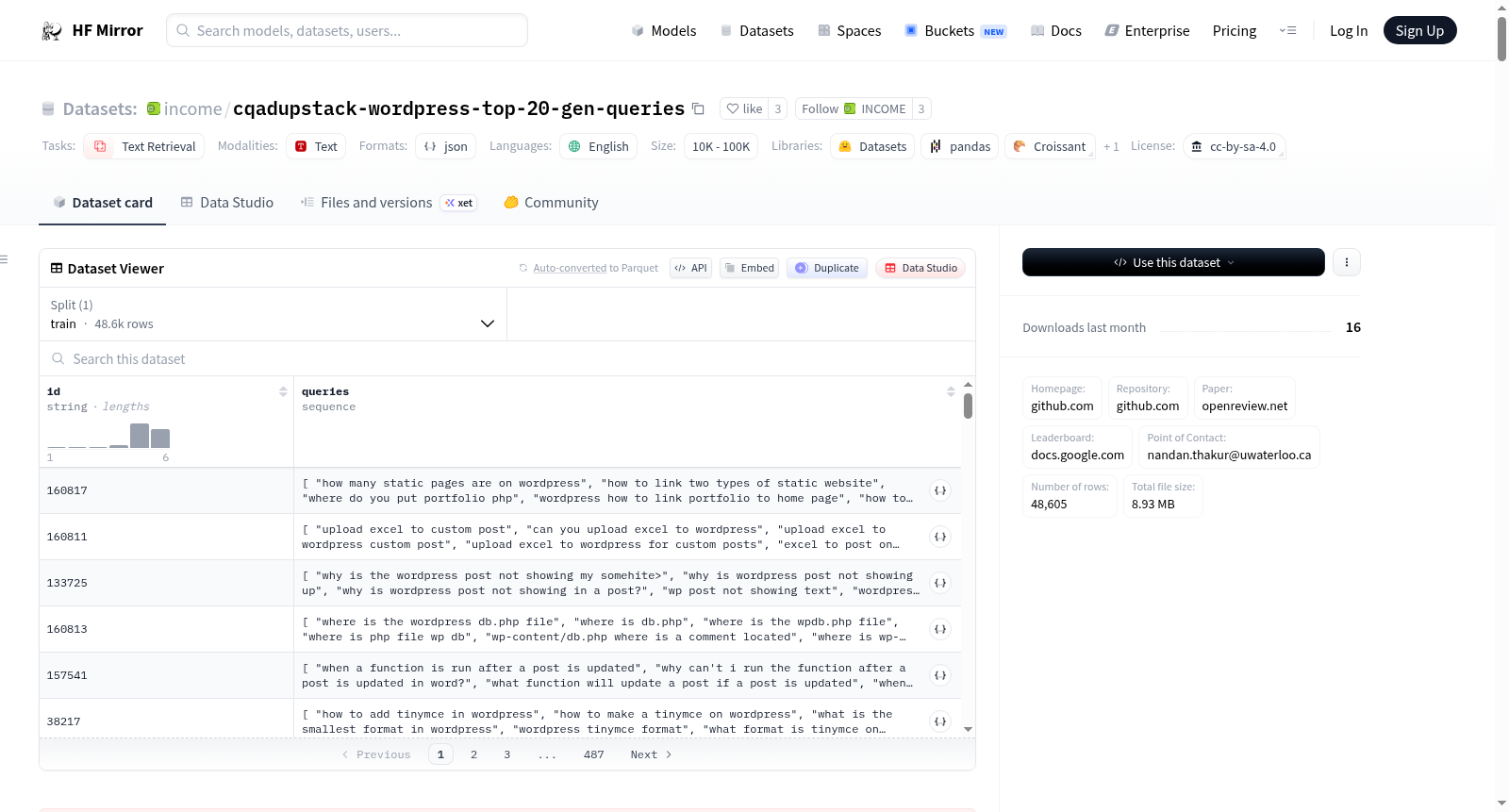
This HF dataset contains the top-20 synthetic queries generated for each passage in the above BEIR benchmark dataset.
- DocT5query model used: [BeIR/query-gen-msmarco-t5-base-v1](https://huggingface.co/BeIR/query-gen-msmarco-t5-base-v1)
- id (str): unique document id in NFCorpus in the BEIR benchmark (`corpus.jsonl`).
- Questions generated: 20
- Code used for generation: [evaluate_anserini_docT5query_parallel.py](https://github.com/beir-cellar/beir/blob/main/examples/retrieval/evaluation/sparse/evaluate_anserini_docT5query_parallel.py)
Below contains the old dataset card for the BEIR benchmark.
# Dataset Card for BEIR Benchmark
## Table of Contents
- [Dataset Description](#dataset-description)
- [Dataset Summary](#dataset-summary)
- [Supported Tasks and Leaderboards](#supported-tasks-and-leaderboards)
- [Languages](#languages)
- [Dataset Structure](#dataset-structure)
- [Data Instances](#data-instances)
- [Data Fields](#data-fields)
- [Data Splits](#data-splits)
- [Dataset Creation](#dataset-creation)
- [Curation Rationale](#curation-rationale)
- [Source Data](#source-data)
- [Annotations](#annotations)
- [Personal and Sensitive Information](#personal-and-sensitive-information)
- [Considerations for Using the Data](#considerations-for-using-the-data)
- [Social Impact of Dataset](#social-impact-of-dataset)
- [Discussion of Biases](#discussion-of-biases)
- [Other Known Limitations](#other-known-limitations)
- [Additional Information](#additional-information)
- [Dataset Curators](#dataset-curators)
- [Licensing Information](#licensing-information)
- [Citation Information](#citation-information)
- [Contributions](#contributions)
## Dataset Description
- **Homepage:** https://github.com/UKPLab/beir
- **Repository:** https://github.com/UKPLab/beir
- **Paper:** https://openreview.net/forum?id=wCu6T5xFjeJ
- **Leaderboard:** https://docs.google.com/spreadsheets/d/1L8aACyPaXrL8iEelJLGqlMqXKPX2oSP_R10pZoy77Ns
- **Point of Contact:** nandan.thakur@uwaterloo.ca
### Dataset Summary
BEIR is a heterogeneous benchmark that has been built from 18 diverse datasets representing 9 information retrieval tasks:
- Fact-checking: [FEVER](http://fever.ai), [Climate-FEVER](http://climatefever.ai), [SciFact](https://github.com/allenai/scifact)
- Question-Answering: [NQ](https://ai.google.com/research/NaturalQuestions), [HotpotQA](https://hotpotqa.github.io), [FiQA-2018](https://sites.google.com/view/fiqa/)
- Bio-Medical IR: [TREC-COVID](https://ir.nist.gov/covidSubmit/index.html), [BioASQ](http://bioasq.org), [NFCorpus](https://www.cl.uni-heidelberg.de/statnlpgroup/nfcorpus/)
- News Retrieval: [TREC-NEWS](https://trec.nist.gov/data/news2019.html), [Robust04](https://trec.nist.gov/data/robust/04.guidelines.html)
- Argument Retrieval: [Touche-2020](https://webis.de/events/touche-20/shared-task-1.html), [ArguAna](tp://argumentation.bplaced.net/arguana/data)
- Duplicate Question Retrieval: [Quora](https://www.quora.com/q/quoradata/First-Quora-Dataset-Release-Question-Pairs), [CqaDupstack](http://nlp.cis.unimelb.edu.au/resources/cqadupstack/)
- Citation-Prediction: [SCIDOCS](https://allenai.org/data/scidocs)
- Tweet Retrieval: [Signal-1M](https://research.signal-ai.com/datasets/signal1m-tweetir.html)
- Entity Retrieval: [DBPedia](https://github.com/iai-group/DBpedia-Entity/)
All these datasets have been preprocessed and can be used for your experiments.
```python
```
### Supported Tasks and Leaderboards
The dataset supports a leaderboard that evaluates models against task-specific metrics such as F1 or EM, as well as their ability to retrieve supporting information from Wikipedia.
The current best performing models can be found [here](https://eval.ai/web/challenges/challenge-page/689/leaderboard/).
### Languages
All tasks are in English (`en`).
## Dataset Structure
All BEIR datasets must contain a corpus, queries and qrels (relevance judgments file). They must be in the following format:
- `corpus` file: a `.jsonl` file (jsonlines) that contains a list of dictionaries, each with three fields `_id` with unique document identifier, `title` with document title (optional) and `text` with document paragraph or passage. For example: `{"_id": "doc1", "title": "Albert Einstein", "text": "Albert Einstein was a German-born...."}`
- `queries` file: a `.jsonl` file (jsonlines) that contains a list of dictionaries, each with two fields `_id` with unique query identifier and `text` with query text. For example: `{"_id": "q1", "text": "Who developed the mass-energy equivalence formula?"}`
- `qrels` file: a `.tsv` file (tab-seperated) that contains three columns, i.e. the `query-id`, `corpus-id` and `score` in this order. Keep 1st row as header. For example: `q1 doc1 1`
### Data Instances
A high level example of any beir dataset:
```python
corpus = {
"doc1" : {
"title": "Albert Einstein",
"text": "Albert Einstein was a German-born theoretical physicist. who developed the theory of relativity, \
one of the two pillars of modern physics (alongside quantum mechanics). His work is also known for \
its influence on the philosophy of science. He is best known to the general public for his mass–energy \
equivalence formula E = mc2, which has been dubbed 'the world's most famous equation'. He received the 1921 \
Nobel Prize in Physics 'for his services to theoretical physics, and especially for his discovery of the law \
of the photoelectric effect', a pivotal step in the development of quantum theory."
},
"doc2" : {
"title": "", # Keep title an empty string if not present
"text": "Wheat beer is a top-fermented beer which is brewed with a large proportion of wheat relative to the amount of \
malted barley. The two main varieties are German Weißbier and Belgian witbier; other types include Lambic (made\
with wild yeast), Berliner Weisse (a cloudy, sour beer), and Gose (a sour, salty beer)."
},
}
queries = {
"q1" : "Who developed the mass-energy equivalence formula?",
"q2" : "Which beer is brewed with a large proportion of wheat?"
}
qrels = {
"q1" : {"doc1": 1},
"q2" : {"doc2": 1},
}
```
### Data Fields
Examples from all configurations have the following features:
### Corpus
- `corpus`: a `dict` feature representing the document title and passage text, made up of:
- `_id`: a `string` feature representing the unique document id
- `title`: a `string` feature, denoting the title of the document.
- `text`: a `string` feature, denoting the text of the document.
### Queries
- `queries`: a `dict` feature representing the query, made up of:
- `_id`: a `string` feature representing the unique query id
- `text`: a `string` feature, denoting the text of the query.
### Qrels
- `qrels`: a `dict` feature representing the query document relevance judgements, made up of:
- `_id`: a `string` feature representing the query id
- `_id`: a `string` feature, denoting the document id.
- `score`: a `int32` feature, denoting the relevance judgement between query and document.
### Data Splits
| Dataset | Website| BEIR-Name | Type | Queries | Corpus | Rel D/Q | Down-load | md5 |
| -------- | -----| ---------| --------- | ----------- | ---------| ---------| :----------: | :------:|
| MSMARCO | [Homepage](https://microsoft.github.io/msmarco/)| ``msmarco`` | ``train``<br>``dev``<br>``test``| 6,980 | 8.84M | 1.1 | [Link](https://public.ukp.informatik.tu-darmstadt.de/thakur/BEIR/datasets/msmarco.zip) | ``444067daf65d982533ea17ebd59501e4`` |
| TREC-COVID | [Homepage](https://ir.nist.gov/covidSubmit/index.html)| ``trec-covid``| ``test``| 50| 171K| 493.5 | [Link](https://public.ukp.informatik.tu-darmstadt.de/thakur/BEIR/datasets/trec-covid.zip) | ``ce62140cb23feb9becf6270d0d1fe6d1`` |
| NFCorpus | [Homepage](https://www.cl.uni-heidelberg.de/statnlpgroup/nfcorpus/) | ``nfcorpus`` | ``train``<br>``dev``<br>``test``| 323 | 3.6K | 38.2 | [Link](https://public.ukp.informatik.tu-darmstadt.de/thakur/BEIR/datasets/nfcorpus.zip) | ``a89dba18a62ef92f7d323ec890a0d38d`` |
| BioASQ | [Homepage](http://bioasq.org) | ``bioasq``| ``train``<br>``test`` | 500 | 14.91M | 8.05 | No | [How to Reproduce?](https://github.com/UKPLab/beir/blob/main/examples/dataset#2-bioasq) |
| NQ | [Homepage](https://ai.google.com/research/NaturalQuestions) | ``nq``| ``train``<br>``test``| 3,452 | 2.68M | 1.2 | [Link](https://public.ukp.informatik.tu-darmstadt.de/thakur/BEIR/datasets/nq.zip) | ``d4d3d2e48787a744b6f6e691ff534307`` |
| HotpotQA | [Homepage](https://hotpotqa.github.io) | ``hotpotqa``| ``train``<br>``dev``<br>``test``| 7,405 | 5.23M | 2.0 | [Link](https://public.ukp.informatik.tu-darmstadt.de/thakur/BEIR/datasets/hotpotqa.zip) | ``f412724f78b0d91183a0e86805e16114`` |
| FiQA-2018 | [Homepage](https://sites.google.com/view/fiqa/) | ``fiqa`` | ``train``<br>``dev``<br>``test``| 648 | 57K | 2.6 | [Link](https://public.ukp.informatik.tu-darmstadt.de/thakur/BEIR/datasets/fiqa.zip) | ``17918ed23cd04fb15047f73e6c3bd9d9`` |
| Signal-1M(RT) | [Homepage](https://research.signal-ai.com/datasets/signal1m-tweetir.html)| ``signal1m`` | ``test``| 97 | 2.86M | 19.6 | No | [How to Reproduce?](https://github.com/UKPLab/beir/blob/main/examples/dataset#4-signal-1m) |
| TREC-NEWS | [Homepage](https://trec.nist.gov/data/news2019.html) | ``trec-news`` | ``test``| 57 | 595K | 19.6 | No | [How to Reproduce?](https://github.com/UKPLab/beir/blob/main/examples/dataset#1-trec-news) |
| ArguAna | [Homepage](http://argumentation.bplaced.net/arguana/data) | ``arguana``| ``test`` | 1,406 | 8.67K | 1.0 | [Link](https://public.ukp.informatik.tu-darmstadt.de/thakur/BEIR/datasets/arguana.zip) | ``8ad3e3c2a5867cdced806d6503f29b99`` |
| Touche-2020| [Homepage](https://webis.de/events/touche-20/shared-task-1.html) | ``webis-touche2020``| ``test``| 49 | 382K | 19.0 | [Link](https://public.ukp.informatik.tu-darmstadt.de/thakur/BEIR/datasets/webis-touche2020.zip) | ``46f650ba5a527fc69e0a6521c5a23563`` |
| CQADupstack| [Homepage](http://nlp.cis.unimelb.edu.au/resources/cqadupstack/) | ``cqadupstack``| ``test``| 13,145 | 457K | 1.4 | [Link](https://public.ukp.informatik.tu-darmstadt.de/thakur/BEIR/datasets/cqadupstack.zip) | ``4e41456d7df8ee7760a7f866133bda78`` |
| Quora| [Homepage](https://www.quora.com/q/quoradata/First-Quora-Dataset-Release-Question-Pairs) | ``quora``| ``dev``<br>``test``| 10,000 | 523K | 1.6 | [Link](https://public.ukp.informatik.tu-darmstadt.de/thakur/BEIR/datasets/quora.zip) | ``18fb154900ba42a600f84b839c173167`` |
| DBPedia | [Homepage](https://github.com/iai-group/DBpedia-Entity/) | ``dbpedia-entity``| ``dev``<br>``test``| 400 | 4.63M | 38.2 | [Link](https://public.ukp.informatik.tu-darmstadt.de/thakur/BEIR/datasets/dbpedia-entity.zip) | ``c2a39eb420a3164af735795df012ac2c`` |
| SCIDOCS| [Homepage](https://allenai.org/data/scidocs) | ``scidocs``| ``test``| 1,000 | 25K | 4.9 | [Link](https://public.ukp.informatik.tu-darmstadt.de/thakur/BEIR/datasets/scidocs.zip) | ``38121350fc3a4d2f48850f6aff52e4a9`` |
| FEVER | [Homepage](http://fever.ai) | ``fever``| ``train``<br>``dev``<br>``test``| 6,666 | 5.42M | 1.2| [Link](https://public.ukp.informatik.tu-darmstadt.de/thakur/BEIR/datasets/fever.zip) | ``5a818580227bfb4b35bb6fa46d9b6c03`` |
| Climate-FEVER| [Homepage](http://climatefever.ai) | ``climate-fever``|``test``| 1,535 | 5.42M | 3.0 | [Link](https://public.ukp.informatik.tu-darmstadt.de/thakur/BEIR/datasets/climate-fever.zip) | ``8b66f0a9126c521bae2bde127b4dc99d`` |
| SciFact| [Homepage](https://github.com/allenai/scifact) | ``scifact``| ``train``<br>``test``| 300 | 5K | 1.1 | [Link](https://public.ukp.informatik.tu-darmstadt.de/thakur/BEIR/datasets/scifact.zip) | ``5f7d1de60b170fc8027bb7898e2efca1`` |
| Robust04 | [Homepage](https://trec.nist.gov/data/robust/04.guidelines.html) | ``robust04``| ``test``| 249 | 528K | 69.9 | No | [How to Reproduce?](https://github.com/UKPLab/beir/blob/main/examples/dataset#3-robust04) |
## Dataset Creation
### Curation Rationale
[Needs More Information]
### Source Data
#### Initial Data Collection and Normalization
[Needs More Information]
#### Who are the source language producers?
[Needs More Information]
### Annotations
#### Annotation process
[Needs More Information]
#### Who are the annotators?
[Needs More Information]
### Personal and Sensitive Information
[Needs More Information]
## Considerations for Using the Data
### Social Impact of Dataset
[Needs More Information]
### Discussion of Biases
[Needs More Information]
### Other Known Limitations
[Needs More Information]
## Additional Information
### Dataset Curators
[Needs More Information]
### Licensing Information
[Needs More Information]
### Citation Information
Cite as:
```
@inproceedings{
thakur2021beir,
title={{BEIR}: A Heterogeneous Benchmark for Zero-shot Evaluation of Information Retrieval Models},
author={Nandan Thakur and Nils Reimers and Andreas R{\"u}ckl{\'e} and Abhishek Srivastava and Iryna Gurevych},
booktitle={Thirty-fifth Conference on Neural Information Processing Systems Datasets and Benchmarks Track (Round 2)},
year={2021},
url={https://openreview.net/forum?id=wCu6T5xFjeJ}
}
```
### Contributions
Thanks to [@Nthakur20](https://github.com/Nthakur20) for adding this dataset.Top-20 generated queries for every passage in NFCorpus
# Dataset Card for BEIR Benchmark
## Table of Contents
- [Dataset Description](#dataset-description)
- [Dataset Summary](#dataset-summary)
- [Supported Tasks and Leaderboards](#supported-tasks-and-leaderboards)
- [Languages](#languages)
- [Dataset Structure](#dataset-structure)
- [Data Instances](#data-instances)
- [Data Fields](#data-fields)
- [Data Splits](#data-splits)
- [Dataset Creation](#dataset-creation)
- [Curation Rationale](#curation-rationale)
- [Source Data](#source-data)
- [Annotations](#annotations)
- [Personal and Sensitive Information](#personal-and-sensitive-information)
- [Considerations for Using the Data](#considerations-for-using-the-data)
- [Social Impact of Dataset](#social-impact-of-dataset)
- [Discussion of Biases](#discussion-of-biases)
- [Other Known Limitations](#other-known-limitations)
- [Additional Information](#additional-information)
- [Dataset Curators](#dataset-curators)
- [Licensing Information](#licensing-information)
- [Citation Information](#citation-information)
- [Contributions](#contributions)
## Dataset Description
- **Homepage:** https://github.com/UKPLab/beir
- **Repository:** https://github.com/UKPLab/beir
- **Paper:** https://openreview.net/forum?id=wCu6T5xFjeJ
- **Leaderboard:** https://docs.google.com/spreadsheets/d/1L8aACyPaXrL8iEelJLGqlMqXKPX2oSP_R10pZoy77Ns
- **Point of Contact:** nandan.thakur@uwaterloo.ca
### Dataset Summary
BEIR is a heterogeneous benchmark that has been built from 18 diverse datasets representing 9 information retrieval tasks:
- Fact-checking: [FEVER](http://fever.ai), [Climate-FEVER](http://climatefever.ai), [SciFact](https://github.com/allenai/scifact)
- Question-Answering: [NQ](https://ai.google.com/research/NaturalQuestions), [HotpotQA](https://hotpotqa.github.io), [FiQA-2018](https://sites.google.com/view/fiqa/)
- Bio-Medical IR: [TREC-COVID](https://ir.nist.gov/covidSubmit/index.html), [BioASQ](http://bioasq.org), [NFCorpus](https://www.cl.uni-heidelberg.de/statnlpgroup/nfcorpus/)
- News Retrieval: [TREC-NEWS](https://trec.nist.gov/data/news2019.html), [Robust04](https://trec.nist.gov/data/robust/04.guidelines.html)
- Argument Retrieval: [Touche-2020](https://webis.de/events/touche-20/shared-task-1.html), [ArguAna](tp://argumentation.bplaced.net/arguana/data)
- Duplicate Question Retrieval: [Quora](https://www.quora.com/q/quoradata/First-Quora-Dataset-Release-Question-Pairs), [CqaDupstack](http://nlp.cis.unimelb.edu.au/resources/cqadupstack/)
- Citation-Prediction: [SCIDOCS](https://allenai.org/data/scidocs)
- Tweet Retrieval: [Signal-1M](https://research.signal-ai.com/datasets/signal1m-tweetir.html)
- Entity Retrieval: [DBPedia](https://github.com/iai-group/DBpedia-Entity/)
All these datasets have been preprocessed and can be used for your experiments.
```python
```
### Supported Tasks and Leaderboards
The dataset supports a leaderboard that evaluates models against task-specific metrics such as F1 or EM, as well as their ability to retrieve supporting information from Wikipedia.
The current best performing models can be found [here](https://eval.ai/web/challenges/challenge-page/689/leaderboard/).
### Languages
All tasks are in English (`en`).
## Dataset Structure
All BEIR datasets must contain a corpus, queries and qrels (relevance judgments file). They must be in the following format:
- `corpus` file: a `.jsonl` file (jsonlines) that contains a list of dictionaries, each with three fields `_id` with unique document identifier, `title` with document title (optional) and `text` with document paragraph or passage. For example: `{"_id": "doc1", "title": "Albert Einstein", "text": "Albert Einstein was a German-born...."}`
- `queries` file: a `.jsonl` file (jsonlines) that contains a list of dictionaries, each with two fields `_id` with unique query identifier and `text` with query text. For example: `{"_id": "q1", "text": "Who developed the mass-energy equivalence formula?"}`
- `qrels` file: a `.tsv` file (tab-seperated) that contains three columns, i.e. the `query-id`, `corpus-id` and `score` in this order. Keep 1st row as header. For example: `q1 doc1 1`
### Data Instances
A high level example of any beir dataset:
```python
corpus = {
"doc1" : {
"title": "Albert Einstein",
"text": "Albert Einstein was a German-born theoretical physicist. who developed the theory of relativity, \
one of the two pillars of modern physics (alongside quantum mechanics). His work is also known for \
its influence on the philosophy of science. He is best known to the general public for his mass–energy \
equivalence formula E = mc2, which has been dubbed 'the world's most famous equation'. He received the 1921 \
Nobel Prize in Physics 'for his services to theoretical physics, and especially for his discovery of the law \
of the photoelectric effect', a pivotal step in the development of quantum theory."
},
"doc2" : {
"title": "", # Keep title an empty string if not present
"text": "Wheat beer is a top-fermented beer which is brewed with a large proportion of wheat relative to the amount of \
malted barley. The two main varieties are German Weißbier and Belgian witbier; other types include Lambic (made\
with wild yeast), Berliner Weisse (a cloudy, sour beer), and Gose (a sour, salty beer)."
},
}
queries = {
"q1" : "Who developed the mass-energy equivalence formula?",
"q2" : "Which beer is brewed with a large proportion of wheat?"
}
qrels = {
"q1" : {"doc1": 1},
"q2" : {"doc2": 1},
}
```
### Data Fields
Examples from all configurations have the following features:
### Corpus
- `corpus`: a `dict` feature representing the document title and passage text, made up of:
- `_id`: a `string` feature representing the unique document id
- `title`: a `string` feature, denoting the title of the document.
- `text`: a `string` feature, denoting the text of the document.
### Queries
- `queries`: a `dict` feature representing the query, made up of:
- `_id`: a `string` feature representing the unique query id
- `text`: a `string` feature, denoting the text of the query.
### Qrels
- `qrels`: a `dict` feature representing the query document relevance judgements, made up of:
- `_id`: a `string` feature representing the query id
- `_id`: a `string` feature, denoting the document id.
- `score`: a `int32` feature, denoting the relevance judgement between query and document.
### Data Splits
| Dataset | Website| BEIR-Name | Type | Queries | Corpus | Rel D/Q | Down-load | md5 |
| -------- | -----| ---------| --------- | ----------- | ---------| ---------| :----------: | :------:|
| MSMARCO | [Homepage](https://microsoft.github.io/msmarco/)| ``msmarco`` | ``train``<br>``dev``<br>``test``| 6,980 | 8.84M | 1.1 | [Link](https://public.ukp.informatik.tu-darmstadt.de/thakur/BEIR/datasets/msmarco.zip) | ``444067daf65d982533ea17ebd59501e4`` |
| TREC-COVID | [Homepage](https://ir.nist.gov/covidSubmit/index.html)| ``trec-covid``| ``test``| 50| 171K| 493.5 | [Link](https://public.ukp.informatik.tu-darmstadt.de/thakur/BEIR/datasets/trec-covid.zip) | ``ce62140cb23feb9becf6270d0d1fe6d1`` |
| NFCorpus | [Homepage](https://www.cl.uni-heidelberg.de/statnlpgroup/nfcorpus/) | ``nfcorpus`` | ``train``<br>``dev``<br>``test``| 323 | 3.6K | 38.2 | [Link](https://public.ukp.informatik.tu-darmstadt.de/thakur/BEIR/datasets/nfcorpus.zip) | ``a89dba18a62ef92f7d323ec890a0d38d`` |
| BioASQ | [Homepage](http://bioasq.org) | ``bioasq``| ``train``<br>``test`` | 500 | 14.91M | 8.05 | No | [How to Reproduce?](https://github.com/UKPLab/beir/blob/main/examples/dataset#2-bioasq) |
| NQ | [Homepage](https://ai.google.com/research/NaturalQuestions) | ``nq``| ``train``<br>``test``| 3,452 | 2.68M | 1.2 | [Link](https://public.ukp.informatik.tu-darmstadt.de/thakur/BEIR/datasets/nq.zip) | ``d4d3d2e48787a744b6f6e691ff534307`` |
| HotpotQA | [Homepage](https://hotpotqa.github.io) | ``hotpotqa``| ``train``<br>``dev``<br>``test``| 7,405 | 5.23M | 2.0 | [Link](https://public.ukp.informatik.tu-darmstadt.de/thakur/BEIR/datasets/hotpotqa.zip) | ``f412724f78b0d91183a0e86805e16114`` |
| FiQA-2018 | [Homepage](https://sites.google.com/view/fiqa/) | ``fiqa`` | ``train``<br>``dev``<br>``test``| 648 | 57K | 2.6 | [Link](https://public.ukp.informatik.tu-darmstadt.de/thakur/BEIR/datasets/fiqa.zip) | ``17918ed23cd04fb15047f73e6c3bd9d9`` |
| Signal-1M(RT) | [Homepage](https://research.signal-ai.com/datasets/signal1m-tweetir.html)| ``signal1m`` | ``test``| 97 | 2.86M | 19.6 | No | [How to Reproduce?](https://github.com/UKPLab/beir/blob/main/examples/dataset#4-signal-1m) |
| TREC-NEWS | [Homepage](https://trec.nist.gov/data/news2019.html) | ``trec-news`` | ``test``| 57 | 595K | 19.6 | No | [How to Reproduce?](https://github.com/UKPLab/beir/blob/main/examples/dataset#1-trec-news) |
| ArguAna | [Homepage](http://argumentation.bplaced.net/arguana/data) | ``arguana``| ``test`` | 1,406 | 8.67K | 1.0 | [Link](https://public.ukp.informatik.tu-darmstadt.de/thakur/BEIR/datasets/arguana.zip) | ``8ad3e3c2a5867cdced806d6503f29b99`` |
| Touche-2020| [Homepage](https://webis.de/events/touche-20/shared-task-1.html) | ``webis-touche2020``| ``test``| 49 | 382K | 19.0 | [Link](https://public.ukp.informatik.tu-darmstadt.de/thakur/BEIR/datasets/webis-touche2020.zip) | ``46f650ba5a527fc69e0a6521c5a23563`` |
| CQADupstack| [Homepage](http://nlp.cis.unimelb.edu.au/resources/cqadupstack/) | ``cqadupstack``| ``test``| 13,145 | 457K | 1.4 | [Link](https://public.ukp.informatik.tu-darmstadt.de/thakur/BEIR/datasets/cqadupstack.zip) | ``4e41456d7df8ee7760a7f866133bda78`` |
| Quora| [Homepage](https://www.quora.com/q/quoradata/First-Quora-Dataset-Release-Question-Pairs) | ``quora``| ``dev``<br>``test``| 10,000 | 523K | 1.6 | [Link](https://public.ukp.informatik.tu-darmstadt.de/thakur/BEIR/datasets/quora.zip) | ``18fb154900ba42a600f84b839c173167`` |
| DBPedia | [Homepage](https://github.com/iai-group/DBpedia-Entity/) | ``dbpedia-entity``| ``dev``<br>``test``| 400 | 4.63M | 38.2 | [Link](https://public.ukp.informatik.tu-darmstadt.de/thakur/BEIR/datasets/dbpedia-entity.zip) | ``c2a39eb420a3164af735795df012ac2c`` |
| SCIDOCS| [Homepage](https://allenai.org/data/scidocs) | ``scidocs``| ``test``| 1,000 | 25K | 4.9 | [Link](https://public.ukp.informatik.tu-darmstadt.de/thakur/BEIR/datasets/scidocs.zip) | ``38121350fc3a4d2f48850f6aff52e4a9`` |
| FEVER | [Homepage](http://fever.ai) | ``fever``| ``train``<br>``dev``<br>``test``| 6,666 | 5.42M | 1.2| [Link](https://public.ukp.informatik.tu-darmstadt.de/thakur/BEIR/datasets/fever.zip) | ``5a818580227bfb4b35bb6fa46d9b6c03`` |
| Climate-FEVER| [Homepage](http://climatefever.ai) | ``climate-fever``|``test``| 1,535 | 5.42M | 3.0 | [Link](https://public.ukp.informatik.tu-darmstadt.de/thakur/BEIR/datasets/climate-fever.zip) | ``8b66f0a9126c521bae2bde127b4dc99d`` |
| SciFact| [Homepage](https://github.com/allenai/scifact) | ``scifact``| ``train``<br>``test``| 300 | 5K | 1.1 | [Link](https://public.ukp.informatik.tu-darmstadt.de/thakur/BEIR/datasets/scifact.zip) | ``5f7d1de60b170fc8027bb7898e2efca1`` |
| Robust04 | [Homepage](https://trec.nist.gov/data/robust/04.guidelines.html) | ``robust04``| ``test``| 249 | 528K | 69.9 | No | [How to Reproduce?](https://github.com/UKPLab/beir/blob/main/examples/dataset#3-robust04) |
## Dataset Creation
### Curation Rationale
[Needs More Information]
### Source Data
#### Initial Data Collection and Normalization
[Needs More Information]
#### Who are the source language producers?
[Needs More Information]
### Annotations
#### Annotation process
[Needs More Information]
#### Who are the annotators?
[Needs More Information]
### Personal and Sensitive Information
[Needs More Information]
## Considerations for Using the Data
### Social Impact of Dataset
[Needs More Information]
### Discussion of Biases
[Needs More Information]
### Other Known Limitations
[Needs More Information]
## Additional Information
### Dataset Curators
[Needs More Information]
### Licensing Information
[Needs More Information]
### Citation Information
Cite as:
```
@inproceedings{
thakur2021beir,
title={{BEIR}: A Heterogeneous Benchmark for Zero-shot Evaluation of Information Retrieval Models},
author={Nandan Thakur and Nils Reimers and Andreas R{\"u}ckl{\'e} and Abhishek Srivastava and Iryna Gurevych},
booktitle={Thirty-fifth Conference on Neural Information Processing Systems Datasets and Benchmarks Track (Round 2)},
year={2021},
url={https://openreview.net/forum?id=wCu6T5xFjeJ}
}
```
### Contributions
Thanks to [@Nthakur20](https://github.com/Nthakur20) for adding this dataset.