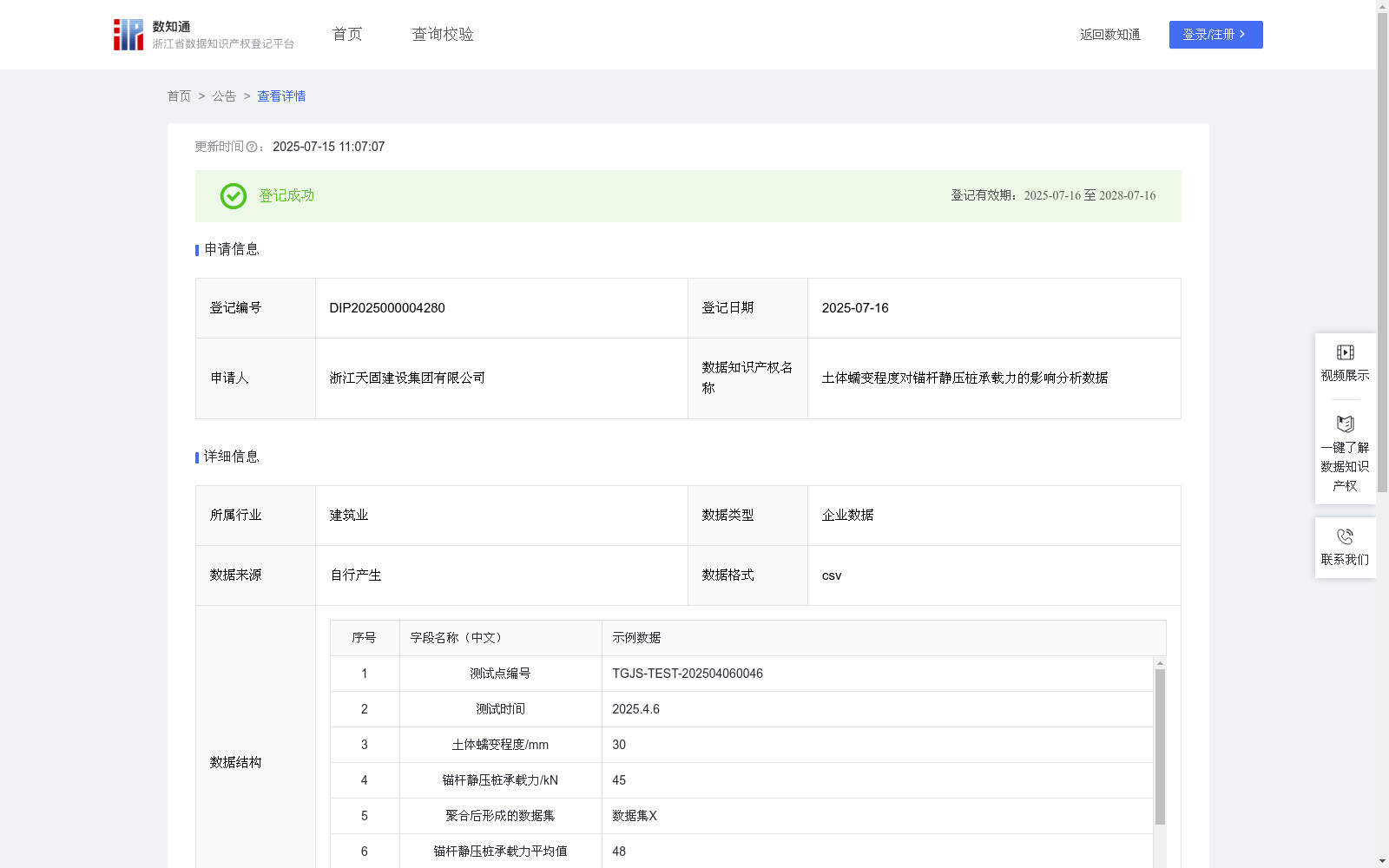
土体蠕变程度对锚杆静压桩承载力的影响分析数据
收藏资源简介:
本数据聚焦于分析土体蠕变程度对锚杆静压桩承载力的影响,揭示了蠕变参数与长期荷载传递、桩土界面强度衰减及结构时效变形之间的量化关系,为公司(作为施工单位)及外部相关方提供了关键的长期性能评估依据,具有重要的工程实践价值。具体体现在以下方面: 1.优化长期荷载设计:施工单位可通过分析不同蠕变程度对锚杆静压桩承载力的影响规律,精准制定蠕变控制标准,在保障结构长期稳定性的同时提高经济效益,从而增强桩基时效性能并减少长期沉降风险。 2.促进蠕变防控技术发展:本数据为岩土工程研究机构及新型材料研发单位提供基础支撑,助力其探究蠕变机理与加固措施的关联机制,推动蠕变抑制材料或智能监测系统在静压桩工程中的应用,实现长期性能与经济性的协同优化,引领桩基工程向长效稳定方向发展。1.数据采集:记录不同土体蠕变程度下的锚杆静压桩承载力测试数据,具体包括测试点编号、测试时间、土体蠕变程度/mm、锚杆静压桩承载力/kN等字段。 2.数据预处理:(1)对采集的数据进行去噪处理,确保数据准确性。(2)把历史采集的数据(包含本次采集)进行聚合,形成数据集X,并针对数据集X中的锚杆静压桩承载力字段,计算出其平均值。 3.计算线性回归斜率a和截距b:基于数据集X(以土体蠕变程度为自变量、锚杆静压桩承载力为因变量),运用SLOPE函数,基于最小二乘法原理确定斜率a,运用INTERCEPT函数确定截距b。斜率a表示单位土体蠕变程度变化对锚杆静压桩承载力的影响程度,截距b表示基准土体蠕变程度下锚杆静压桩承载力。 4.结果运用:(1)计算比例系数k:k=|a/锚杆静压桩承载力平均值|×100%;(2)若k≥10%,则判定为“高影响”,若5%≤k<10%,则判定为“中影响”,若k<5%,则判定为“低影响”。
This dataset focuses on analyzing the impact of soil creep degree on the bearing capacity of static pressure anchor piles, and reveals the quantitative relationship between creep parameters and long-term load transfer, strength attenuation of pile-soil interface, as well as time-dependent deformation of structures. It provides key long-term performance evaluation basis for the company (as a construction contractor) and external relevant parties, and has important engineering practical value. Specifically reflected in the following aspects: 1. Optimize long-term load design: Construction contractors can analyze the influence law of different creep degrees on the bearing capacity of static pressure anchor piles, accurately formulate creep control standards, improve economic benefits while ensuring the long-term stability of structures, thereby enhancing the time-dependent performance of pile foundations and reducing long-term settlement risks. 2. Promote the development of creep prevention and control technologies: This dataset provides basic support for geotechnical engineering research institutions and new material R&D institutions, helping them explore the correlation mechanism between creep mechanism and reinforcement measures, promote the application of creep-inhibiting materials or intelligent monitoring systems in static pressure pile engineering, achieve synergistic optimization of long-term performance and economic efficiency, and lead pile foundation engineering towards long-term stability. 1. Data Collection: Record the test data of bearing capacity of static pressure anchor piles under different soil creep degrees, including fields such as test point number, test time, soil creep degree / mm, and bearing capacity of static pressure anchor pile / kN. 2. Data Preprocessing: (1) Perform denoising processing on the collected data to ensure data accuracy. (2) Aggregate the historically collected data (including this collection) to form dataset X, and calculate the average value of the bearing capacity field of static pressure anchor piles in dataset X. 3. Calculate linear regression slope a and intercept b: Based on dataset X (taking soil creep degree as the independent variable and bearing capacity of static pressure anchor piles as the dependent variable), use the SLOPE function to determine slope a based on the principle of least squares, and use the INTERCEPT function to determine intercept b. Slope a represents the influence degree of unit soil creep degree change on the bearing capacity of static pressure anchor piles, and intercept b represents the bearing capacity of static pressure anchor piles under the reference soil creep degree. 4. Application of Results: (1) Calculate the proportional coefficient k: k = |a / average bearing capacity of static pressure anchor piles| × 100%; (2) If k ≥ 10%, it is classified as "high impact"; if 5% ≤ k < 10%, it is classified as "medium impact"; if k < 5%, it is classified as "low impact".