petaniindo/wnut_17
收藏资源简介:
--- annotations_creators: - crowdsourced language_creators: - found language: - en license: - cc-by-4.0 multilinguality: - monolingual size_categories: - 1K<n<10K source_datasets: - original task_categories: - token-classification task_ids: - named-entity-recognition paperswithcode_id: wnut-2017-emerging-and-rare-entity pretty_name: WNUT 17 dataset_info: features: - name: id dtype: string - name: tokens sequence: string - name: ner_tags sequence: class_label: names: '0': O '1': B-corporation '2': I-corporation '3': B-creative-work '4': I-creative-work '5': B-group '6': I-group '7': B-location '8': I-location '9': B-person '10': I-person '11': B-product '12': I-product config_name: wnut_17 splits: - name: train num_bytes: 1078379 num_examples: 3394 - name: validation num_bytes: 259383 num_examples: 1009 - name: test num_bytes: 405536 num_examples: 1287 download_size: 800955 dataset_size: 1743298 --- # Dataset Card for "wnut_17" ## Table of Contents - [Dataset Description](#dataset-description) - [Dataset Summary](#dataset-summary) - [Supported Tasks and Leaderboards](#supported-tasks-and-leaderboards) - [Languages](#languages) - [Dataset Structure](#dataset-structure) - [Data Instances](#data-instances) - [Data Fields](#data-fields) - [Data Splits](#data-splits) - [Dataset Creation](#dataset-creation) - [Curation Rationale](#curation-rationale) - [Source Data](#source-data) - [Annotations](#annotations) - [Personal and Sensitive Information](#personal-and-sensitive-information) - [Considerations for Using the Data](#considerations-for-using-the-data) - [Social Impact of Dataset](#social-impact-of-dataset) - [Discussion of Biases](#discussion-of-biases) - [Other Known Limitations](#other-known-limitations) - [Additional Information](#additional-information) - [Dataset Curators](#dataset-curators) - [Licensing Information](#licensing-information) - [Citation Information](#citation-information) - [Contributions](#contributions) ## Dataset Description - **Homepage:** [http://noisy-text.github.io/2017/emerging-rare-entities.html](http://noisy-text.github.io/2017/emerging-rare-entities.html) - **Repository:** [More Information Needed](https://github.com/huggingface/datasets/blob/master/CONTRIBUTING.md#how-to-contribute-to-the-dataset-cards) - **Paper:** [More Information Needed](https://github.com/huggingface/datasets/blob/master/CONTRIBUTING.md#how-to-contribute-to-the-dataset-cards) - **Point of Contact:** [More Information Needed](https://github.com/huggingface/datasets/blob/master/CONTRIBUTING.md#how-to-contribute-to-the-dataset-cards) - **Size of downloaded dataset files:** 0.80 MB - **Size of the generated dataset:** 1.74 MB - **Total amount of disk used:** 2.55 MB ### Dataset Summary WNUT 17: Emerging and Rare entity recognition This shared task focuses on identifying unusual, previously-unseen entities in the context of emerging discussions. Named entities form the basis of many modern approaches to other tasks (like event clustering and summarisation), but recall on them is a real problem in noisy text - even among annotators. This drop tends to be due to novel entities and surface forms. Take for example the tweet “so.. kktny in 30 mins?” - even human experts find entity kktny hard to detect and resolve. This task will evaluate the ability to detect and classify novel, emerging, singleton named entities in noisy text. The goal of this task is to provide a definition of emerging and of rare entities, and based on that, also datasets for detecting these entities. ### Supported Tasks and Leaderboards [More Information Needed](https://github.com/huggingface/datasets/blob/master/CONTRIBUTING.md#how-to-contribute-to-the-dataset-cards) ### Languages [More Information Needed](https://github.com/huggingface/datasets/blob/master/CONTRIBUTING.md#how-to-contribute-to-the-dataset-cards) ## Dataset Structure ### Data Instances - **Size of downloaded dataset files:** 0.80 MB - **Size of the generated dataset:** 1.74 MB - **Total amount of disk used:** 2.55 MB An example of 'train' looks as follows. ``` { "id": "0", "ner_tags": [0, 0, 0, 0, 0, 0, 0, 0, 0, 0, 0, 0, 0, 0, 7, 8, 8, 0, 7, 0, 0, 0, 0, 0, 0, 0, 0], "tokens": ["@paulwalk", "It", "'s", "the", "view", "from", "where", "I", "'m", "living", "for", "two", "weeks", ".", "Empire", "State", "Building", "=", "ESB", ".", "Pretty", "bad", "storm", "here", "last", "evening", "."] } ``` ### Data Fields The data fields are the same among all splits: - `id` (`string`): ID of the example. - `tokens` (`list` of `string`): Tokens of the example text. - `ner_tags` (`list` of class labels): NER tags of the tokens (using IOB2 format), with possible values: - 0: `O` - 1: `B-corporation` - 2: `I-corporation` - 3: `B-creative-work` - 4: `I-creative-work` - 5: `B-group` - 6: `I-group` - 7: `B-location` - 8: `I-location` - 9: `B-person` - 10: `I-person` - 11: `B-product` - 12: `I-product` ### Data Splits |train|validation|test| |----:|---------:|---:| | 3394| 1009|1287| ## Dataset Creation ### Curation Rationale [More Information Needed](https://github.com/huggingface/datasets/blob/master/CONTRIBUTING.md#how-to-contribute-to-the-dataset-cards) ### Source Data #### Initial Data Collection and Normalization [More Information Needed](https://github.com/huggingface/datasets/blob/master/CONTRIBUTING.md#how-to-contribute-to-the-dataset-cards) #### Who are the source language producers? [More Information Needed](https://github.com/huggingface/datasets/blob/master/CONTRIBUTING.md#how-to-contribute-to-the-dataset-cards) ### Annotations #### Annotation process [More Information Needed](https://github.com/huggingface/datasets/blob/master/CONTRIBUTING.md#how-to-contribute-to-the-dataset-cards) #### Who are the annotators? [More Information Needed](https://github.com/huggingface/datasets/blob/master/CONTRIBUTING.md#how-to-contribute-to-the-dataset-cards) ### Personal and Sensitive Information [More Information Needed](https://github.com/huggingface/datasets/blob/master/CONTRIBUTING.md#how-to-contribute-to-the-dataset-cards) ## Considerations for Using the Data ### Social Impact of Dataset [More Information Needed](https://github.com/huggingface/datasets/blob/master/CONTRIBUTING.md#how-to-contribute-to-the-dataset-cards) ### Discussion of Biases [More Information Needed](https://github.com/huggingface/datasets/blob/master/CONTRIBUTING.md#how-to-contribute-to-the-dataset-cards) ### Other Known Limitations [More Information Needed](https://github.com/huggingface/datasets/blob/master/CONTRIBUTING.md#how-to-contribute-to-the-dataset-cards) ## Additional Information ### Dataset Curators [More Information Needed](https://github.com/huggingface/datasets/blob/master/CONTRIBUTING.md#how-to-contribute-to-the-dataset-cards) ### Licensing Information [More Information Needed](https://github.com/huggingface/datasets/blob/master/CONTRIBUTING.md#how-to-contribute-to-the-dataset-cards) ### Citation Information ``` @inproceedings{derczynski-etal-2017-results, title = "Results of the {WNUT}2017 Shared Task on Novel and Emerging Entity Recognition", author = "Derczynski, Leon and Nichols, Eric and van Erp, Marieke and Limsopatham, Nut", booktitle = "Proceedings of the 3rd Workshop on Noisy User-generated Text", month = sep, year = "2017", address = "Copenhagen, Denmark", publisher = "Association for Computational Linguistics", url = "https://www.aclweb.org/anthology/W17-4418", doi = "10.18653/v1/W17-4418", pages = "140--147", abstract = "This shared task focuses on identifying unusual, previously-unseen entities in the context of emerging discussions. Named entities form the basis of many modern approaches to other tasks (like event clustering and summarization), but recall on them is a real problem in noisy text - even among annotators. This drop tends to be due to novel entities and surface forms. Take for example the tweet {``}so.. kktny in 30 mins?!{''} {--} even human experts find the entity {`}kktny{'} hard to detect and resolve. The goal of this task is to provide a definition of emerging and of rare entities, and based on that, also datasets for detecting these entities. The task as described in this paper evaluated the ability of participating entries to detect and classify novel and emerging named entities in noisy text.", } ``` ### Contributions Thanks to [@thomwolf](https://github.com/thomwolf), [@lhoestq](https://github.com/lhoestq), [@stefan-it](https://github.com/stefan-it), [@lewtun](https://github.com/lewtun), [@jplu](https://github.com/jplu) for adding this dataset.
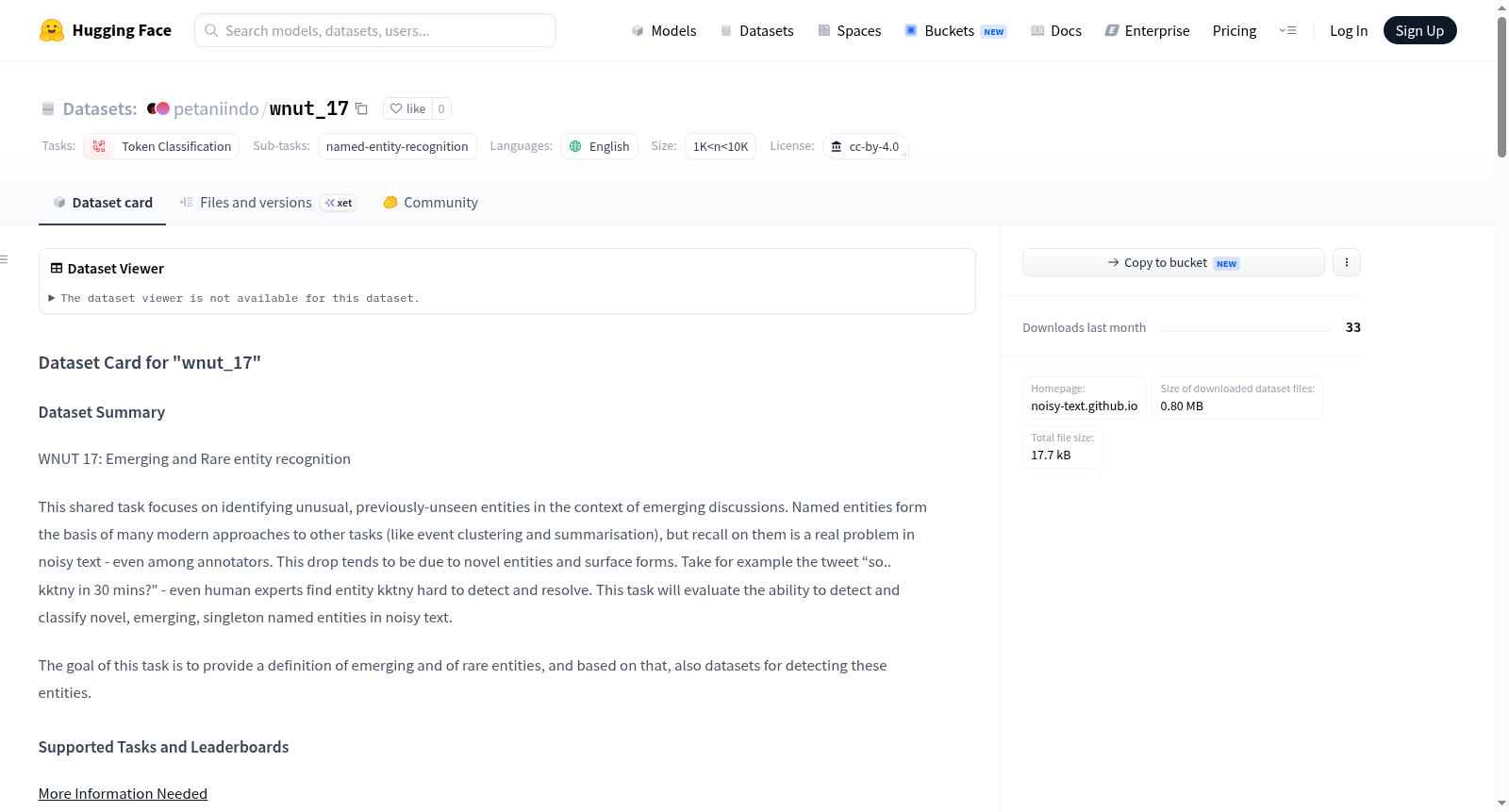
WNUT 17: Emerging and Rare entity recognition. This shared task focuses on identifying unusual, previously-unseen entities in the context of emerging discussions. Named entities form the basis of many modern approaches to other tasks (like event clustering and summarisation), but recall on them is a real problem in noisy text - even among annotators. This drop tends to be due to novel entities and surface forms. Take for example the tweet so.. kktny in 30 mins? - even human experts find entity kktny hard to detect and resolve. This task will evaluate the ability to detect and classify novel, emerging, singleton named entities in noisy text. The goal of this task is to provide a definition of emerging and of rare entities, and based on that, also datasets for detecting these entities.