
dougtrajano/olid-br
收藏Hugging Face2023-07-13 更新2024-03-04 收录
下载链接:
https://hf-mirror.com/datasets/dougtrajano/olid-br
下载链接
链接失效反馈资源简介:
---
language: pt
license: cc-by-4.0
dataset_info:
features:
- name: id
dtype: string
- name: text
dtype: string
- name: is_offensive
dtype: string
- name: is_targeted
dtype: string
- name: targeted_type
dtype: string
- name: toxic_spans
sequence: int64
- name: health
dtype: bool
- name: ideology
dtype: bool
- name: insult
dtype: bool
- name: lgbtqphobia
dtype: bool
- name: other_lifestyle
dtype: bool
- name: physical_aspects
dtype: bool
- name: profanity_obscene
dtype: bool
- name: racism
dtype: bool
- name: religious_intolerance
dtype: bool
- name: sexism
dtype: bool
- name: xenophobia
dtype: bool
splits:
- name: train
num_bytes: 1763684
num_examples: 5214
- name: test
num_bytes: 590953
num_examples: 1738
download_size: 1011742
dataset_size: 2354637
---
# OLID-BR
Offensive Language Identification Dataset for Brazilian Portuguese (OLID-BR) is a dataset with multi-task annotations for the detection of offensive language.
The current version (v1.0) contains **7,943** (extendable to 13,538) comments from different sources, including social media (YouTube and Twitter) and related datasets.
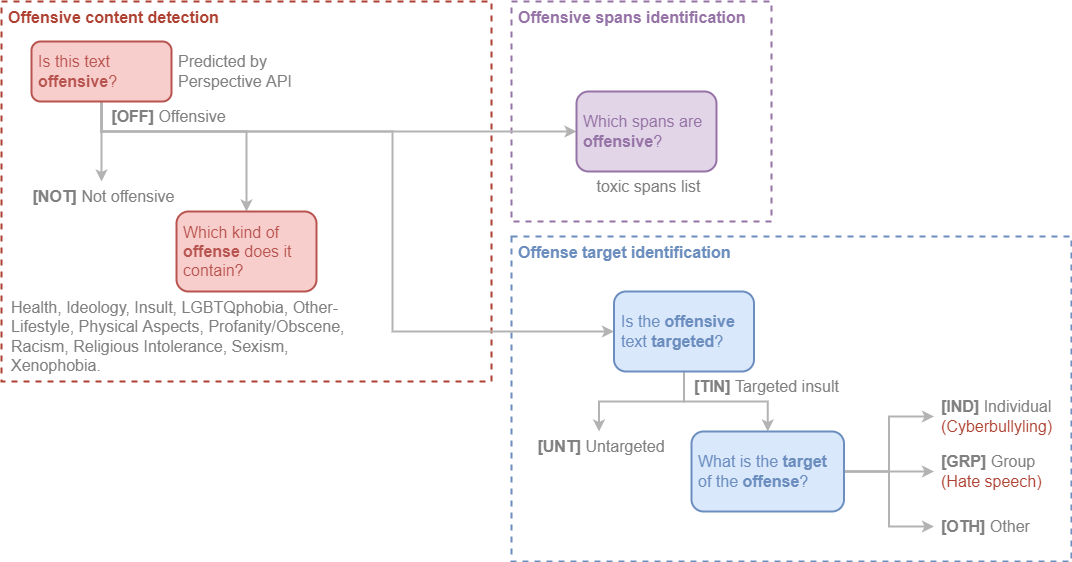
OLID-BR contains a collection of annotated sentences in Brazilian Portuguese using an annotation model that encompasses the following levels:
- [Offensive content detection](#offensive-content-detection): Detect offensive content in sentences and categorize it.
- [Offense target identification](#offense-target-identification): Detect if an offensive sentence is targeted to a person or group of people.
- [Offensive spans identification](#offensive-spans-identification): Detect curse words in sentences.
## Categorization
### Offensive Content Detection
This level is used to detect offensive content in the sentence.
**Is this text offensive?**
We use the [Perspective API](https://www.perspectiveapi.com/) to detect if the sentence contains offensive content with double-checking by our [qualified annotators](annotation/index.en.md#who-are-qualified-annotators).
- `OFF` Offensive: Inappropriate language, insults, or threats.
- `NOT` Not offensive: No offense or profanity.
**Which kind of offense does it contain?**
The following labels were tagged by our annotators:
`Health`, `Ideology`, `Insult`, `LGBTQphobia`, `Other-Lifestyle`, `Physical Aspects`, `Profanity/Obscene`, `Racism`, `Religious Intolerance`, `Sexism`, and `Xenophobia`.
See the [**Glossary**](glossary.en.md) for further information.
### Offense Target Identification
This level is used to detect if an offensive sentence is targeted to a person or group of people.
**Is the offensive text targeted?**
- `TIN` Targeted Insult: Targeted insult or threat towards an individual, a group or other.
- `UNT` Untargeted: Non-targeted profanity and swearing.
**What is the target of the offense?**
- `IND` The offense targets an individual, often defined as “cyberbullying”.
- `GRP` The offense targets a group of people based on ethnicity, gender, sexual
- `OTH` The target can belong to other categories, such as an organization, an event, an issue, etc.
### Offensive Spans Identification
As toxic spans, we define a sequence of words that attribute to the text's toxicity.
For example, let's consider the following text:
> "USER `Canalha` URL"
The toxic spans are:
```python
[5, 6, 7, 8, 9, 10, 11, 12, 13]
```
## Dataset Structure
### Data Instances
Each instance is a social media comment with a corresponding ID and annotations for all the tasks described below.
### Data Fields
The simplified configuration includes:
- `id` (string): Unique identifier of the instance.
- `text` (string): The text of the instance.
- `is_offensive` (string): Whether the text is offensive (`OFF`) or not (`NOT`).
- `is_targeted` (string): Whether the text is targeted (`TIN`) or untargeted (`UNT`).
- `targeted_type` (string): Type of the target (individual `IND`, group `GRP`, or other `OTH`). Only available if `is_targeted` is `True`.
- `toxic_spans` (string): List of toxic spans.
- `health` (boolean): Whether the text contains hate speech based on health conditions such as disability, disease, etc.
- `ideology` (boolean): Indicates if the text contains hate speech based on a person's ideas or beliefs.
- `insult` (boolean): Whether the text contains insult, inflammatory, or provocative content.
- `lgbtqphobia` (boolean): Whether the text contains harmful content related to gender identity or sexual orientation.
- `other_lifestyle` (boolean): Whether the text contains hate speech related to life habits (e.g. veganism, vegetarianism, etc.).
- `physical_aspects` (boolean): Whether the text contains hate speech related to physical appearance.
- `profanity_obscene` (boolean): Whether the text contains profanity or obscene content.
- `racism` (boolean): Whether the text contains prejudiced thoughts or discriminatory actions based on differences in race/ethnicity.
- `religious_intolerance` (boolean): Whether the text contains religious intolerance.
- `sexism` (boolean): Whether the text contains discriminatory content based on differences in sex/gender (e.g. sexism, misogyny, etc.).
- `xenophobia` (boolean): Whether the text contains hate speech against foreigners.
See the [**Get Started**](get-started.en.md) page for more information.
## Considerations for Using the Data
### Social Impact of Dataset
Toxicity detection is a worthwhile problem that can ensure a safer online environment for everyone.
However, toxicity detection algorithms have focused on English and do not consider the specificities of other languages.
This is a problem because the toxicity of a comment can be different in different languages.
Additionally, the toxicity detection algorithms focus on the binary classification of a comment as toxic or not toxic.
Therefore, we believe that the OLID-BR dataset can help to improve the performance of toxicity detection algorithms in Brazilian Portuguese.
### Discussion of Biases
We are aware that the dataset contains biases and is not representative of global diversity.
We are aware that the language used in the dataset could not represent the language used in different contexts.
Potential biases in the data include: Inherent biases in the social media and user base biases, the offensive/vulgar word lists used for data filtering, and inherent or unconscious bias in the assessment of offensive identity labels.
All these likely affect labeling, precision, and recall for a trained model.
## Citation
Pending
提供机构:
dougtrajano
原始信息汇总
OLID-BR 数据集概述
数据集描述
OLID-BR(Offensive Language Identification Dataset for Brazilian Portuguese)是一个用于检测巴西葡萄牙语中冒犯性语言的多任务标注数据集。当前版本(v1.0)包含7,943条(可扩展至13,538条)来自不同来源的评论,包括社交媒体(YouTube和Twitter)及相关数据集。
数据集结构
特征
id(string): 实例的唯一标识符。text(string): 实例的文本内容。is_offensive(string): 文本是否具有冒犯性(OFF表示冒犯性,NOT表示非冒犯性)。is_targeted(string): 文本是否针对特定对象(TIN表示针对,UNT表示非针对)。targeted_type(string): 目标类型(IND表示个人,GRP表示群体,OTH表示其他)。仅在is_targeted为True时可用。toxic_spans(string): 有毒词汇的序列。health(boolean): 文本是否包含基于健康状况的仇恨言论。ideology(boolean): 文本是否包含基于个人思想或信仰的仇恨言论。insult(boolean): 文本是否包含侮辱性、煽动性或挑衅性内容。lgbtqphobia(boolean): 文本是否包含与性别身份或性取向相关的有害内容。other_lifestyle(boolean): 文本是否包含与生活习惯相关的仇恨言论。physical_aspects(boolean): 文本是否包含基于身体外貌的仇恨言论。profanity_obscene(boolean): 文本是否包含亵渎或猥亵内容。racism(boolean): 文本是否包含基于种族/民族差异的偏见或歧视行为。religious_intolerance(boolean): 文本是否包含宗教不容忍内容。sexism(boolean): 文本是否包含基于性别差异的歧视内容。xenophobia(boolean): 文本是否包含对外国人的仇恨言论。
数据分割
train:包含5,214个样本,大小为1,763,684字节。test:包含1,738个样本,大小为590,953字节。
数据集大小
- 下载大小:1,011,742字节
- 数据集大小:2,354,637字节
数据集分类
冒犯性内容检测
用于检测句子中的冒犯性内容。
OFF:冒犯性内容,包括不当语言、侮辱或威胁。NOT:非冒犯性内容,无冒犯或亵渎。
冒犯目标识别
用于检测冒犯性句子是否针对个人或群体。
TIN:针对特定对象的侮辱或威胁。UNT:非针对特定对象的亵渎和咒骂。
冒犯性词汇识别
定义为文本中具有毒性的词汇序列。
数据集使用考虑
数据集的社会影响
毒性检测是一个有价值的问题,可以确保更安全的在线环境。然而,现有的毒性检测算法主要关注英语,并未考虑其他语言的特定性。OLID-BR数据集有助于提高巴西葡萄牙语中毒性检测算法的性能。
偏见讨论
数据集包含潜在偏见,可能影响标签、精确度和召回率。偏见来源包括社交媒体和用户基础的固有偏见、用于数据过滤的冒犯/粗俗词汇列表以及对冒犯性身份标签评估中的固有或无意识偏见。



