
山地生态养殖场狼图像识别AI训练数据
收藏浙江省数据知识产权登记平台2025-03-04 更新2025-03-05 收录
下载链接:
https://www.zjip.org.cn/home/announce/trends/115391
下载链接
链接失效反馈官方服务:
资源简介:
山地生态养殖场狼图像识别AI训练数据的应用场景主要集中在提升AI模型对狼行为的识别能力和准确度。通过对这些数据的训练,AI模型能够更有效地识别山地生态养殖场及其周边范围内的狼活动,从而为养殖场的管理和动物保护提供强有力的支持。可以实时监测养殖场周边的狼活动,识别其入侵行为,及时发现潜在的威胁,保护养殖动物的安全,减少经济损失;动物保护,通过识别狼的活动模式,模型能够提供科学依据,有助于制定相应的保护策略,比如识别出狼聚集的高风险区域,从而在这些区域采取合理的干预措施,维护生态平衡;通过收集和分析狼活动的数据,管理者可以依据实际情况进行优化决策,例如在狼频繁出没的区域加强监控或设立防护措施,从而提高养殖场的整体安全性;通过训练,能够在不同光照、天气条件及复杂背景下,准确识别狼的活动,这种适应性提升使得AI模型在真实环境中更具实用性,能够应对多变的自然条件。一、数据采集:通过Royalty-free公开图像数据库及自行拍摄,收集所需图像,并记录每张图像的图像ID和文件路径。每条记录包含图像分类、边界框、分割掩码及模型训练的多种信息。 二、算法工作流程: 数据准备:从指定路径读取图像数据,并提取相关信息。 模型训练:基于卷积神经网络(Convolutional Neural Network, CNN)的深度学习方法,使用标记的图像数据进行训练。此过程中通过调整模型参数,减少训练损失。在每个Epoch结束时记录训练损失和精度。 模型评估:通过验证集评估模型性能,记录验证损失和精度。 指标计算:计算F1分数、精确率和召回率,并生成混淆矩阵和AUC值。 结果分析:通过收集的各种指标,分析模型的优缺点,优化算法参数,提高识别精度。 三、该数据结构与算法规则为图像识别和分类任务提供了一种系统化的方法。通过有效管理和分析数据,可以提高模型性能。通过不断迭代和优化训练过程,可以实现更高的准确率和更好的模型泛化能力。
The application scenarios of the wolf image recognition AI training dataset for mountain ecological breeding farms mainly focus on improving the recognition capability and accuracy of AI models for wolf behaviors. Through training on this dataset, AI models can more effectively identify wolf activities within and around mountain ecological breeding farms, thereby providing strong support for farm management and wildlife conservation.
1. Real-time monitoring of wolf activities around the farm to identify intrusion behaviors, detect potential threats in a timely manner, protect the safety of farmed animals and reduce economic losses;
2. Wildlife conservation: By identifying wolf activity patterns, the model can provide scientific basis for formulating corresponding conservation strategies, such as identifying high-risk areas where wolves gather, so as to take reasonable intervention measures in these areas and maintain ecological balance;
3. Optimized decision-making for managers: By collecting and analyzing wolf activity data, managers can make optimized decisions based on actual conditions, such as strengthening monitoring or setting up protective measures in areas where wolves frequently appear, thereby improving the overall safety of the farm;
4. Environmental adaptability: The model can accurately identify wolf activities under different lighting, weather conditions and complex backgrounds. This improved adaptability makes the AI model more practical in real-world environments and capable of coping with changing natural conditions.
1. Data Collection: Images are collected from royalty-free public image databases and self-captured materials, with the image ID and file path recorded for each image. Each record contains information such as image classification, bounding boxes, segmentation masks, and various details required for model training.
2. Algorithm Workflow:
1. Data Preparation: Read image data from the specified path and extract relevant information.
2. Model Training: Adopt a deep learning method based on Convolutional Neural Network (CNN) and train using labeled image data. During this process, model parameters are adjusted to reduce training loss, and training loss and accuracy are recorded at the end of each Epoch.
3. Model Evaluation: Evaluate model performance using the validation set, and record validation loss and accuracy.
4. Metric Calculation: Calculate F1 score, precision, recall and generate confusion matrix and AUC value.
5. Result Analysis: Analyze the advantages and disadvantages of the model using various collected metrics, optimize algorithm parameters, and improve recognition accuracy.
This dataset structure and algorithm workflow provide a systematic approach for image recognition and classification tasks. Effective data management and analysis can improve model performance. Through continuous iteration and optimization of the training process, higher accuracy and better model generalization ability can be achieved.
提供机构:
宁波设会物联网科技有限公司
创建时间:
2024-11-30
搜集汇总
数据集介绍
特点
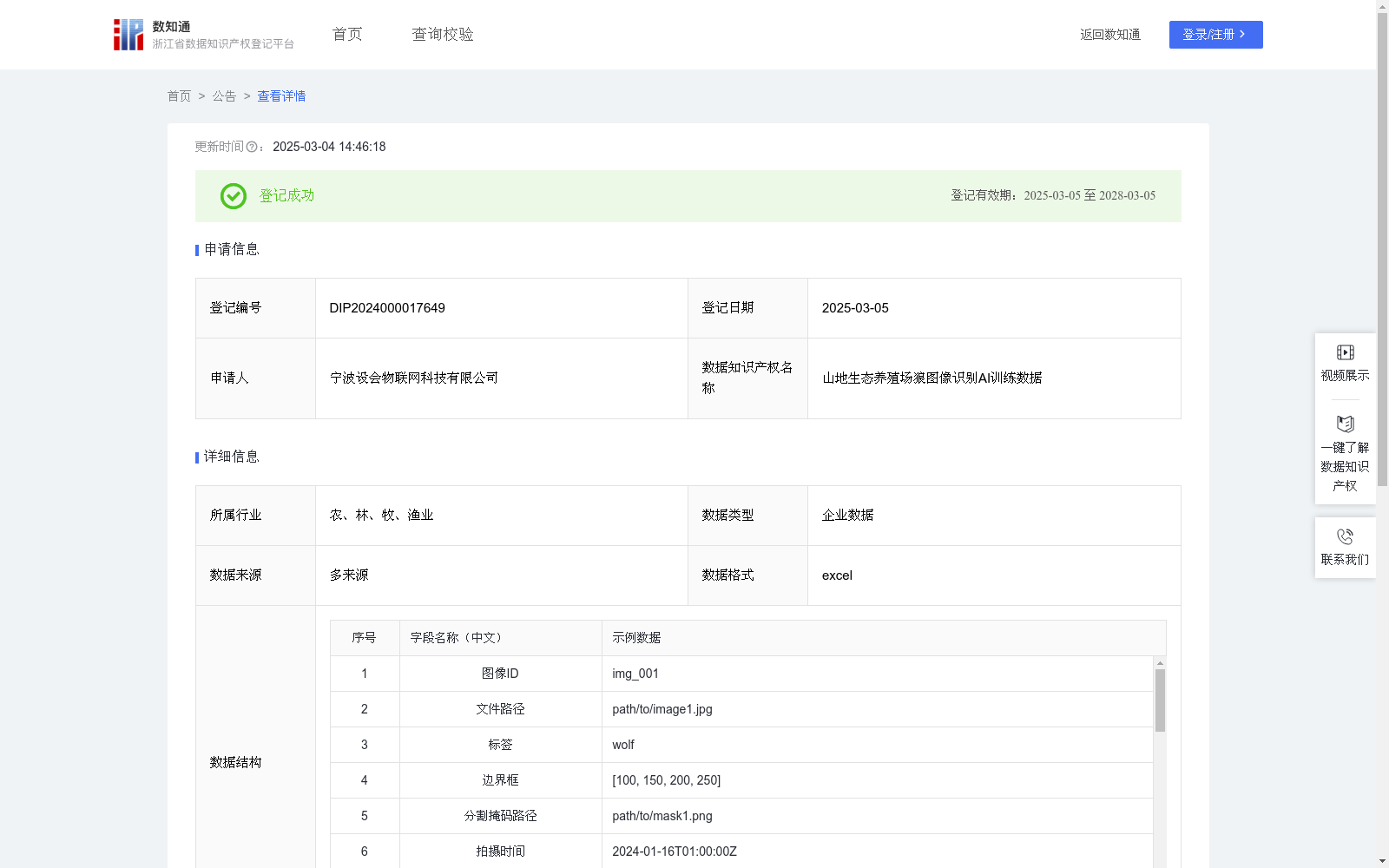
该数据集为山地生态养殖场狼图像识别AI训练数据,包含1888条数据,每年更新一次,主要用于提升AI模型对狼行为的识别能力和准确度。数据格式为excel,数据结构包含图像ID、文件路径、标签等多种信息,算法规则基于卷积神经网络(CNN)的深度学习方法。
以上内容由遇见数据集搜集并总结生成



