
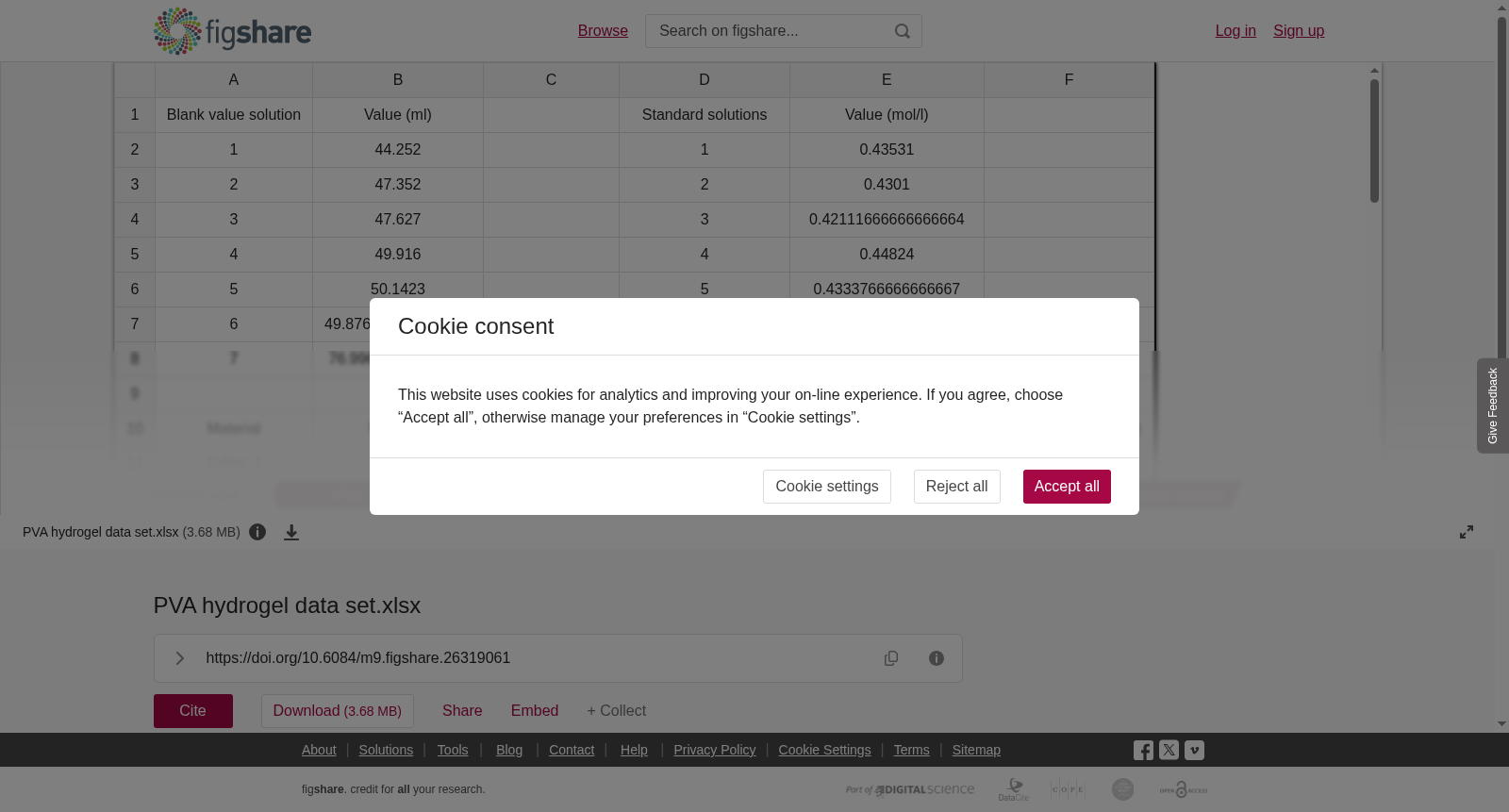
PVA hydrogel data set.xlsx
收藏DataCite Commons2025-06-01 更新2024-08-19 收录
下载链接:
https://figshare.com/articles/dataset/PVA_hydrogel_data_set_xlsx/26319061/1
下载链接
链接失效反馈官方服务:
资源简介:
Hydrogel materials have a variety of applications, ranging from biomedical materials tissues and drug delivery systems, to their employment as immobilisation matrices in bioprocessing applications. Polyvinyl alcohol (PVA) is a synthetic, water-soluble and biocompatible polymer denoted by the general formula [CH2CH(OH)]n. Due to its physical properties when gelled, this polymer has been highlighted itself as a suitable candidate for application in the bioprocessing industry as an immobilisation matrix for microorganisms. This study aims to investigates the effects which of using various polyols as co-solvent have on the gelation of PVA-based hydrogels formed at ambient conditions, and their resulting properties. In addition to glycerol, previously known for its capabilities to induce improve gelation when used as co-solvent, polyols including erythritol (C4H10O4), xylitol (C5H12O5) and sorbitol (C6H14O6) were investigated. The key physical properties of these the resulting PVA-based hydrogels were investigated, including: transparency; tensile and compressive strengths; diffusion coefficients; rates of gelation; and method of gelation. It was determined that these hydrogels are formed through physical crosslinking rather than chemical crosslinking. The glycerol-PVA hydrogels tended to exhibit more suitable properties for application in the immobilisation of photosynthetic organisms, although the difference in properties between the glycerol-PVA, xylitol-PVA and sorbitol-PVA hydrogels were comparable and often not significantly different after rehydration. This investigation showed that through the addition of simple polyols, solid PVA-based hydrogels could be formed at ambient conditions without the requirement of toxic cytotoxic chemicals, harsh gelation conditions or unfavourable intermediate chemicals.
水凝胶材料应用场景广泛,涵盖生物医用组织材料、药物递送系统,以及作为固定化基质(immobilisation matrix)应用于生物加工领域。聚乙烯醇(PVA)是一种合成型水溶性生物相容性聚合物,通用分子式为[CH₂CH(OH)]ₙ。鉴于其凝胶态下的物理特性,该聚合物被视作生物加工工业中用于微生物固定化的理想载体材料。
本研究旨在探究多种多元醇(polyols)作为助溶剂时,对常温条件下制备的聚乙烯醇基水凝胶凝胶过程及其最终性能的影响。除此前已被证实可改善凝胶效果的甘油外,本次研究还考察了赤藓糖醇(C₄H₁₀O₄)、木糖醇(C₅H₁₂O₅)与山梨糖醇(C₆H₁₄O₆)等多元醇。
研究人员对所得聚乙烯醇基水凝胶的关键物理性能进行了表征,包括透明度、拉伸与压缩强度、扩散系数、凝胶速率及凝胶形成机制。经测定,此类水凝胶通过物理交联而非化学交联方式形成。
甘油-聚乙烯醇水凝胶在用于光合生物固定化的应用中表现出更适配的综合性能,不过甘油-聚乙烯醇、木糖醇-聚乙烯醇与山梨糖醇-聚乙烯醇三类水凝胶的性能差异较小,复水后通常无统计学显著性差异。
本研究表明,通过添加简单多元醇,可在常温条件下制备固态聚乙烯醇基水凝胶,无需使用有毒细胞毒性化学试剂、苛刻的凝胶制备条件或不适宜的中间化学品。
提供机构:
figshare
创建时间:
2024-07-17
搜集汇总
数据集介绍
背景与挑战
背景概述
该数据集包含PVA基水凝胶在不同多元醇共溶剂条件下的物理性质研究数据,重点比较了甘油、赤藓糖醇等对水凝胶性能的影响,包括透明度、机械强度和扩散特性等关键参数。研究表明这些水凝胶通过物理交联形成,无需使用有毒化学物质。
以上内容由遇见数据集搜集并总结生成



