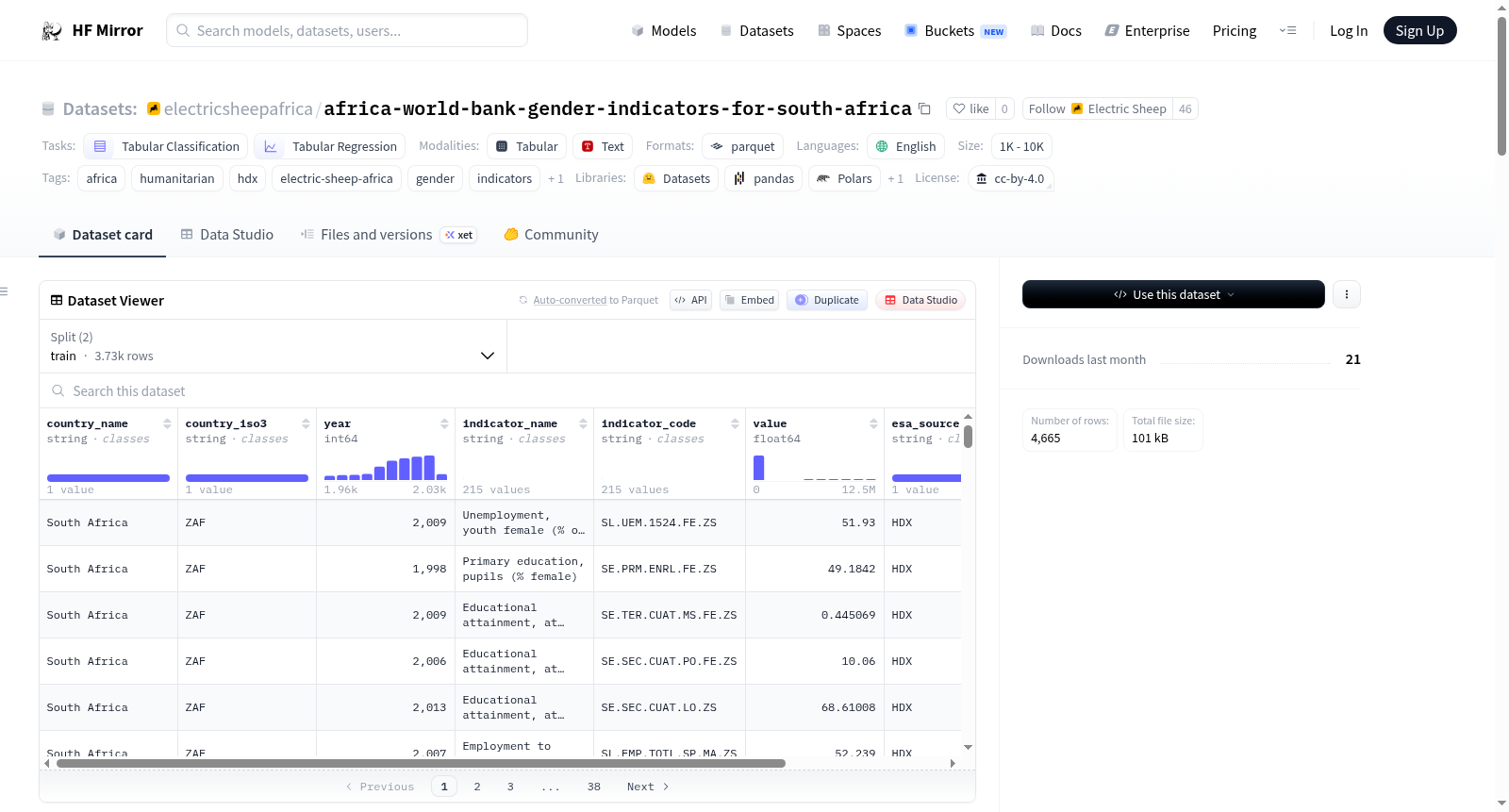
electricsheepafrica/africa-world-bank-gender-indicators-for-south-africa
收藏资源简介:
--- annotations_creators: - no-annotation language_creators: - found language: - en license: cc-by-4.0 multilinguality: - monolingual size_categories: - 1K<n<10K source_datasets: - original task_categories: - tabular-classification - tabular-regression task_ids: [] tags: - africa - humanitarian - hdx - electric-sheep-africa - gender - indicators - zaf pretty_name: "South Africa - Gender" dataset_info: splits: - name: train num_examples: 3732 - name: test num_examples: 933 --- # South Africa - Gender **Publisher:** World Bank Group · **Source:** [HDX](https://data.humdata.org/dataset/world-bank-gender-indicators-for-south-africa) · **License:** `cc-by` · **Updated:** 2026-03-27 --- ## Abstract Contains data from the World Bank's [data portal](http://data.worldbank.org/). There is also a [consolidated country dataset](https://data.humdata.org/dataset/world-bank-combined-indicators-for-south-africa) on HDX. Gender equality is a core development objective in its own right. It is also smart development policy and sound business practice. It is integral to economic growth, business growth and good development outcomes. Gender equality can boost productivity, enhance prospects for the next generation, build resilience, and make institutions more representative and effective. In December 2015, the World Bank Group Board discussed our new Gender Equality Strategy 2016-2023, which aims to address persistent gaps and proposed a sharpened focus on more and better gender data. The Bank Group is continually scaling up commitments and expanding partnerships to fill significant gaps in gender data. The database hosts the latest sex-disaggregated data and gender statistics covering demography, education, health, access to economic opportunities, public life and decision-making, and agency. Each row in this dataset represents country-level aggregates. Data was last updated on HDX on 2026-03-27. Geographic scope: **ZAF**. *Curated into ML-ready Parquet format by [Electric Sheep Africa](https://huggingface.co/electricsheepafrica).* --- ## Dataset Characteristics | | | |---|---| | **Domain** | Public health | | **Unit of observation** | Country-level aggregates | | **Rows (total)** | 4,665 | | **Columns** | 8 (2 numeric, 6 categorical, 0 datetime) | | **Train split** | 3,732 rows | | **Test split** | 933 rows | | **Geographic scope** | ZAF | | **Publisher** | World Bank Group | | **HDX last updated** | 2026-03-27 | --- ## Variables **Geographic** — `country_name` (South Africa), `country_iso3` (ZAF), `year` (range 1960.0–2025.0). **Outcome / Measurement** — `value` (range 0.0–12450162.0). **Identifier / Metadata** — `indicator_name` (Age population, age 01, male, Age population, age 02, female, Age population, age 00, female), `indicator_code` (SP.POP.AG01.MA.IN, SP.POP.AG02.FE.IN, SP.POP.AG00.FE.IN), `esa_source` (HDX), `esa_processed` (2026-04-11). --- ## Quick Start ```python from datasets import load_dataset ds = load_dataset("electricsheepafrica/africa-world-bank-gender-indicators-for-south-africa") train = ds["train"].to_pandas() test = ds["test"].to_pandas() print(train.shape) train.head() ``` --- ## Schema | Column | Type | Null % | Range / Sample Values | |---|---|---|---| | `country_name` | object | 0.0% | South Africa | | `country_iso3` | object | 0.0% | ZAF | | `year` | int64 | 0.0% | 1960.0 – 2025.0 (mean 2002.5501) | | `indicator_name` | object | 0.0% | Age population, age 01, male, Age population, age 02, female, Age population, age 00, female | | `indicator_code` | object | 0.0% | SP.POP.AG01.MA.IN, SP.POP.AG02.FE.IN, SP.POP.AG00.FE.IN | | `value` | float64 | 0.0% | 0.0 – 12450162.0 (mean 152846.1729) | | `esa_source` | object | 0.0% | HDX | | `esa_processed` | object | 0.0% | 2026-04-11 | --- ## Numeric Summary | Column | Min | Max | Mean | Median | |---|---|---|---|---| | `year` | 1960.0 | 2025.0 | 2002.5501 | 2005.0 | | `value` | 0.0 | 12450162.0 | 152846.1729 | 51.384 | --- ## Curation Raw data was downloaded from HDX via the CKAN API and converted to Parquet. Column names were lowercased and standardised to snake_case. Common missing-value markers (`N/A`, `null`, `none`, `-`, `unknown`, `no data`, `#N/A`) were unified to `NaN`. The dataset was split 80/20 into train and test partitions using a fixed random seed (42) and saved as Snappy-compressed Parquet. --- ## Limitations - Data originates from World Bank Group and has not been independently validated by ESA. - Automated cleaning cannot correct for misreported values, definitional inconsistencies, or sampling bias in the original collection. - Refer to the [original HDX dataset page](https://data.humdata.org/dataset/world-bank-gender-indicators-for-south-africa) for the publisher's own methodology notes and caveats. --- ## Citation ```bibtex @dataset{hdx_africa_world_bank_gender_indicators_for_south_africa, title = {South Africa - Gender}, author = {World Bank Group}, year = {2026}, url = {https://data.humdata.org/dataset/world-bank-gender-indicators-for-south-africa}, note = {Repackaged for machine learning by Electric Sheep Africa (https://huggingface.co/electricsheepafrica)} } ``` --- *[Electric Sheep Africa](https://huggingface.co/electricsheepafrica) — Africa's ML dataset infrastructure. Lagos, Nigeria.*