
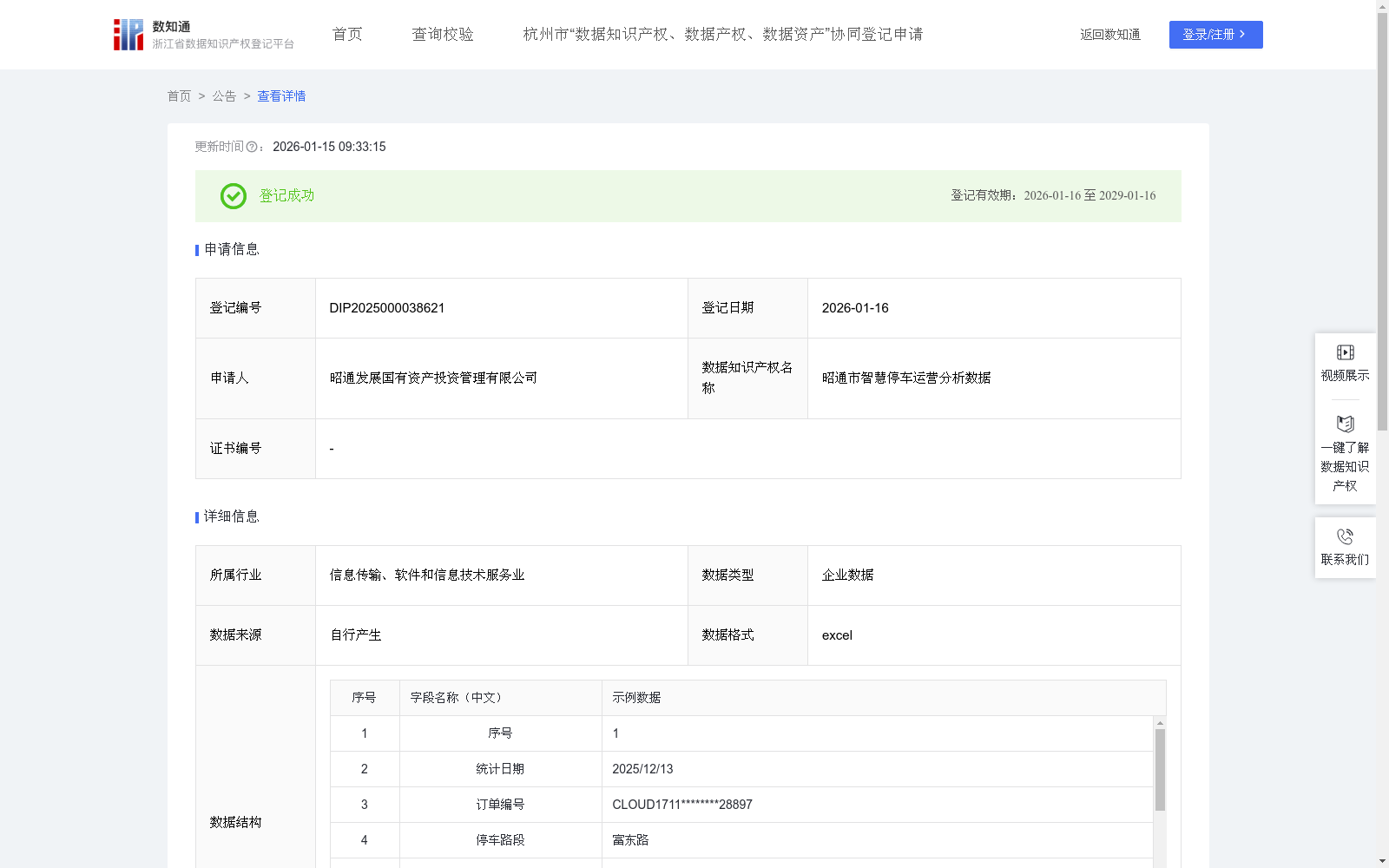
昭通市智慧停车运营分析数据
收藏浙江省数据知识产权登记平台2026-01-15 更新2026-01-16 收录
下载链接:
https://www.zjip.org.cn/home/announce/trends/8423657
下载链接
链接失效反馈官方服务:
资源简介:
1.停车资源效能评估:通过周转率、有效周转率、利用率衡量泊位使用效率,协同系数进一步判断周转与有效利用匹配度,助力精准定位资源闲置或供需失衡问题,为资源优化配置提供依据;2.静态交通规划:基于总停车时长、路段平均停车时长等数据,结合入车流量(次)、出车流量(次)反映昭阳区动静态交通需求的时空分布特征,解决规划部门、研究机构数据缺失,助力布局停车场与泊位;3.交通管理决策辅助:提供周转率、协同系数,借此识别周转与利用失衡路段,针对性制定管控策略,盘活存量资源;为综合执法局、交警等提供动静态交通管理数据支撑;4.停车运营优化:借助免费订单总停车次数、收费订单总停车次数、路段平均停车时长、订单金额数据辅助优化定价与免费规则,提升运营效率与营收。数据获取和预处理:前端感知设备抓拍车辆入场和出场数据,上报至停车运营平台,由停车运营平台调用车位映射关系,自动组装成一条完整的停车记录,具体数据字段包括订单编号、停车路段、入车时间、出车时间、累计停车时长(分钟)、订单金额(元)。对获取的数据进行加工清洗,数据字段包括路段平均停车时长、周转率、有效周转率、入车流量(次)、出车流量(次)、利用率、协同系数。
路段平均停车时长(分钟)=累计车时长(分钟)/(免费订单总停车次数+收费订单总停车次数),该指标用于衡量某路段车辆平均占用车位的时间特征,刻画停车行为规律,为车位流转调控、商业策略制定提供依据。
周转率(次/个)=(免费订单总停车次数+收费订单总停车次数)/总车位数。反映单位车位统计周期内的使用总次数,是判断车位活跃度与跨区域效率对比的核心依据。
有效周转率(次/个)=收费订单总停车次数/总车位数。聚焦产生营收的收费订单,衡量车位的商业运营效益与有效经济周转能力,是停车场营收评估的核心指标。
利用率=累计车时长(分钟)/(统计日期的时长*总车位数),按日统计时时长为24*60=1440(分钟),按月、年统计时以此类推,计算结果保留两位小数四舍五入。用于衡量车位时间占用程度,反映统计周期内车位实际被占用的时间占比,评估车位饱和度与资源闲置状态。
协同系数=周转率/有效周转率×利用率,衡量车位周转效率与有效利用程度的匹配度。
1. Parking Resource Efficiency Evaluation: Measure the usage efficiency of parking spaces via turnover rate, effective turnover rate and utilization rate, and further judge the matching degree between turnover and effective utilization via the coordination coefficient, so as to accurately locate resource idleness or supply-demand imbalance problems and provide a basis for optimal allocation of resources.
2. Static Traffic Planning: Based on data such as total parking duration and average parking duration per section, combined with inbound traffic volume (times) and outbound traffic volume (times) to reflect the spatiotemporal distribution characteristics of dynamic and static traffic demand in Zhaoyang District, this module solves the data shortage of planning departments and research institutions, and facilitates the layout of parking lots and parking spaces.
3. Traffic Management Decision Support: Provide turnover rate and coordination coefficient to identify sections with unbalanced turnover and utilization, formulate targeted control strategies to revitalize stock resources, and provide data support for dynamic and static traffic management for comprehensive law enforcement bureaus, traffic police and other relevant departments.
4. Parking Operation Optimization: Use data such as total free order parking times, total paid order parking times, average parking duration per section and order amount to assist in optimizing pricing and free parking rules, so as to improve operational efficiency and revenue.
Data Acquisition and Preprocessing: Front-end sensing devices capture vehicle entry and exit data, and report them to the parking operation platform. The platform calls the parking space mapping relationship to automatically assemble a complete parking record. The specific original data fields include "order number", "parking section", "entry time", "exit time", "cumulative parking duration (minutes)", and "order amount (yuan)". The acquired data is processed and cleaned, and the processed data fields include average parking duration per section, turnover rate, effective turnover rate, inbound traffic volume (times), outbound traffic volume (times), utilization rate and coordination coefficient.
Average parking duration per section (minutes) = cumulative parking duration (minutes) / (total number of free order parking times + total number of paid order parking times). This indicator is used to measure the average parking time occupied by vehicles on a certain section, characterize the parking behavior pattern, and provide a basis for parking space flow regulation and business strategy formulation.
Turnover rate (times/unit) = (total number of free order parking times + total number of paid order parking times) / total number of parking spaces. It reflects the total number of uses per parking space within the statistical cycle, and is the core basis for judging parking space activity and cross-regional efficiency comparison.
Effective turnover rate (times/unit) = total number of paid order parking times / total number of parking spaces. It focuses on paid orders that generate revenue, measures the commercial operating efficiency and effective economic turnover capability of parking spaces, and is a core indicator for parking lot revenue evaluation.
Utilization rate = cumulative parking duration (minutes) / (statistical period duration × total number of parking spaces). The daily statistical period duration is 24×60=1440 (minutes), and the same rule applies to monthly and annual statistics. The calculation result is rounded to two decimal places. It is used to measure the time occupancy degree of parking spaces, reflect the proportion of time that parking spaces are actually occupied within the statistical period, and evaluate parking space saturation and resource idleness.
Coordination coefficient = turnover rate / effective turnover rate × utilization rate, which measures the matching degree between parking space turnover efficiency and effective utilization degree.
提供机构:
昭通发展国有资产投资管理有限公司
创建时间:
2025-12-16
搜集汇总
数据集介绍
背景与挑战
背景概述
该数据集聚焦昭通市智慧停车运营,包含541条每日更新的停车记录,涵盖订单、路段、时间、金额及车位使用效率指标如周转率和利用率等。它主要用于评估停车资源效能、辅助交通规划与管理决策,并通过算法规则计算关键指标,以优化停车运营和资源配置。
以上内容由遇见数据集搜集并总结生成



