
Datasets with and without deliberate head movements for evaluating the performance of markerless prospective motion correction and selective reacquisition in a general clinical protocol for brain MRI
收藏OpenNeuro2022-11-09 更新2026-03-14 收录
下载链接:
https://openneuro.org/datasets/ds004332
下载链接
链接失效反馈官方服务:
资源简介:
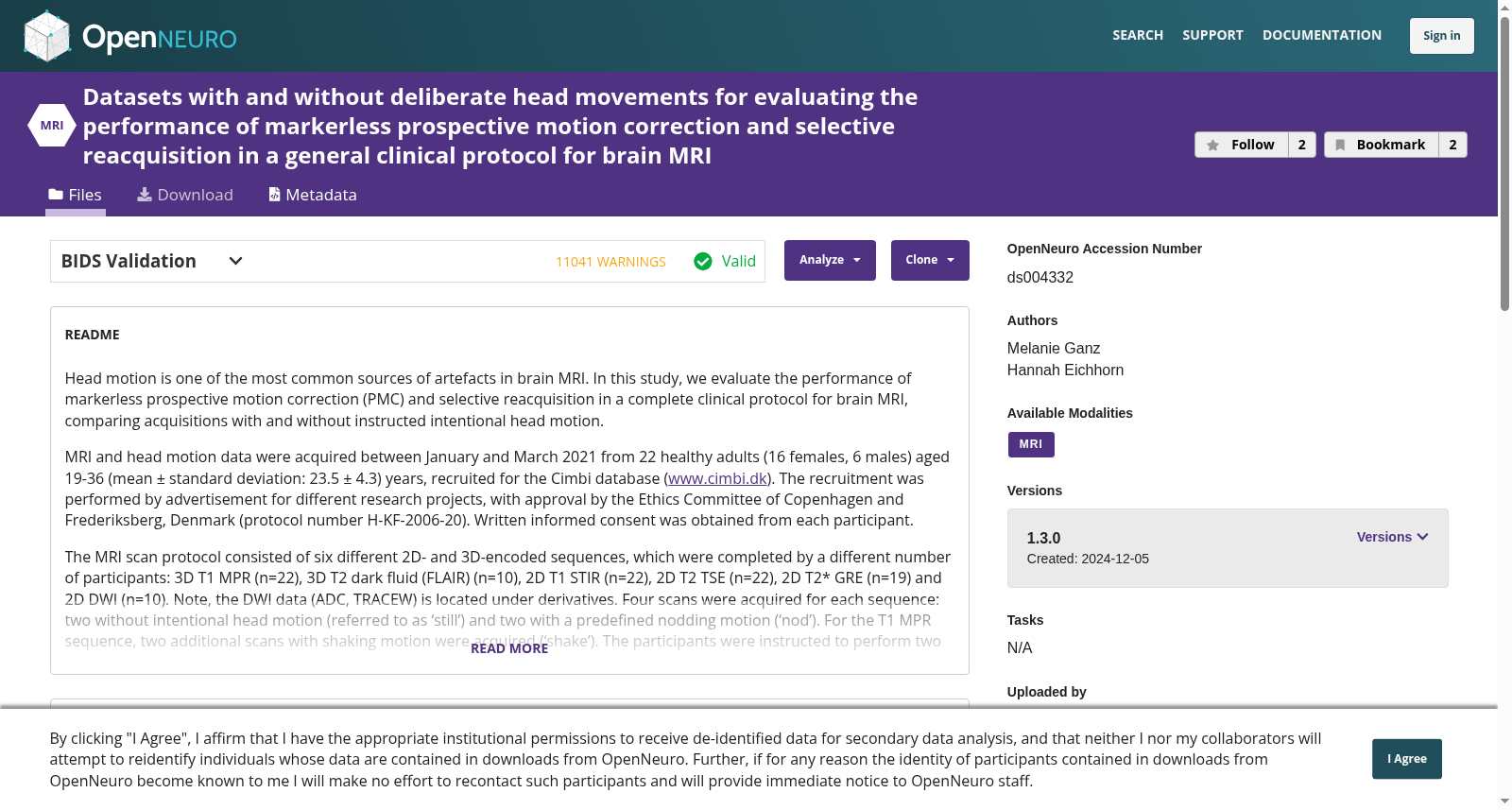
Head motion is one of the most common sources of artefacts in brain MRI. In this study, we evaluate the performance of markerless prospective motion correction (PMC) and selective reacquisition in a complete clinical protocol for brain MRI, comparing acquisitions with and without instructed intentional head motion.
MRI and head motion data were acquired between January and March 2021 from 22 healthy adults (16 females, 6 males) aged 19-36 (mean ± standard deviation: 23.5 ± 4.3) years, recruited for the Cimbi database (www.cimbi.dk). The recruitment was performed by advertisement for different research projects, with approval by the Ethics Committee of Copenhagen and Frederiksberg, Denmark (protocol number H-KF-2006-20). Written informed consent was obtained from each participant.
The MRI scan protocol consisted of six different 2D- and 3D-encoded sequences, which were completed by a different number of participants: 3D T1 MPR (n=22), 3D T2 dark fluid (FLAIR) (n=10), 2D T1 STIR (n=22), 2D T2 TSE (n=22), 2D T2* GRE (n=19) and 2D DWI (n=10). Note, the DWI data (ADC, TRACEW) is located under derivatives.
Four scans were acquired for each sequence:
two without intentional head motion (referred to as ‘still’) and two with a predefined nodding motion (‘nod’). For the T1 MPR sequence, two additional scans with shaking motion were acquired (‘shake’). The participants were instructed to perform two periods of nodding or shaking motion for 40 seconds during the middle of the acquisition, corresponding to the acquisition of the k-space center for the 3D-encoded sequences.
The scans with and without PMC were acquired in the following order:
- Still, no correction
- Still, PMC
- Nod motion, no correction (+ selective reacquisition)
- Nod motion, PMC (+ selective reacquisition)
- Shake motion, no correction (+ selective reacquisition) - ONLY MPRAGE
- Shake motion, PMC (+ selective reacquisition) - ONLY MPRAGE
Note that _run-01 indicates the still scans, _run-02 indicates the nodding scans and _run-03 indicates the shaking scans. _rec-wore indicates a scan without reacquisition, _rec-wre indicates a scan with reacquisition.
Nodding motion was chosen as the primary motion pattern based on results of a previous study (https://www.frontiersin.org/articles/10.3389/fradi.2021.789632/full) , where nodding rotation was found to be significantly larger than the rotational components around the other axes for awake children. Rigid-body head motion was measured with the optical tracking system Tracoline (TracInnovations, Ballerup, Denmark).
More details regarding the acquisition protocol can be seen in our preprint https://psyarxiv.com/vzh4g.
头部运动是颅脑MRI最常见的伪影来源之一。本研究在完整的颅脑MRI临床扫描流程中,评估无标记前瞻性运动校正(markerless prospective motion correction, PMC)与选择性重采集成像的性能,对比存在指令性刻意头部运动与无运动的扫描结果。
MRI与头部运动数据采集于2021年1月至3月,共纳入22名健康成年人(16名女性、6名男性),年龄区间为19~36岁,平均±标准差为23.5±4.3岁,受试者均招募自Cimbi数据库(www.cimbi.dk)。招募通过针对不同研究项目的广告进行,研究方案已获得丹麦哥本哈根与腓特烈斯贝伦理委员会批准(协议编号:H-KF-2006-20),所有受试者均签署书面知情同意书。
本次MRI扫描方案包含6种不同的二维(2D)与三维(3D)编码序列,各序列的有效参与人数存在差异:3D T1 MPR(n=22)、3D T2液体衰减反转恢复序列(FLAIR)(n=10)、2D T1短TI反转恢复序列(STIR)(n=22)、2D T2快速自旋回波序列(TSE)(n=22)、2D T2*梯度回波序列(GRE)(n=19)以及2D弥散加权成像序列(DWI)(n=10)。需注意,DWI相关数据(包括表观扩散系数ADC、扩散张量迹线TRACEW)存储于衍生数据集目录下。
每种序列均完成4次扫描:2次无刻意头部运动(记为“静息”),2次带有预设点头运动(记为“点头”)。针对T1 MPR序列,额外增加2次带有摇头运动的扫描(记为“摇头”)。受试者需在扫描过程中段——对应3D编码序列的k空间中心采集时段——完成两次时长为40秒的点头或摇头运动。
带与不带PMC校正的扫描按以下顺序完成:
1. 静息扫描,无运动校正
2. 静息扫描,启用PMC校正
3. 点头运动扫描,无运动校正(+选择性重采集)
4. 点头运动扫描,启用PMC校正(+选择性重采集)
5. 摇头运动扫描,无运动校正(+选择性重采集)——仅针对MPRAGE序列
6. 摇头运动扫描,启用PMC校正(+选择性重采集)——仅针对MPRAGE序列
需注意,_run-01代表静息扫描,_run-02代表点头扫描,_run-03代表摇头扫描;_rec-wore代表未启用重采集的扫描,_rec-wre代表启用重采集的扫描。
本研究选取点头运动作为核心运动模式,依据来自此前一项研究(https://www.frontiersin.org/articles/10.3389/fradi.2021.789632/full),该研究发现清醒儿童的点头旋转运动幅度显著大于其余轴向上的旋转分量。头部刚体运动通过光学追踪系统Tracoline(TracInnovations,丹麦巴勒鲁普)进行采集。
关于采集方案的更多细节可参见我们的预印本文章https://psyarxiv.com/vzh4g。
创建时间:
2022-11-09
搜集汇总
数据集介绍
背景与挑战
背景概述
该数据集是一个用于评估脑MRI中无标记前瞻性运动校正和选择性重采集技术性能的临床研究数据,包含22名健康成年人在有无故意头部运动(如点头和摇头)条件下的多序列MRI扫描。数据集通过对比不同运动条件和校正技术,旨在优化脑成像质量,减少运动伪影,并支持相关方法学研究和临床协议改进。
以上内容由遇见数据集搜集并总结生成


