
juliensimon/artemis-ii
收藏Hugging Face2026-04-11 更新2026-04-12 收录
下载链接:
https://hf-mirror.com/datasets/juliensimon/artemis-ii
下载链接
链接失效反馈官方服务:
资源简介:
---
license: cc-by-4.0
pretty_name: "Artemis II Mission Data"
language:
- en
description: "NASA Artemis II crewed lunar flyby mission: trajectory state vectors from JPL Horizons, crew manifest, mission timeline, and payload inventory."
task_categories:
- time-series-forecasting
- tabular-regression
tags:
- space
- artemis
- nasa
- moon
- lunar
- orion
- trajectory
- orbital-mechanics
- sls
- deep-space
- open-data
- tabular-data
- parquet
size_categories:
- 1K<n<10K
configs:
- config_name: trajectory
data_files:
- split: train
path: data/trajectory.parquet
default: true
- config_name: crew
data_files:
- split: train
path: data/crew.parquet
- config_name: timeline
data_files:
- split: train
path: data/timeline.parquet
- config_name: payloads
data_files:
- split: train
path: data/payloads.parquet
---
# Artemis II Mission Data
<div align="center">
<img src="banner.jpg" alt="Voyager spacecraft artist concept" width="400">
<p><em>Credit: NASA/JPL-Caltech</em></p>
</div>
*Part of the [Space Probe & Mission Datasets](https://huggingface.co/collections/juliensimon/space-probe-and-mission-datasets-69c3fe82d410a42b1e313167) collection on Hugging Face.*

Comprehensive dataset for NASA's **Artemis II** mission — the first crewed flight beyond low Earth orbit since Apollo 17 (1972). Covers the ~10-day crewed lunar flyby aboard the Orion spacecraft *Integrity*, launched April 1, 2026 on SLS Block 1.
## Configs
This dataset has four configs (tables):
| Config | Records | Description |
|--------|---------|-------------|
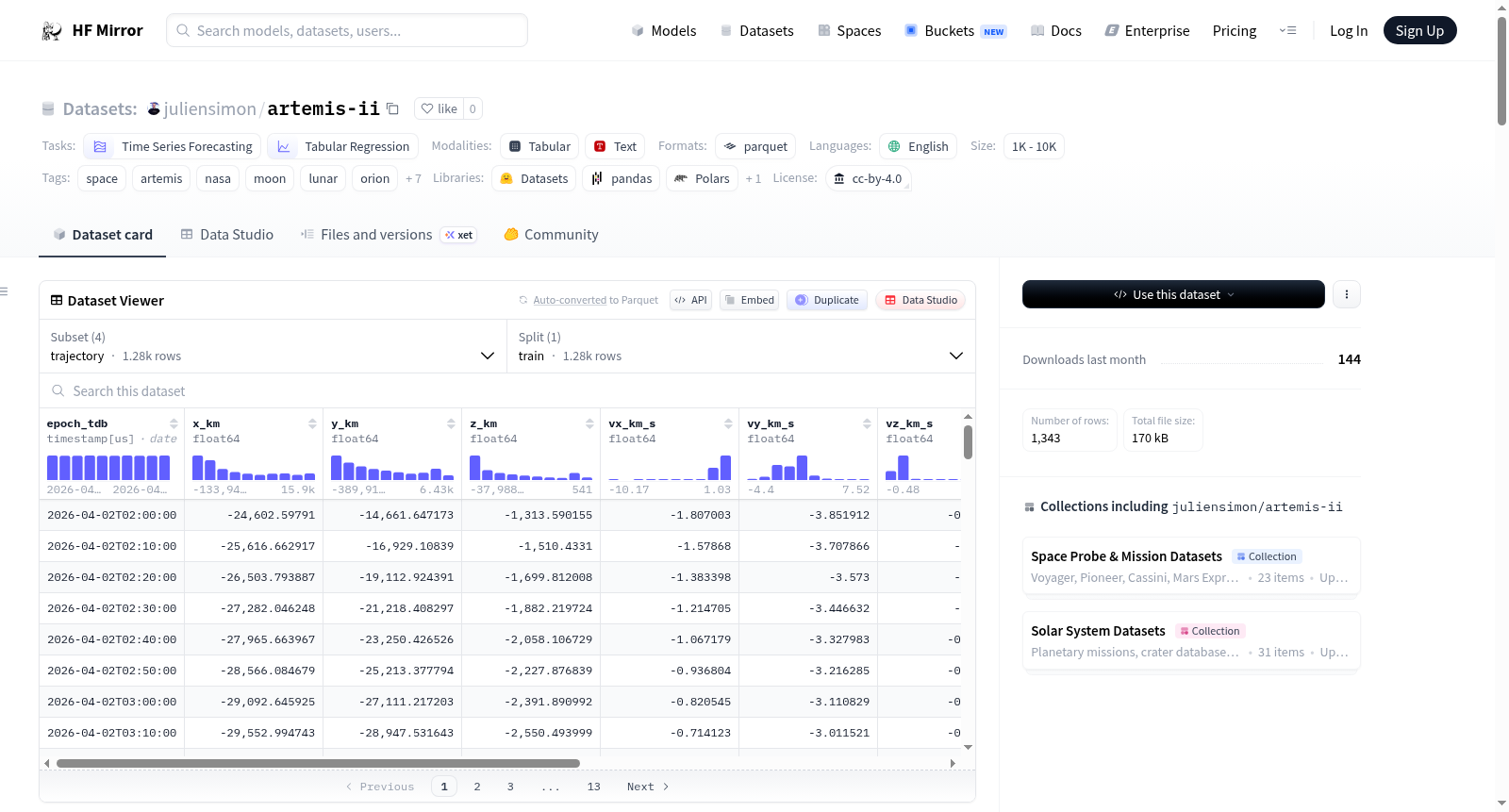
| `trajectory` | **1,284** | State vectors at 10-min intervals (position, velocity, distances) |
| `timeline` | **47** | Mission events from terminal countdown through splashdown |
| `crew` | **4** | Crew manifest with biographical data |
| `payloads` | **8** | CubeSats and onboard experiments |
## Trajectory schema
Geocentric J2000 ecliptic state vectors from [JPL Horizons](https://ssd.jpl.nasa.gov/horizons/) (spacecraft ID `-1024`).
| Column | Type | Description |
|--------|------|-------------|
| `epoch_tdb` | datetime | Timestamp of the state vector in Barycentric Dynamical Time (TDB), sampled at 10-minute intervals throughout the mission; TDB differs from UTC by a slowly varying offset (≈69 s during 2026) |
| `x_km` | float | Geocentric X position in km in the J2000 mean ecliptic and equinox frame; origin at Earth's center; X-axis points toward vernal equinox; typical range ±450,000 km (Earth–Moon distance ≈384,400 km) |
| `y_km` | float | Geocentric Y position in km (J2000 ecliptic frame); orthogonal to X in the ecliptic plane |
| `z_km` | float | Geocentric Z position in km (J2000 ecliptic frame); positive toward ecliptic north pole; small for near-ecliptic trajectories |
| `vx_km_s` | float | X velocity component in km/s (J2000 geocentric frame); Orion reaches ~10.8 km/s at TLI and decelerates to ≈11 km/s at entry interface |
| `vy_km_s` | float | Y velocity component in km/s (J2000 geocentric frame) |
| `vz_km_s` | float | Z velocity component in km/s (J2000 geocentric frame) |
| `distance_earth_km` | float | Distance from Earth's center in km, derived as √(x²+y²+z²); peaks near 450,000 km during the lunar flyby; Earth's surface is at 6,371 km, LEO at ~400 km |
| `speed_km_s` | float | Scalar speed in km/s, derived as √(vx²+vy²+vz²); peaks at TLI burn (≈10.8 km/s), reaches minimum near maximum Earth distance, then increases again during return; entry interface speed ≈11 km/s |
| `distance_moon_km` | float | Distance from the Moon's center in km from selenocentric Horizons query; minimum occurs at closest lunar approach (~8,900 km); null if Horizons returned a different number of rows than geocentric query |
| `mission_phase` | string | Mission segment label assigned by event timestamps: `earth_orbit` (launch through ICPS separation burn), `transit_outbound` (TLI through lunar sphere-of-influence entry), `lunar_approach` (SOI entry through closest approach), `lunar_flyby` (closest approach through SOI exit), `transit_return` (SOI exit through entry interface), `entry` (entry interface through splashdown) |
## Quick stats
- **1,284** trajectory vectors (2026-04-02 02:00 to 2026-04-10 23:50 TDB)
- Maximum distance from Earth: **413,143 km** (256770 statute miles)
- Closest lunar approach: **8,283 km** at 2026-04-06 23:00 TDB
- Maximum speed: **10.57 km/s** (38068 km/h)
- Crew: **4** (3 NASA + 1 CSA) — first crewed mission beyond LEO in 54 years
- CubeSats: **4** secondary payloads from Germany, South Korea, Saudi Arabia, Argentina
## Usage
```python
from datasets import load_dataset
# Trajectory data (default config)
ds = load_dataset("juliensimon/artemis-ii", split="train")
df = ds.to_pandas()
# Plot distance from Moon over time
import matplotlib.pyplot as plt
plt.figure(figsize=(12, 4))
plt.plot(df["epoch_tdb"], df["distance_moon_km"])
plt.xlabel("Time (TDB)")
plt.ylabel("Distance from Moon (km)")
plt.title("Artemis II — Distance to Moon")
plt.tight_layout()
plt.show()
# Find closest lunar approach
idx = df["distance_moon_km"].idxmin()
print(f"Closest approach: {df.loc[idx, 'distance_moon_km']:,.0f} km at {df.loc[idx, 'epoch_tdb']}")
# Load other configs
crew = load_dataset("juliensimon/artemis-ii", "crew", split="train").to_pandas()
timeline = load_dataset("juliensimon/artemis-ii", "timeline", split="train").to_pandas()
payloads = load_dataset("juliensimon/artemis-ii", "payloads", split="train").to_pandas()
```
## Data source
- **Trajectory:** [JPL Horizons](https://ssd.jpl.nasa.gov/horizons/) — spacecraft `-1024` ("Integrity Orion EM-2"), geocentric and selenocentric vectors
- **Timeline & crew:** [NASA Artemis II Press Kit](https://www.nasa.gov/wp-content/uploads/2026/01/artemis-ii-press-kit.pdf) and [launch blog](https://www.nasa.gov/blogs/missions/2026/04/01/live-artemis-ii-launch-day-updates/)
- **Payload data:** NASA, DLR, KARI, KACST, CONAE public announcements
## Update schedule
Updated during the mission as JPL Horizons trajectory data is refined. Will switch to as-flown ephemeris after splashdown.
## Related datasets
- [space-track-tle-history](https://huggingface.co/datasets/juliensimon/space-track-tle-history) — Orbital element history for tracked objects
- [donki-space-weather-events](https://huggingface.co/datasets/juliensimon/donki-space-weather-events) — Space weather events (relevant for crew radiation exposure)
- [dst-index](https://huggingface.co/datasets/juliensimon/dst-index) — Geomagnetic storm index
## Pipeline
Source code: [juliensimon/space-datasets](https://github.com/juliensimon/space-datasets)
## Support
If you find this dataset useful, please give it a ❤️ on the [dataset page](https://huggingface.co/datasets/juliensimon/artemis-ii) and share feedback in the Community tab! Also consider giving a ⭐️ to the [space-datasets](https://github.com/juliensimon/space-datasets) repo.
## Citation
```bibtex
@dataset{artemis_ii,
author = {Simon, Julien},
title = {Artemis II Mission Data},
year = {2026},
publisher = {Hugging Face},
url = {https://huggingface.co/datasets/juliensimon/artemis-ii},
note = {Trajectory from JPL Horizons; mission data from NASA press kit}
}
```
## License
[CC-BY-4.0](https://creativecommons.org/licenses/by/4.0/)
提供机构:
juliensimon
搜集汇总
数据集介绍
构建方式
在深空探测领域,数据集的构建往往依赖于权威机构的精确测量与系统整合。Artemis II任务数据集通过多源异构数据的融合形成,其核心轨迹数据源自美国喷气推进实验室的Horizons系统,以10分钟间隔采样获取航天器在J2000历元黄道坐标系下的状态向量。任务时间线与乘员信息则系统化提取自NASA官方发布的新闻资料与技术文档,而有效载荷数据整合了各国航天机构的公开声明。这种构建方式确保了数据在时空维度上的精确对齐,为后续分析建立了可靠的基准框架。
使用方法
针对轨道力学与任务规划研究,使用者可通过`datasets`库便捷加载数据,默认配置即为高精度轨迹数据,可转换为Pandas DataFrame进行时间序列分析与可视化,例如绘制航天器与月球距离的动态变化图。通过指定`crew`、`timeline`、`payloads`等配置名称,可分别获取任务的其他结构化信息。数据集支持对关键任务节点进行检索,如通过索引操作快速定位最近月球飞越点。这种分层访问机制使得研究者既能进行深度的轨迹动力学仿真,也能开展任务乘组构成或实验载荷分布等宏观层面的分析。
背景与挑战
背景概述
Artemis II数据集聚焦于美国国家航空航天局(NASA)主导的“阿尔忒弥斯II号”载人绕月飞行任务,该任务标志着自1972年阿波罗17号以来人类首次超越近地轨道的深空探索。数据集由独立研究者juliensimon于2026年构建,整合了喷气推进实验室(JPL)Horizons系统提供的精确轨迹状态向量、任务时间线、乘员档案及有效载荷清单。其核心研究问题在于为轨道力学、航天器轨迹预测及载人深空任务规划提供高保真、多模态的基准数据,旨在推动航天信息学、时间序列分析及相关人工智能应用的发展,为重返月球及后续深空探测任务奠定关键的数据基础。
当前挑战
该数据集致力于解决载人深空任务轨迹预测与任务规划的复杂挑战,其核心在于精确建模地月转移轨道中受多体引力摄动、太阳辐射压及轨道机动影响的非线性动力学系统。构建过程中的挑战尤为显著:首先,轨迹数据源自JPL Horizons系统的理论星历,其时间基准为质心力学时(TDB),需协调与协调世界时(UTC)的微妙偏移以确保时序一致性;其次,整合多维异构数据(如轨迹向量、事件时间线、乘员生物信息及有效载荷参数)要求严谨的模式对齐与缺失值处理,例如月球距离字段因数据源行数不匹配而存在空值;此外,任务数据的动态更新机制需在任务执行期间持续校准理论轨迹,并在溅落后切换至实际飞行星历,这对数据版本的完整性与时效性提出了较高要求。
常用场景
经典使用场景
在深空探测与轨道力学领域,Artemis II数据集为研究人员提供了高精度的航天器轨迹状态向量。该数据集最经典的使用场景在于轨道动力学建模与预测,通过包含位置、速度及距离等参数的时序数据,能够精确模拟载人月球飞越任务的完整轨迹。这些数据支持对航天器在复杂引力环境下的运动行为进行可视化分析与数值仿真,为任务规划与实时监控提供了关键参考。
解决学术问题
该数据集有效解决了深空任务中轨道优化与不确定性分析的学术挑战。通过提供真实任务背景下的轨迹数据,它支持研究地月转移轨道设计、引力辅助机动效率以及长期轨道稳定性等问题。其意义在于填补了载人深空飞行实测数据的空白,为轨道力学、航天器导航与控制等领域的理论验证与模型改进提供了实证基础,推动了相关学科的前沿探索。
实际应用
在实际工程层面,Artemis II数据集可直接应用于任务操作支持与航天器系统验证。任务控制中心可利用轨迹数据实时评估航天器状态,优化飞行路径并确保安全。同时,该数据为下一代载人深空任务(如月球基地建设)的轨道设计提供了经验参考,并可用于训练自主导航算法,提升航天器在深空环境中的鲁棒性与可靠性。
数据集最近研究
最新研究方向
在深空探测与载人航天领域,Artemis II数据集作为首个重返月球载人飞行的开源数据资源,正推动轨道动力学与任务规划的前沿研究。学者们利用其高精度轨迹状态向量,结合机器学习方法优化深空转移轨道的预测模型,以提升未来月球及火星任务的导航精度。同时,数据集整合的乘员信息与任务时间线,为航天医学与人类行为学研究提供了独特视角,探索长期深空飞行中乘员表现与任务节奏的关联。随着国际月球科研站等合作倡议的推进,该数据集亦成为跨机构任务仿真与协同分析的重要基准,助力新一代载人航天系统的可靠性与安全性评估。
以上内容由遇见数据集搜集并总结生成



