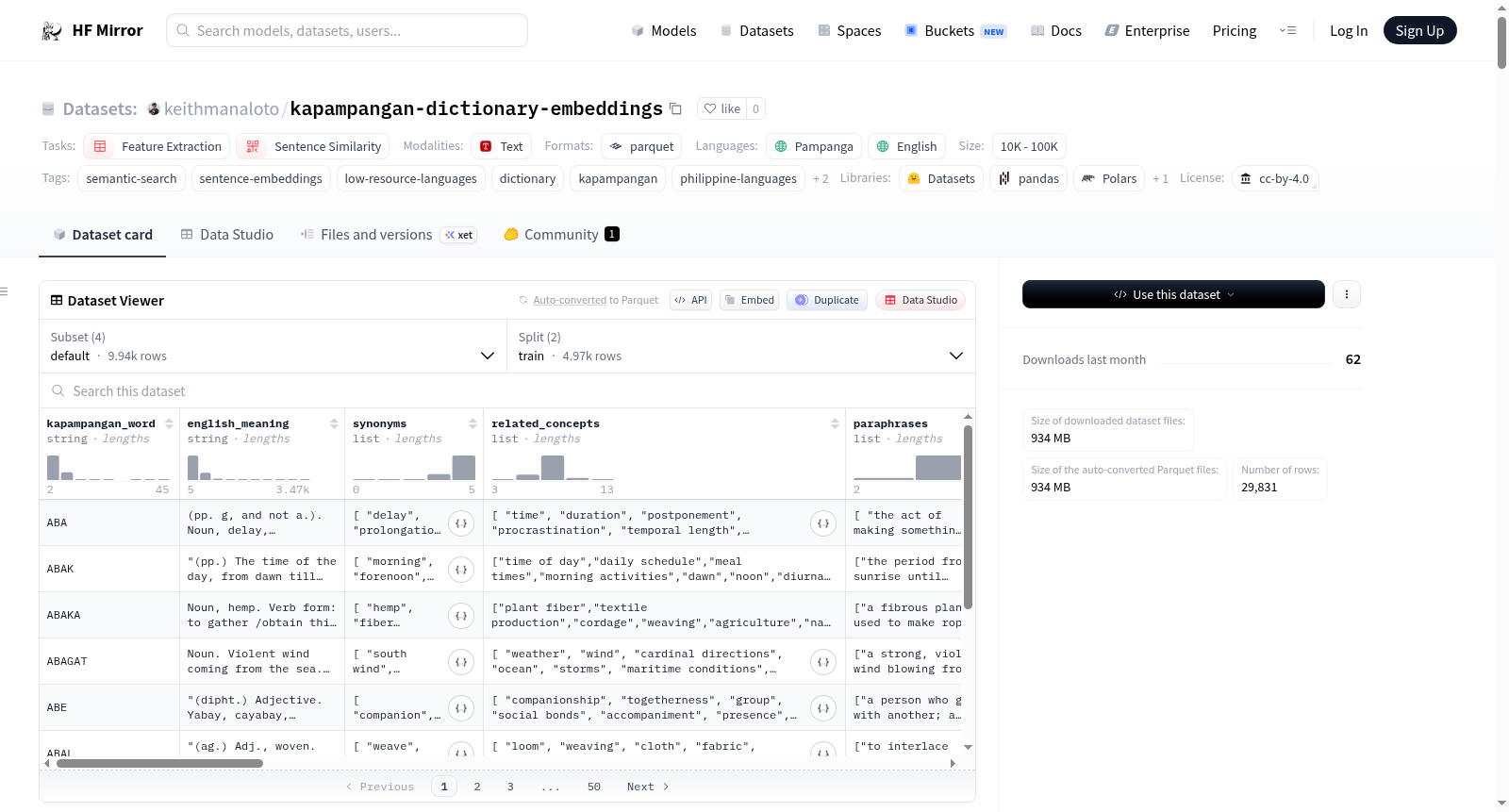
keithmanaloto/kapampangan-dictionary-embeddings
收藏资源简介:
--- language: - pam - en license: cc-by-4.0 task_categories: - feature-extraction - sentence-similarity tags: - semantic-search - sentence-embeddings - low-resource-languages - dictionary - kapampangan - philippine-languages - austronesian - sentence-transformers pretty_name: Kapampangan Dictionary Embeddings size_categories: - 1K<n<10K configs: - config_name: default data_files: - split: train path: data/train-* - split: raw path: data/raw-* - config_name: source data_files: - split: train path: source/train-* - config_name: enriched data_files: - split: train path: enriched/train-* --- # Kapampangan Dictionary Embeddings The first dedicated Kapampangan sentence embedding dataset. 4,971 entries from a 1730s Kapampangan-English dictionary, enriched with LLM-generated semantic metadata and pre-computed embeddings from 6 models. Designed for semantic search, retrieval, and clustering over Kapampangan vocabulary. Includes a 100-query retrieval benchmark and evaluation results from 5 retrieval improvement experiments. **Read the origin story:** [From a 300-Year-Old Dictionary to Hugging Face: I Built Kapampágan's First Embedding Dataset](https://medium.com/@keithmanaloto/from-a-300-year-old-dictionary-to-hugging-face-i-built-kapamp%C3%A1ngans-first-embedding-dataset-dce2b877bd83) — covers the pipeline from raw dictionary to initial dataset (pre-experiment baseline). ## How It Works Off-the-shelf embedding models don't understand Kapampangan. This dataset bridges the gap by enriching each dictionary entry with English semantic metadata (synonyms, paraphrases, categories, search queries) using Claude Haiku 4.5, then embedding the combined text. The models search over the English enrichment — not the Kapampangan words directly. This "enrichment bridge" approach works for any low-resource language: describe your language's vocabulary in a language the model already knows. > **Note on enrichment quality:** The semantic metadata was generated automatically by an LLM (Claude Haiku 4.5) based on the dictionary's English definitions, then spot-checked by a native Kapampangan speaker. However, not every entry was individually verified — accuracy was traded for coverage across all 4,971 entries. The enrichment reflects what an LLM infers from English translations, not ground-truth Kapampangan semantics. Treat the enrichment fields as useful for retrieval, not as authoritative linguistic data. ## Dataset Schema ### Text Fields | Column | Type | Description | |---|---|---| | `kapampangan_word` | string | Modern Kapampangan spelling (normalized from 1730s orthography) | | `english_meaning` | string | English translation/definition | | `original_word` | string | Original 1730s Spanish-influenced spelling (when different from normalized) | | `category` | string | Original dictionary thematic grouping (52 unique values, present on ~24% of entries) | ### Enrichment Fields (LLM-generated) | Column | Type | Description | |---|---|---| | `synonyms` | list[string] | English synonyms and near-synonyms | | `related_concepts` | list[string] | Semantically related English terms | | `paraphrases` | list[string] | Alternative English phrasings of the meaning | | `categories` | list[string] | Semantic category tags from a closed 27-tag set | | `usage_contexts` | list[string] | Example contexts where the word might appear | | `search_queries` | list[string] | Anticipated search queries a user might type | ### Embedding Columns | Column | Model | Dims | Multilingual? | |---|---|---|---| | `emb_stella_400m` | `NovaSearch/stella_en_400M_v5` | 1024 | No (English) | | `emb_multilingual_e5_large` | `intfloat/multilingual-e5-large` | 1024 | Yes (100 langs) | | `emb_multilingual_e5_small` | `intfloat/multilingual-e5-small` | 384 | Yes (100 langs) | | `emb_bge_m3` | `BAAI/bge-m3` | 1024 | Yes (100+ langs) | | `emb_bge_base_en_v1_5` | `BAAI/bge-base-en-v1.5` | 768 | No (English) | | `emb_all_minilm_l6_v2` | `sentence-transformers/all-MiniLM-L6-v2` | 384 | No (English) | All embeddings are L2-normalized (unit vectors). Cosine similarity = dot product. ## Which Model to Use | Use Case | Model | Why | |---|---|---| | **Best overall retrieval** | `stella_en_400M_v5` | Highest bi-encoder MRR (0.539), +8.5% over e5-large | | **Best with reranker** | `stella_en_400M_v5` + `bge-reranker-v2-m3` | MRR 0.596 (+20% over baseline), best overall pipeline | | **Exact Kapampangan lookups** | `bge-base-en-v1.5` | 0.950 MRR on exact queries, good for edge deployment | | **Lightweight / mobile** | `all-MiniLM-L6-v2` | 22M params, ties the 568M bge-m3 head-to-head (42 vs 41 query wins) | | **Not recommended** | `bge-m3` | Worst overall despite being the largest model. Has catastrophic failures on queries others get rank 1 | ## Evaluation Results Benchmarked with 100 hand-crafted queries across 4 categories: exact Kapampangan lookups (20), English keyword (30), semantic/descriptive (30), Kapampangan-to-Kapampangan (20). ### Bi-encoder Only | Model | Params | R@1 | R@5 | R@20 | MRR | |---|---|---|---|---|---| | **stella_en_400M_v5** | 400M | **0.440** | **0.620** | **0.740** | **0.539** | | multilingual-e5-large | 560M | 0.420 | 0.560 | 0.670 | 0.497 | | bge-base-en-v1.5 | 109M | 0.320 | 0.510 | 0.650 | 0.413 | | multilingual-e5-small | 118M | 0.310 | 0.540 | 0.610 | 0.410 | | all-MiniLM-L6-v2 | 22M | 0.300 | 0.530 | 0.670 | 0.397 | | bge-m3 | 568M | 0.250 | 0.490 | 0.570 | 0.356 | ### Best Pipeline (Bi-encoder + Reranker) | Pipeline | R@1 | R@5 | R@20 | MRR | |---|---|---|---|---| | **stella_400M → bge-reranker-v2-m3 (top-50)** | **0.520** | **0.640** | **0.740** | **0.596** | | stella_400M (bi-encoder only) | 0.440 | 0.620 | 0.740 | 0.539 | | e5-large baseline | 0.420 | 0.560 | 0.670 | 0.497 | The reranker improves MRR by +0.057 over stella alone and +0.099 (+20%) over the original e5-large baseline. See `eval/results_reranker_comparison.json` for the full reranker model comparison. ### Per Category (MRR) | Model | Exact | Keyword | Semantic | Kap-to-kap | |---|---|---|---|---| | stella_en_400M_v5 | 0.941 | 0.697 | 0.368 | 0.008 | | multilingual-e5-large | 0.930 | 0.650 | 0.378 | 0.012 | | bge-base-en-v1.5 | **0.950** | 0.489 | 0.251 | 0.003 | | multilingual-e5-small | 0.678 | 0.601 | 0.313 | 0.003 | | all-MiniLM-L6-v2 | 0.775 | 0.580 | 0.225 | 0.001 | | bge-m3 | 0.620 | 0.509 | 0.256 | 0.010 | ### Retrieval Improvement Experiments Five experiments were conducted to improve retrieval beyond the original baseline: | Experiment | Hypothesis | Result | |---|---|---| | **E1: Reranker** | Cross-encoder reranking improves retrieval | +0.057 MRR on stella. Equalizes weaker bi-encoders to ~0.50. | | **E2: English-only text** | Removing Kapampangan from embedding text helps | Destroys exact lookups (bge-base exact: 0.950 → 0.319). Net negative. | | **E3: New English models** | stella/nomic may outperform e5-large | stella_400M wins (0.539 vs 0.497). nomic disappoints (0.409). | | **E4: Query expansion** | LLM-expanded queries improve retrieval | Hurts overall (MRR −0.048). LLM hallucinates wrong Kapampangan meanings. | | **E5: Reranker comparison** | Which reranker works best with stella? | bge-reranker-v2-m3 is the only one that improves stella. ms-marco-MiniLM actually hurts it. | Full experiment results are in `eval/results_*.json`. The evaluation script and query set are included in the [source repo](https://github.com/keithmanaloto/kapampangan-dict-embeddings). ## Usage ### Load the Dataset ```python from datasets import load_dataset ds = load_dataset("keithmanaloto/kapampangan-dictionary-embeddings") print(ds["train"][0]["kapampangan_word"], ds["train"][0]["english_meaning"]) ``` ### Semantic Search (Recommended: stella_en_400M_v5) ```python from datasets import load_dataset from sentence_transformers import SentenceTransformer import numpy as np ds = load_dataset("keithmanaloto/kapampangan-dictionary-embeddings") model = SentenceTransformer("NovaSearch/stella_en_400M_v5", trust_remote_code=True) query_emb = model.encode("water", normalize_embeddings=True) embs = np.array(ds["train"]["emb_stella_400m"]) sims = embs @ query_emb top_5 = np.argsort(-sims)[:5] for i in top_5: entry = ds["train"][i] print(f"{sims[i]:.3f} {entry['kapampangan_word']} — {entry['english_meaning'][:80]}") ``` ### Other Splits and Configs The dataset includes intermediate pipeline outputs as separate splits/configs: ```python from datasets import load_dataset # Raw split — cleaned dictionary (normalized orthography, deduped), no enrichment or embeddings raw = load_dataset("keithmanaloto/kapampangan-dictionary-embeddings", split="raw") # Fields: kapampangan_word, english_meaning, original_word, category # Source config — original uncleaned entries.json (4,976 entries, pre-deduplication) source = load_dataset("keithmanaloto/kapampangan-dictionary-embeddings", "source", split="train") # Fields: word, meaning # Enriched config — LLM-enriched metadata, no embeddings enriched = load_dataset("keithmanaloto/kapampangan-dictionary-embeddings", "enriched", split="train") # Fields: kapampangan_word, english_meaning, original_word, category, synonyms, related_concepts, paraphrases, categories, usage_contexts, search_queries ``` ### Using Text Fields Only (BYO Embeddings) ```python from datasets import load_dataset ds = load_dataset("keithmanaloto/kapampangan-dictionary-embeddings") # Use the enrichment fields to build your own embedding text entry = ds["train"][0] text = f"{entry['kapampangan_word']}\n{entry['english_meaning']}\n" text += "\n".join(entry["paraphrases"]) text += "\n".join(entry["search_queries"]) # Embed with your preferred model ``` ## Important: Query Prefixes E5 models require specific prefixes. The dataset embeddings were generated with `"passage: "` prefix. At query time, use `"query: "` prefix. Getting this wrong silently degrades results. | Model | Query Prefix | Passage Prefix (already applied) | |---|---|---| | stella_en_400M_v5 | *(none)* | *(none)* | | multilingual-e5-large | `"query: "` | `"passage: "` | | multilingual-e5-small | `"query: "` | `"passage: "` | | all-MiniLM-L6-v2 | *(none)* | *(none)* | | bge-m3 | *(none)* | *(none)* | | bge-base-en-v1.5 | *(none)* | *(none)* | ## Known Limitations - **Kapampangan-to-Kapampangan retrieval fails.** All 20 kap-to-kap queries score ~0 across all models. No off-the-shelf model understands Kapampangan semantic relationships. The models retrieve via English enrichment text, not Kapampangan understanding. - **English word collisions.** Some normalized Kapampangan words match English words (e.g., "API" = fire, "MATE" = death). The embedding may pull toward the English meaning. 497 such collisions exist; only one (BANGLE) caused a material enrichment error (fixed). - **The eval benchmark tests retrieval, not understanding.** High Recall@K means the model surfaces the right entry — the LLM enrichment is doing the heavy lifting, not Kapampangan comprehension. - **Enrichment is LLM-generated with spot checks.** All enrichment fields (synonyms, paraphrases, categories, etc.) were produced by Claude Haiku 4.5 from English definitions and spot-checked by a native Kapampangan speaker, but not exhaustively verified. Useful for retrieval but not authoritative linguistic data, especially for culturally specific or archaic terms. - **UPPERCASE headwords.** Entries are stored in UPPERCASE. This is intentional — lowercasing was tested and degraded retrieval (MRR 0.497 → 0.451). Keep queries in natural case. ## Austronesian Cognate Effect Kapampangan words with Pan-Austronesian cognates (shared with Tagalog, Malay, Indonesian) get 3.2% higher cross-lingual alignment from embedding models compared to uniquely Kapampangan words. The models leverage incidental subword overlap from related languages in their training data. Examples: - **bulan** (moon) — 0.948 similarity. Cognate: Tag *buwan*, Mal/Indo *bulan* - **takut** (fear) — 0.923. Cognate: Tag *takot*, Mal/Indo *takut* - **lugud** (love) — 0.774. No cognate (uniquely Kapampangan) - **yaman** (delicious) — 0.801. False friend: Tag *yaman* = wealth This is relevant for anyone working on other low-resource Austronesian languages. ## Building on This Dataset ### Use Cases - **Semantic search for Kapampangan apps** — the [Learn Kulitan app I built](https://keithmanaloto.medium.com/i-built-an-app-in-an-attempt-to-slow-down-the-death-of-a-language-c63882ab66a5) already uses `multilingual-e5-large` for dictionary search, but without orthography normalization, data cleaning, or enrichment. This dataset provides all three with `stella_en_400M_v5` as the recommended model. Details on how it was applied and the app download link are in the linked article. - **RAG** — retrieve relevant dictionary entries as context for an LLM (e.g., "What's the Kapampangan word for rain?" → retrieve URAN → feed to LLM) - **Text classification** — train a classifier using embedding vectors + the 27 category tags - **Clustering** — discover semantic neighborhoods in the Kapampangan vocabulary - **Cross-lingual retrieval research** — benchmark embedding models on a low-resource Philippine language - **Apply this pipeline to other low-resource languages** — the enrichment bridge approach (LLM-generate English metadata → embed with off-the-shelf models) is language-agnostic. If you have a bilingual dictionary for any low-resource language, you can replicate this pipeline to get working semantic search without waiting for a dedicated model ### Future Improvements - **Native speaker review of enrichment fields** — exhaustive verification of LLM-generated metadata, especially for culturally specific terms - **Expand the eval set** — more kap-to-kap queries to better measure cross-lingual capability as models improve - **Fine-tune a multilingual model on Kapampangan text** — could unlock kap-to-kap retrieval, which currently scores ~0 - **Add entries from other Kapampangan sources** — expand beyond the Bergaño dictionary ## Source Data Derived from *Vocabulario de la lengua Pampangan* by Fray Diego Bergaño, O.S.A. (1732), a Spanish Augustinian missionary's Kapampangan dictionary — one of the oldest extant studies of the Kapampangan language. English translation by Fray Venancio Q. Samson, published 2007 by the Juan D. Nepomuceno Center for Kapampangan Studies, Holy Angel University (Angeles City, Pampanga, Philippines), with support from the National Commission for Culture and the Arts (NCCA). ISBN 978-971-93672-1-5. Winner of the NBDB National Book Awards (2007). ~40% of entries have orthography normalized from 1730s Spanish-influenced spelling to modern Kapampangan. Original spellings are preserved in the `original_word` field. ## Pipeline 1. **Clean** — Validate, deduplicate, normalize orthography (4,976 raw → 4,971 clean) 2. **Enrich** — Claude Haiku 4.5 via Batch API generates semantic metadata per entry (~$5, 4,971/4,971 success) 3. **Embed** — 6 sentence-transformer models, ~25 min on Apple Silicon 4. **Evaluate** — 100 hand-crafted queries, Recall@1/5/20 + MRR per model and category 5. **Experiment** — 5 retrieval improvement experiments (reranking, text variants, new models, query expansion) Full source code: [github.com/keithmanaloto/kapampangan-dict-embeddings](https://github.com/keithmanaloto/kapampangan-dict-embeddings) ## License CC BY 4.0. The source dictionary (1732) is public domain. LLM-enriched fields and embeddings are original to this project. ## Citation If you use this dataset, please cite: ```bibtex @dataset{manaloto2026kapampangan, title={Kapampangan Dictionary Embeddings}, author={Manaloto, Keith}, year={2026}, publisher={HuggingFace}, url={https://huggingface.co/datasets/keithmanaloto/kapampangan-dictionary-embeddings} } ``` Original dictionary: Bergaño, Diego (1732). *Vocabulario de la lengua Pampangan*. English translation: Samson, Venancio Q. (2007). Holy Angel University.