
Urban scaling of firearm violence, ownership and accessibility in the United States
收藏DataCite Commons2024-06-22 更新2024-07-13 收录
下载链接:
https://ultraviolet.library.nyu.edu/doi/10.58153/xv1tw-98j62
下载链接
链接失效反馈官方服务:
资源简介:
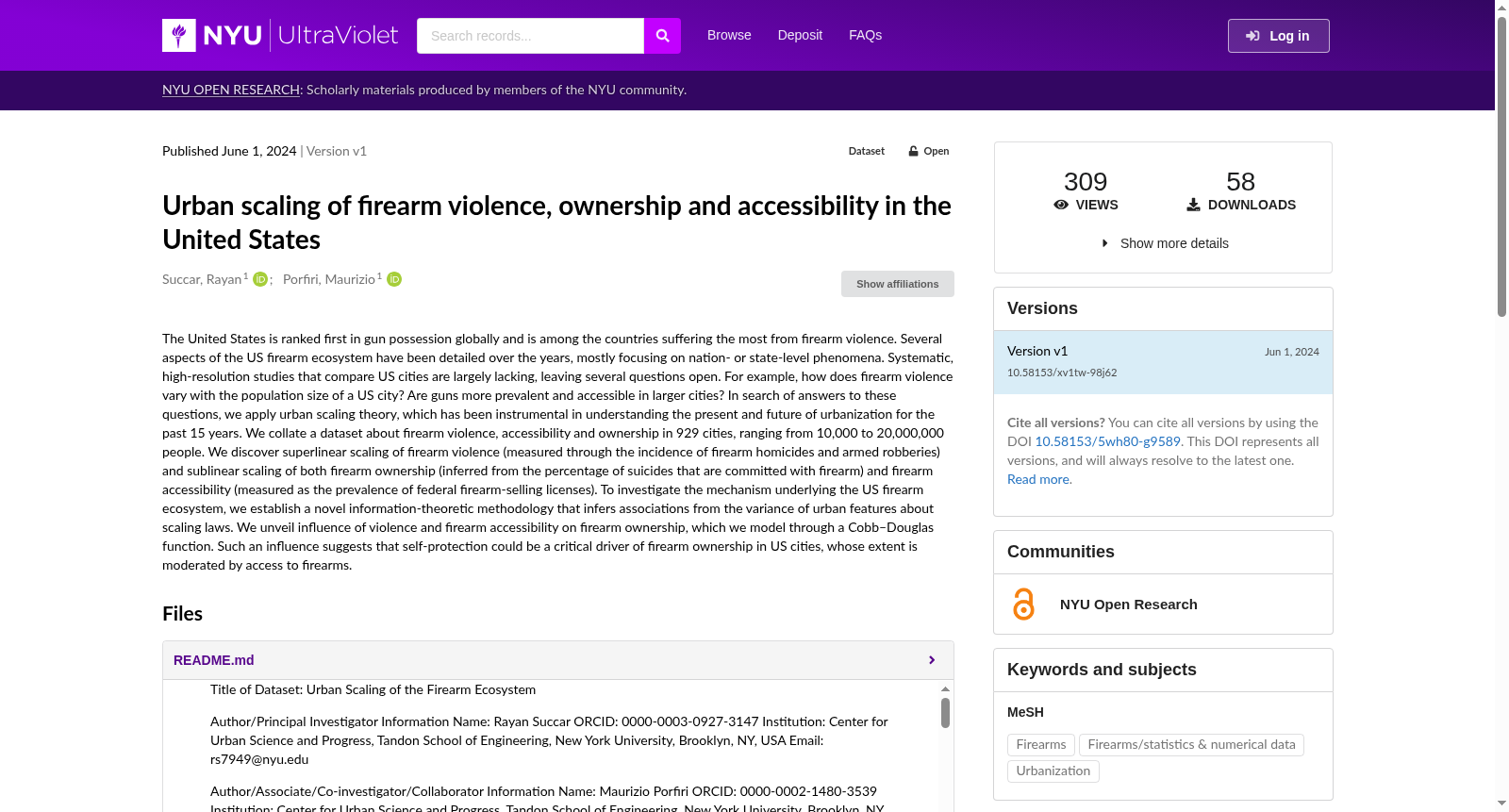
The United States is ranked first in gun possession globally and is among the countries suffering the most from firearm violence. Several aspects of the US firearm ecosystem have been detailed over the years, mostly focusing on nation- or state-level phenomena. Systematic, high-resolution studies that compare US cities are largely lacking, leaving several questions open. For example, how does firearm violence vary with the population size of a US city? Are guns more prevalent and accessible in larger cities? In search of answers to these questions, we apply urban scaling theory, which has been instrumental in understanding the present and future of urbanization for the past 15 years. We collate a dataset about firearm violence, accessibility and ownership in 929 cities, ranging from 10,000 to 20,000,000 people. We discover superlinear scaling of firearm violence (measured through the incidence of firearm homicides and armed robberies) and sublinear scaling of both firearm ownership (inferred from the percentage of suicides that are committed with firearm) and firearm accessibility (measured as the prevalence of federal firearm-selling licenses). To investigate the mechanism underlying the US firearm ecosystem, we establish a novel information-theoretic methodology that infers associations from the variance of urban features about scaling laws. We unveil influence of violence and firearm accessibility on firearm ownership, which we model through a Cobb–Douglas function. Such an influence suggests that self-protection could be a critical driver of firearm ownership in US cities, whose extent is moderated by access to firearms.
美国是全球私人枪支拥有量排名第一的国家,同时也是受枪支暴力(firearm violence)危害最严重的国家之一。多年来,学界已对美国枪支生态系统的多个维度展开了详尽剖析,但相关研究大多聚焦于国家或州级层面的现象。目前针对美国城市的系统性、高分辨率对比研究仍较为匮乏,诸多相关问题尚未得到解答。例如,美国城市的枪支暴力水平会如何随城市人口规模变化?大城市中的枪支是否更为普及、更容易获取?为探寻这些问题的答案,我们运用了城市缩放理论(urban scaling theory)——该理论在过去15年间为城市化进程的现状与未来研究提供了重要助力。我们整理了涵盖929座城市的数据集,涉及枪支暴力、枪支可及性(firearm accessibility)与枪支拥有量(firearm ownership)情况,这些城市的人口规模从1万至2000万不等。研究发现,枪支暴力以枪支凶杀案与武装抢劫的发生率为衡量标准呈现超线性缩放关系,而枪支拥有量通过以枪支实施的自杀占总自杀比例推断得出、枪支可及性以联邦枪支销售许可证(federal firearm-selling licenses)的普及率为衡量标准,二者均呈现亚线性缩放关系。为探究美国枪支生态系统的内在作用机制,我们提出了一种全新的信息论方法论,可从城市特征与缩放定律的关联方差中推断变量间的关联关系。我们揭示了暴力水平与枪支可及性对枪支拥有量的影响,并通过柯布-道格拉斯函数(Cobb–Douglas function)对该影响关系进行建模。该影响关系表明,自我保护可能是美国城市中枪支拥有量增长的关键驱动因素,其影响程度受枪支可及性的调节。
提供机构:
New York University
创建时间:
2024-06-18
搜集汇总
数据集介绍
背景与挑战
背景概述
该数据集聚焦于美国城市枪支暴力、拥有率和可及性的规模关系研究,覆盖929个城市,人口范围从1万到2000万。研究发现,枪支暴力随城市人口规模呈超线性增长,而枪支拥有率和可及性则呈亚线性增长,并揭示了自卫可能是驱动枪支拥有率的关键因素。数据集包含详细的数据文件和元数据,适用于城市化和公共安全相关分析。
以上内容由遇见数据集搜集并总结生成


