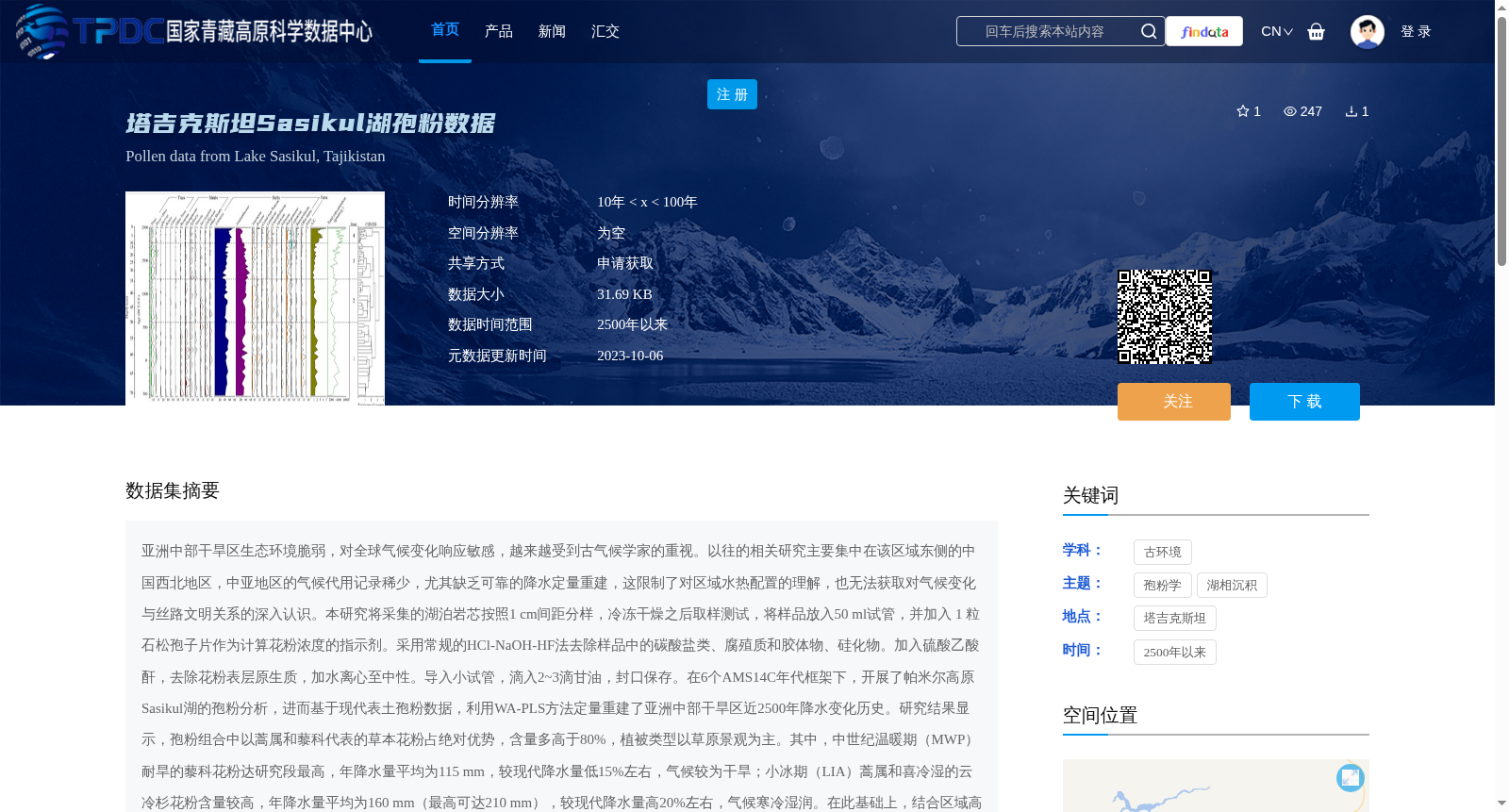
塔吉克斯坦Sasikul湖孢粉数据
收藏资源简介:
亚洲中部干旱区生态环境脆弱,对全球气候变化响应敏感,越来越受到古气候学家的重视。以往的相关研究主要集中在该区域东侧的中国西北地区,中亚地区的气候代用记录稀少,尤其缺乏可靠的降水定量重建,这限制了对区域水热配置的理解,也无法获取对气候变化与丝路文明关系的深入认识。本研究将采集的湖泊岩芯按照1 cm间距分样,冷冻干燥之后取样测试,将样品放入50 ml试管,并加入 1 粒石松孢子片作为计算花粉浓度的指示剂。采用常规的HCl-NaOH-HF法去除样品中的碳酸盐类、腐殖质和胶体物、硅化物。加入硫酸乙酸酐,去除花粉表层原生质,加水离心至中性。导入小试管,滴入2~3滴甘油,封口保存。在6个AMS14C年代框架下,开展了帕米尔高原Sasikul湖的孢粉分析,进而基于现代表土孢粉数据,利用WA-PLS方法定量重建了亚洲中部干旱区近2500年降水变化历史。研究结果显示,孢粉组合中以蒿属和藜科代表的草本花粉占绝对优势,含量多高于80%,植被类型以草原景观为主。其中,中世纪温暖期(MWP)耐旱的藜科花粉达研究段最高,年降水量平均为115 mm,较现代降水量低15%左右,气候较为干旱;小冰期(LIA)蒿属和喜冷湿的云冷杉花粉含量较高,年降水量平均为160 mm(最高可达210 mm),较现代降水量高20%左右,气候寒冷湿润。在此基础上,结合区域高质量温度记录和考古学资料,探讨了历史时期气候变化对丝路文明演化的可能影响。我们认为水热配置中的温度条件对亚洲中部干旱区人类活动与丝路文明演化的影响最为重要:在隋唐时期,温暖的气候背景下,冰雪融水明显增加,人类定居强度明显提升,丝路文明繁荣发展;而到了明代,寒冷的气候条件下,由于淡水输入的缺乏,从而减弱了当地人类定居强度,丝路文明显著衰退。那么,目前在全球变暖和降水增加的气候背景下,为亚洲中部干旱区农业和社会经济迎来新的发展机会。
The arid regions of Central Asia (ACA) feature fragile ecological environments and are highly sensitive to global climate change, drawing increasing attention from paleoclimatologists. Previous relevant studies have mainly focused on the eastern part of this region, i.e., Northwest China. However, climate proxy records from Central Asia are scarce, especially reliable quantitative reconstructions of precipitation, which has limited our understanding of regional moisture-temperature configurations and prevented in-depth insights into the relationship between climate change and Silk Road civilization. In this study, collected lake sediment cores were subsampled at 1 cm intervals. After freeze-drying, samples were prepared for pollen analysis: each sample was placed into a 50 ml test tube, and one Lycopodium spore tablet was added as an indicator for calculating pollen concentrations. The conventional HCl-NaOH-HF method was applied to remove carbonates, humic substances, colloids, and silicates from the samples. Acetic anhydride-sulfuric acid solution was then added to digest the protoplasm on the pollen surface, followed by addition of water and centrifugation until the supernatant reached neutral pH. The treated pollen samples were transferred into small test tubes, with 2-3 drops of glycerol added, and sealed for preservation. Pollen analysis was conducted on sediment cores from Lake Sasikul on the Pamir Plateau, anchored by a chronological framework established via 6 AMS ¹⁴C dates. Based on modern surface pollen data, the Weighted Averaging Partial Least Squares (WA-PLS) method was used to quantitatively reconstruct the precipitation variation history of Arid Central Asia over the past 2500 years. The results show that herbaceous pollen represented by Artemisia and Chenopodiaceae dominates the pollen assemblages, with concentrations mostly exceeding 80%, indicating a dominant grassland vegetation landscape. During the Medieval Warm Period (MWP), drought-tolerant Chenopodiaceae pollen reached its highest concentration in the study interval, with an average annual precipitation of 115 mm, approximately 15% lower than modern levels, reflecting relatively arid conditions. During the Little Ice Age (LIA), Artemisia and cold-wet loving spruce-fir (Picea-Abies) pollen had higher concentrations, with an average annual precipitation of 160 mm (up to 210 mm), approximately 20% higher than modern levels, indicating cold and humid climate. On this basis, combined with high-quality regional temperature records and archaeological data, we discussed the potential impacts of historical climate changes on the evolution of Silk Road civilization. We argue that temperature conditions within the moisture-temperature configuration are the most critical factor influencing human activities and the evolution of Silk Road civilization in Arid Central Asia: During the Sui and Tang Dynasties, under a warm climate background, snow and ice meltwater increased significantly, leading to a notable rise in human settlement intensity and the prosperous development of Silk Road civilization. In contrast, during the Ming Dynasty, under cold climate conditions, the lack of freshwater input reduced local human settlement intensity, resulting in a significant decline of Silk Road civilization. Against the current backdrop of global warming and increased precipitation, Arid Central Asia is presented with new development opportunities for its agriculture and social economy.