rvos-motion-questions
收藏资源简介:
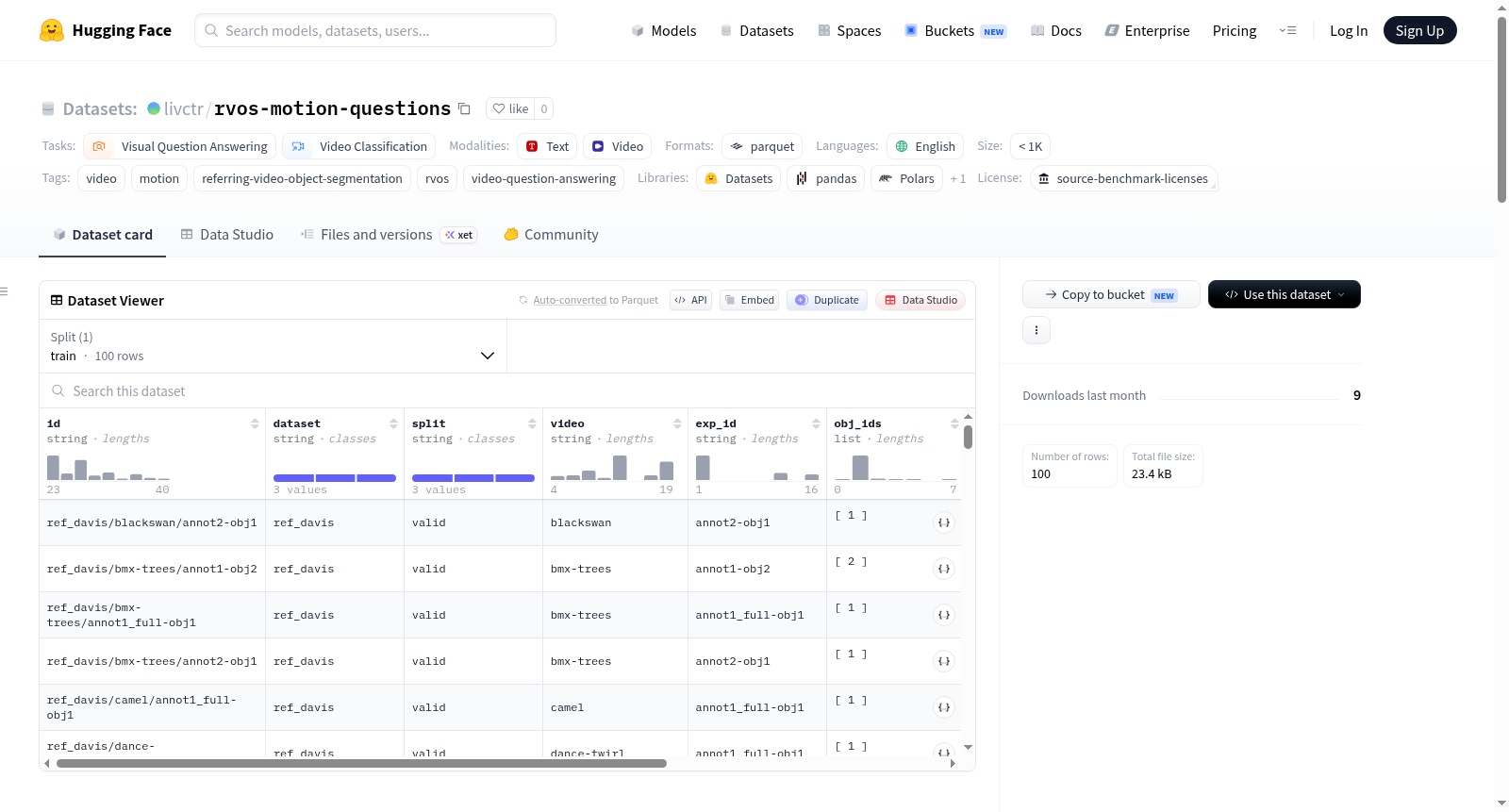
RVOS Motion Questions 是一个基于指代视频对象分割(RVOS)指代表达式合成的基准式运动问题数据集。该数据集旨在将描述视频中对象运动的自然语言表达式(例如“向左移动的大象”)转化为结构化的运动问题,其答案是一个运动属性,如方向、计数、顺序或动作,并以被指代的对象作为问题的主体。数据集的每一行都对应一个源RVOS基准中的指代表达式,但不包含视频像素、真实分割掩码或问题答案本身。相反,它通过元数据字段(包括源数据集名称、分割集、视频标识符、表达式ID和对象ID)引用源视频片段。用户需要持有相应的源RVOS基准数据(如Ref-DAVIS17、MeViS、ReVOS或Ref-YouTube-VOS)的本地副本,才能根据这些引用获取视频帧和真实掩码,并在评估时从基准的真实数据中推导出答案。因此,该数据集本质上是一组“基于真实分割标注的运动问题”,用于评估模型如何根据问题理解并追踪视频中的指定对象。数据模式包含唯一标识符(id)、源数据集(dataset)、分割集(split)、视频键(video)、表达式ID(exp_id)、对象ID列表(obj_ids)、原始指代表达式(expression)、最终生成的运动问题(question)、问题所属的运动类别(question_type)以及问题来源(question_source,如模型自选、人工选择的候选或人工编写)。问题通过一个自动化流水线生成,该流水线利用视觉语言模型为每个表达式生成多个候选问题并自选最佳,部分经过人工审核。问题类型综合了多个现有视频运动问答基准的类别,覆盖了方向、旋转、轨迹、速度、动作、顺序、计数等多种运动维度。该数据集主要适用于由自然语言问题驱动的指代视频对象分割(RVOS)任务评估,即测试模型在给定一个关于对象运动的问题时,能否准确地分割并追踪视频中指定的对象。评估通常通过比较模型预测的分割掩码与源基准提供的真实掩码(使用Jaccard指数J和边界F分数)来进行。数据集规模小于1000个样本,遵循研究用途许可,但用户必须单独获取并遵守其所引用的各个源视频数据集的许可证。
RVOS Motion Questions is a benchmark-style motion question dataset based on referring video object segmentation (RVOS) referring expressions. It aims to convert natural language expressions describing object motion in videos (e.g., the elephant moving to the left) into structured motion questions, where the answer is a motion attribute such as direction, count, order, or action, with the referred object as the subject of the question. Each row in the dataset corresponds to a referring expression from a source RVOS benchmark but does not include video pixels, ground truth segmentation masks, or the question answers themselves. Instead, it references source video clips through metadata fields, including source dataset name, split set, video identifier, expression ID, and object ID. Users need to have local copies of the corresponding source RVOS benchmark data (e.g., Ref-DAVIS17, MeViS, ReVOS, or Ref-YouTube-VOS) to retrieve video frames and ground truth masks based on these references and derive answers from the benchmarks ground truth during evaluation. Thus, the dataset is essentially a set of motion questions based on ground truth segmentation annotations for evaluating how models understand and track specified objects in videos based on questions. The data schema includes a unique identifier (id), source dataset (dataset), split set (split), video key (video), expression ID (exp_id), list of object IDs (obj_ids), original referring expression (expression), the final generated motion question (question), the motion category of the question (question_type), and the question source (question_source, e.g., model self-selection, human-selected candidates, or human-written). Questions are generated through an automated pipeline that uses vision-language models to produce multiple candidate questions for each expression and self-selects the best, with some undergoing manual review. The question types integrate categories from multiple existing video motion question-answering benchmarks, covering various motion dimensions such as direction, rotation, trajectory, speed, action, order, and count. The dataset is primarily suitable for evaluating referring video object segmentation (RVOS) tasks driven by natural language questions, i.e., testing whether a model can accurately segment and track specified objects in videos given a question about object motion. Evaluation typically involves comparing the models predicted segmentation masks with the ground truth masks provided by the source benchmark (using Jaccard index J and boundary F-score). The dataset size is less than 1000 samples, licensed for research use, but users must separately obtain and comply with the licenses of the various source video datasets it references.
数据集名称
RVOS Motion Questions
数据集概况
这是一个面向视频运动理解的基准风格问题数据集,问题从参照视频对象分割(RVOS) 的指代表达式中自动合成。每一条数据将一个指代表达式(如*“向左移动的大象”)转化为一个运动问题,其答案是一个运动属性(如方向、计数、顺序、动作等),被指代的对象作为问题的主语(例如“最左边的大象朝哪个方向移动?”*,答案:向左)。数据集不直接提供视频像素、分割掩码或答案,而是通过引用的方式让用户从原始RVOS基准数据集中获取。
数据规模
- 总样本数:小于1,000条(
n<1K)
任务与语言
- 任务类型:视觉问答、视频分类
- 语言:英语
数据集用途
- 提供问题 → 跟踪目标的映射,用于评估模型根据运动问题驱动RVOS跟踪的能力。
- 不存储直接答案,答案需在评估时通过基准数据集的真实标注获得(如对象的跟踪运动)。
数据模式(Schema)
每一条数据对应一个指代表达式,包含以下字段:
| 字段 | 类型 | 说明 |
|---|---|---|
id |
string | 唯一标识,格式为 "<数据集>/<视频>/<表达式ID>" |
dataset |
string | 来源基准数据集,可选:ref_davis、mevis_v2、revos、ref_ytvos |
split |
string | 来源数据集的划分(如 valid) |
video |
string | 数据集内的视频键值 |
exp_id |
string | 来源标注ID,用于获取真实分割掩码 |
obj_ids |
list[int] | 表达式所指代的对象/调色板索引,对应真实分割掩码 |
expression |
string | 原始的RVOS指代表达式 |
question |
string | 最终生成的运动问题(若生成失败则为 null) |
question_type |
string | 问题的运动类别(若未标注或生成失败则为 null) |
使用方式
用户需要自行获取对应基准数据集的本地副本(如Ref-DAVIS17、MeViS、ReVOS、Ref-YouTube-VOS),然后通过 video、exp_id、obj_ids 定位视频帧和真实分割掩码。示例代码:
python from datasets import load_dataset ds = load_dataset("livctr/rvos-motion-questions", split="train") row = ds[0]
使用 row["dataset"], row["video"], row["exp_id"], row["obj_ids"] 获取本地帧和真实掩码
使用 row["question"] 作为模型输入,评估其跟踪/答案得分
评估方法
自然评估方法为:根据生成的问题驱动RVOS跟踪,让模型从问题主语中恢复要跟踪什么,然后使用预测掩码与基准真实标注计算 J & F 指标。可通过 motion-qa 仓库中的评估脚本执行,例如:
bash
评估生成的问题(基于基准真实标注)
python3 -m motion_qa.rvos.eval.runner --dataset ref_davis --split valid --root /path/to/Ref-DAVIS17 --out runs/eval_question --mode question_mode --questions questions.jsonl --trace
基线:使用原始指代表达式在相同视频上进行评估
python3 -m motion_qa.rvos.eval.runner --dataset ref_davis --split valid --root /path/to/Ref-DAVIS17 --out runs/eval_expr --mode benchmark_mode
数据来源(Provenance)
问题类型综合自四个视频运动问答基准:TOMATO(arXiv 2410.23266)、VLM4D(arXiv 2508.02095)、MotionBench(arXiv 2501.02955)和FAVOR-Bench(arXiv 2503.14935)。涵盖的运动类别包括:运动方向、旋转/自旋、轨迹形状、速度/加速度、动作/动词、动作顺序、重复/计数、相对运动、位置变化、出现/消失、运动状态变化。指代表达式和真实标注来源于上述RVOS基准数据集。
许可证
- 生成的问题部分采用 source-benchmark-licenses 许可证(详见 链接)。
- 底层视频、指代表达式和真实分割掩码受其各自来源基准数据集的许可证约束,用户需自行获取并遵守相应条款。