
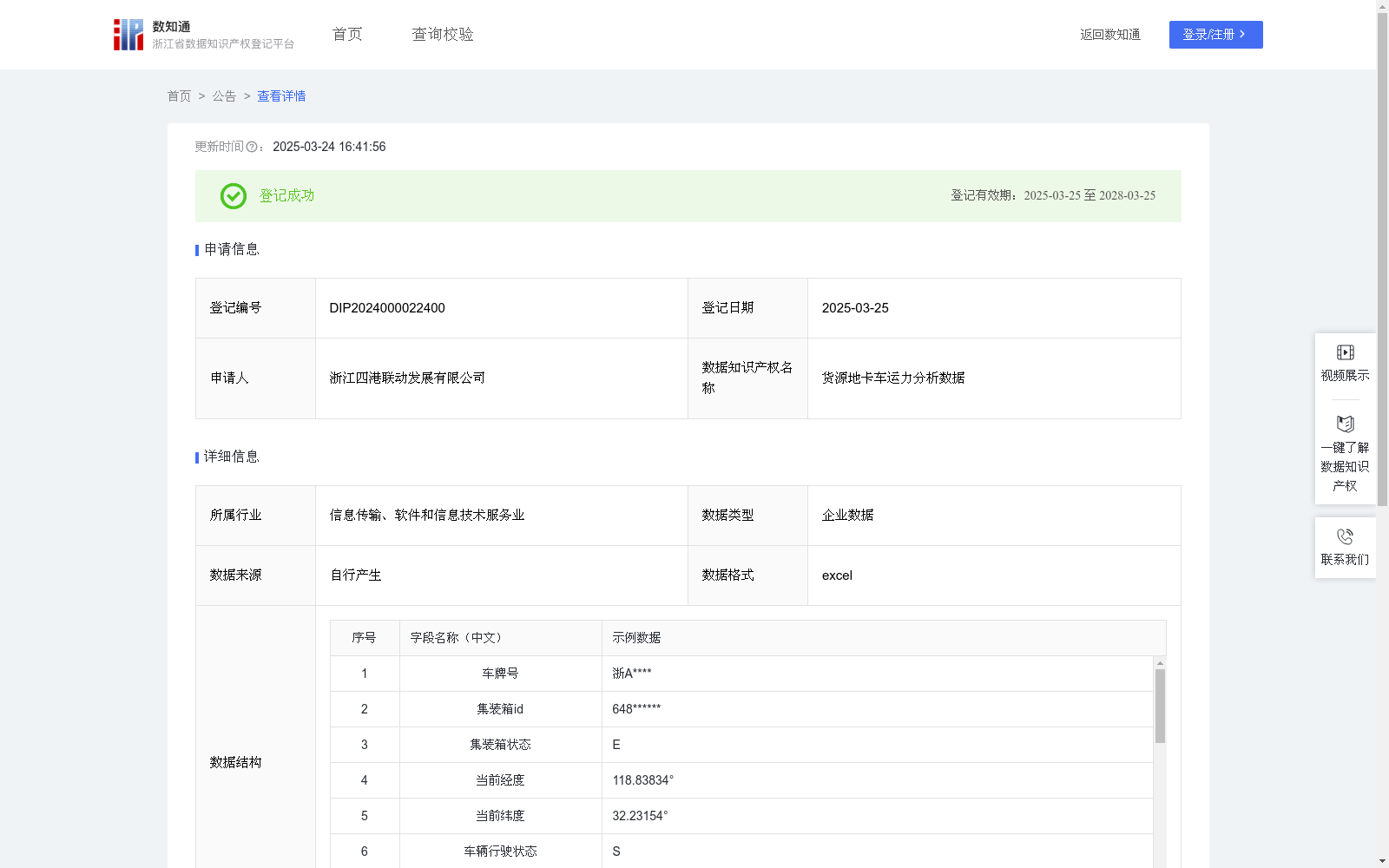
货源地卡车运力分析数据
收藏浙江省数据知识产权登记平台2025-03-24 更新2025-03-25 收录
下载链接:
https://www.zjip.org.cn/home/announce/trends/119597
下载链接
链接失效反馈官方服务:
资源简介:
对集装箱货运卡车轨迹记录分析,掌握出口货源地卡车运动信息,分析货源地卡车运力利用情况,对卡车所在货源地进行分级,分为运力充分使用区域,运力不充分使用区域,有利于跟踪感知货源地货车运力利用情况,方便同行业企业统筹调度不同区域货车运力资源,达到对不同区域货车运力资源利用效率最大化。1、数据采集:通过四港联动货源地数据库输出车牌号、卡车GPS、集装箱状态等字段;
2、数据处理:对采集到的数据进行清洗、分类汇总,对卡车车牌号等进行匿名化处理。
3、数据加工:设定一个固定时间频率K,对固定时间频率K内卡车GPS数据是否变化分类,分为移动和静止两种状态,根据卡车车牌号对不同地市卡车分类,使用SUMIFS和COUNTIFS计算出不同地市卡车空车时长A,与运输集装箱时长B,以及运载集装箱公里数C,计算卡车装箱时间比率D=A/(A+B)*100%,将C与D指数化处理为C1,D1,计算卡车运力利用指数=0.7*C1+0.3*D1,指数排名前三的为卡车运力利用高的地市,指数排名倒数前三的为卡车运力利用低的地市,其余记为正常。
4、数据应用:更有利于货物调运中对卡车运力的统筹调配。
This dataset is designed for analyzing the trajectory records of container freight trucks, with the objectives of acquiring the movement information of trucks at export cargo origins, evaluating the utilization of truck transportation capacity at these origins, and classifying the cargo origins into three categories: regions with fully utilized transportation capacity, regions with underutilized transportation capacity, and normally utilized regions. This work facilitates tracking and monitoring the utilization status of truck transportation capacity at cargo origins, enabling enterprises in the same industry to centrally allocate truck transportation capacity resources across different regions, so as to maximize the utilization efficiency of truck transportation capacity in all regions.
1. Data Collection: Extract fields including license plate numbers, truck GPS data, container status and other relevant information from the four-port intermodal cargo origin database.
2. Data Preprocessing: Clean, classify and aggregate the collected data, and anonymize sensitive information such as truck license plate numbers.
3. Data Analysis & Processing: Set a fixed time frequency K. Classify truck GPS data within each time interval K into two states: moving and stationary based on whether the data changes. Group trucks by their license plate numbers to categorize them by prefecture-level cities. Use the SUMIFS and COUNTIFS functions to calculate the total empty truck duration A, total container transportation duration B, and total container transportation mileage C for trucks in each prefecture-level city. Calculate the truck container loading time ratio D = A/(A+B) * 100%. Normalize C and D into standardized indices C1 and D1 respectively. Compute the truck transportation capacity utilization index as 0.7*C1 + 0.3*D1. Prefecture-level cities with the top three highest indices are classified as regions with high truck transportation capacity utilization, those with the bottom three lowest indices are classified as regions with low truck transportation capacity utilization, and the remaining cities are categorized as normal.
4. Data Application: Better support the centralized allocation of truck transportation capacity during cargo dispatching, optimizing the overall utilization efficiency of transportation resources.
提供机构:
浙江四港联动发展有限公司
创建时间:
2024-12-09
搜集汇总
数据集介绍
背景与挑战
背景概述
该数据集包含999条记录,每日更新,涵盖车牌号、集装箱状态、地理位置等20个字段,用于分析货源地卡车运力利用情况,帮助企业优化货车资源调度。算法通过计算运力利用指数对货源地分级,支持运力资源的高效利用。
以上内容由遇见数据集搜集并总结生成



