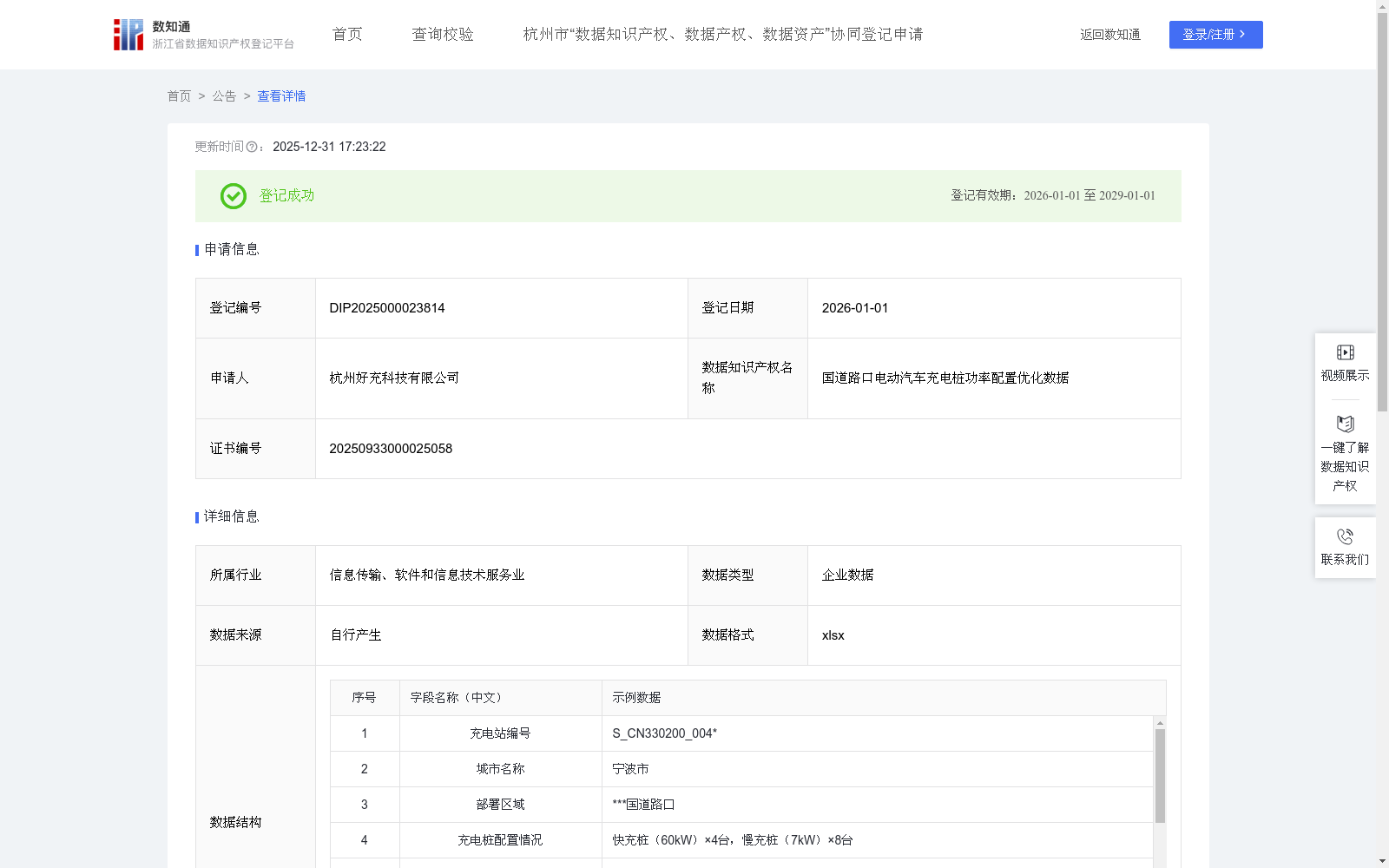
国道路口电动汽车充电桩功率配置优化数据
收藏资源简介:
本数据通过分析国道路口不同时段的充电需求特征,为充电基础设施优化提供决策支持。主要应用于:指导运营商根据不同时段的功率匹配度计算结果,动态调整充电桩功率配置;识别高负荷站点优先扩容,发现闲置设备可优化区域;合理分配电力资源,提升整体运营效率。同时可为管理部门提供充电设施使用时段分析报告,助力实现充电资源的精准配置与高效利用。 "1.数据采集与处理 采集企业自有充电桩设备管理数据,包括充电站编号、城市名称、部署区域、充电桩配置情况、统计日期、早高峰总充电量、晚高峰总充电量、低谷时段总充电量、平峰时段总充电量等数据。时段划分为:早高峰(9:00-12:00)、晚高峰(15:00-19:00)、低谷(0:00-6:00)、平峰(其余时段),通过数据清洗剔除<5分钟充电记录等其他异常值与无效记录。 2.核心计算 计算需求指数: 早高峰需求指数=早高峰总充电量/早高峰时长(3小时) 晚高峰需求指数=晚高峰总充电量/晚高峰时长(4小时)×1.2(晚高峰权重) 低谷时段需求指数=低谷时段总充电量×0.2(低谷时段权重)/低谷时段时长(6小时) 平峰时段需求指数=平峰总充电量×0.4(平峰时段权重)/平峰时段时长(11小时) 计算功率匹配度: 功率匹配度=(早高峰需求指数×1.3+晚高峰需求指数×1.5+低谷需求指数+平峰需求指数)/(快充桩总功率+慢充桩总功率) 3.功率匹配度情况分类及充电桩功率配置优化策略 功率匹配度>1.8:功率匹配度情况分类为""功率不足"",功率配置优化策略:早高峰时段:快充桩锁定100%功率,慢充桩+25%超频;晚高峰时段:快充桩锁定100%功率,慢充桩+30%超频;低谷时段:慢充桩降功40%;平峰时段:维持标准功率 1.2≤匹配度≤1.8:功率匹配度情况分类为""配置基本合理"",功率配置优化策略:早高峰时段:快充桩保持95%功率;晚高峰时段:快充桩保持100%功率;低谷时段:慢充桩降功30%;平峰时段:维持标准功率 匹配度<1.2:功率匹配度情况分类为""功率过剩"",功率配置优化策略:早高峰时段:快充桩保持85%功率;晚高峰时段:快充桩保持90%功率;低谷时段:全桩降功50%;平峰时段:全桩降功40%"
This dataset analyzes the charging demand characteristics at national highway intersections across different time periods, providing decision-making support for the optimization of charging infrastructure. Its main applications include: guiding operators to dynamically adjust the power configuration of charging piles based on the power matching degree calculations for different time periods; identifying high-load stations for priority expansion, and optimizing regions with idle equipment; rationally allocating power resources to improve overall operational efficiency. Additionally, it can provide time-based usage analysis reports of charging facilities for management departments, helping to achieve precise allocation and efficient utilization of charging resources. 1. Data Collection and Processing Collect management data from the enterprise's own charging pile equipment, including charging station ID, city name, deployment area, charging pile configuration, statistical date, total charging volume during morning peak hours, total charging volume during evening peak hours, total charging volume during low-load period, total charging volume during flat peak hours, and other related data. The time periods are divided as follows: morning peak (9:00-12:00), evening peak (15:00-19:00), low-load period (0:00-6:00), and flat peak (remaining time periods). Abnormal and invalid records such as charging sessions shorter than 5 minutes are removed through data cleaning. 2. Core Calculations Calculate the demand index: Morning peak demand index = Total charging volume during morning peak / Duration of morning peak (3 hours) Evening peak demand index = Total charging volume during evening peak / Duration of evening peak (4 hours) × 1.2 (evening peak weight) Low-load period demand index = (Total charging volume during low-load period × 0.2 (low-load period weight)) / Duration of low-load period (6 hours) Flat peak demand index = (Total charging volume during flat peak × 0.4 (flat peak weight)) / Duration of flat peak (11 hours) Calculate the power matching degree: Power matching degree = (Morning peak demand index ×1.3 + Evening peak demand index ×1.5 + Low-load period demand index + Flat peak demand index) / (Total power of fast-charging piles + Total power of slow-charging piles) 3. Power Matching Degree Classification and Charging Pile Power Configuration Optimization Strategies Power matching degree > 1.8: Classified as "Insufficient Power". The power configuration optimization strategies are as follows: during morning peak hours, fast-charging piles are locked at 100% power, slow-charging piles are overclocked by +25%; during evening peak hours, fast-charging piles are locked at 100% power, slow-charging piles are overclocked by +30%; during low-load period, slow-charging piles are derated by 40%; during flat peak hours, standard power is maintained. 1.2 ≤ Power matching degree ≤1.8: Classified as "Basically Reasonable Configuration". The power configuration optimization strategies are as follows: during morning peak hours, fast-charging piles maintain 95% power; during evening peak hours, fast-charging piles maintain 100% power; during low-load period, slow-charging piles are derated by 30%; during flat peak hours, standard power is maintained. Power matching degree <1.2: Classified as "Excessive Power". The power configuration optimization strategies are as follows: during morning peak hours, fast-charging piles maintain 85% power; during evening peak hours, fast-charging piles maintain 90% power; during low-load period, all piles are derated by 50%; during flat peak hours, all piles are derated by 40%