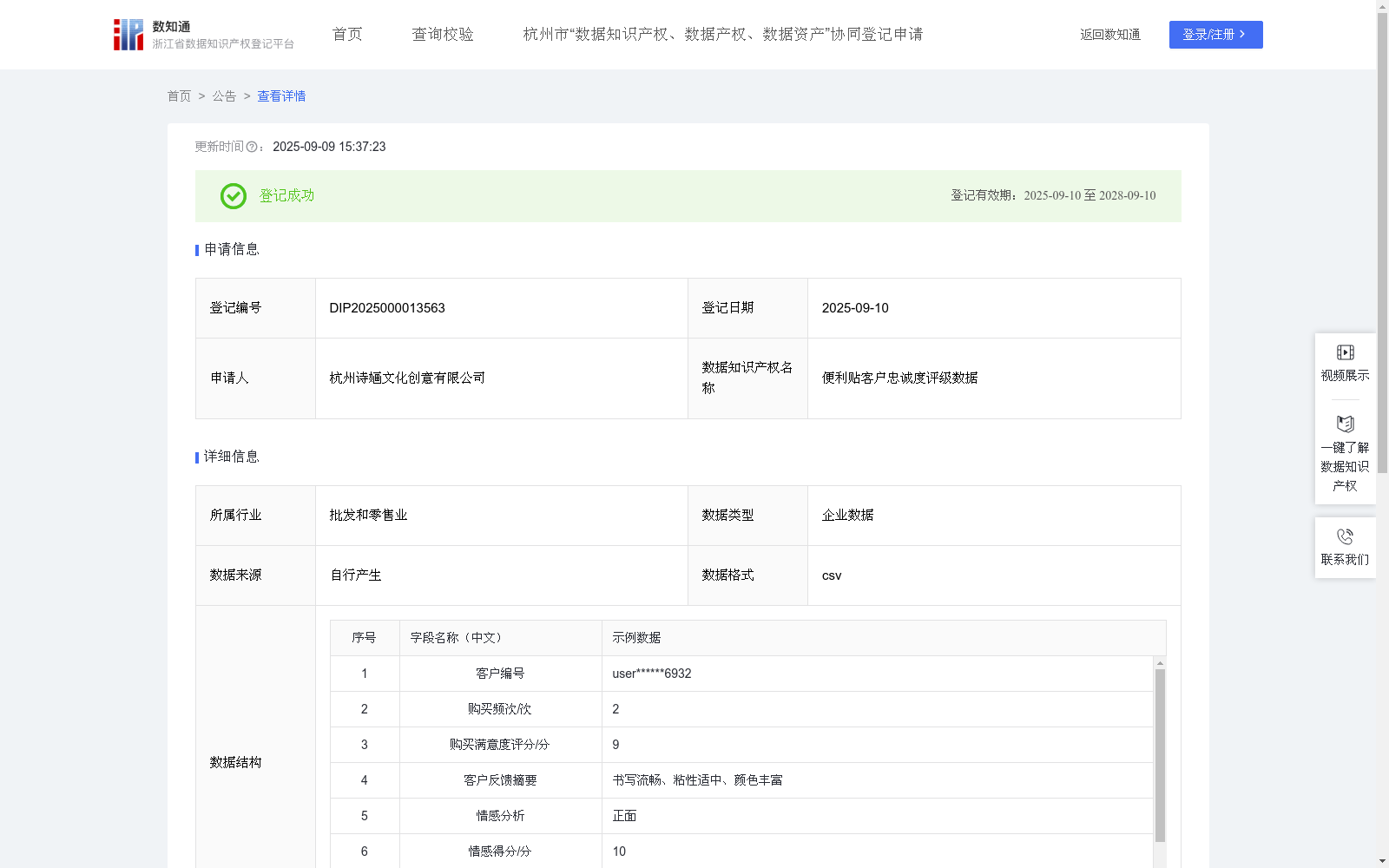
便利贴客户忠诚度评级数据
收藏资源简介:
本数据基于便利贴用户的购买周期、复购行为及品牌选择偏好进行忠诚度评级,呈现客户在日常使用中的持续采购特征。该评级有助于企业了解用户对基础文具产品的品牌依赖与使用惯性,识别稳定消费群体的分布特点。对于文具品牌方、办公用品平台及零售渠道而言,此类数据可为评估用户留存与使用持续性提供参考。同时,该评级也为供应链相关方了解需求稳定性提供信息支持,助力在服务匹配与资源安排中提升运行效率。1.数据收集和预处理:从公司内部订单管理系统中收集客户编号、购买频次、购买满意度评分、客户反馈摘要。通过数据清洗去除无效或错误记录,确保数据质量。 2.计算购买频次得分:根据行业经验划分以下得分区间,将每个客户购买频次映射到相应得分区间。1次:2分;2次:4分;3次:6分;4次:8分;5次及以上:10分 。 3.情感分析:使用情感分析模型(基于机器学习的文本分类模型)对客户反馈摘要进行情感分析,输出为正面、中性或负面。 4.情感得分转换:将情感分析转换为定量得分:正面得10分,中性得6分,负面得2分 。 5.权重分配:根据影响程度研讨确定满意度评分、购买频次和情感得分的权重,满意度评分70%,购买频次20%,情感得分10% 。 6.客户忠诚度评分计算:客户忠诚度评分=(购买满意度评分×0.7)+(购买频次得分×0.2)+(情感得分×0.1) 。 7.客户忠诚度评级:研讨设定以下评级得分,给出客户忠诚度评级 A级(高忠诚度):9分及以上; B级(中高忠诚度):8分(含)~9分(不含); C级(中等忠诚度):6分(含)~8分(不含); D级(低忠诚度):6分以下。
This dataset develops customer loyalty ratings based on the purchase cycles, repurchase behaviors and brand choice preferences of sticky note users, reflecting the continuous purchasing characteristics of customers in their daily usage. This rating helps enterprises understand users' brand dependence and usage inertia towards basic stationery products, and identify the distribution characteristics of stable consumer groups. For stationery brands, office supply platforms and retail channels, this dataset can provide references for evaluating user retention and usage continuity. Meanwhile, this rating also provides information support for supply chain stakeholders to understand demand stability, helping to improve operational efficiency in service matching and resource allocation. 1. Data Collection and Preprocessing: Collect customer ID, purchase frequency, purchase satisfaction score and customer feedback summaries from the company's internal order management system. Remove invalid or erroneous records through data cleaning to ensure data quality. 2. Purchase Frequency Score Calculation: Divide the following score intervals based on industry experience, and map each customer's purchase frequency to the corresponding score interval. 1 purchase: 2 points; 2 purchases: 4 points; 3 purchases: 6 points; 4 purchases: 8 points; 5 or more purchases: 10 points. 3. Sentiment Analysis: Conduct sentiment analysis on customer feedback summaries using a sentiment analysis model (a machine learning-based text classification model), with outputs categorized as positive, neutral or negative. 4. Sentiment Score Conversion: Convert sentiment analysis results into quantitative scores: 10 points for positive sentiment, 6 points for neutral sentiment, and 2 points for negative sentiment. 5. Weight Allocation: Determine the weights of purchase satisfaction score, purchase frequency score and sentiment score through discussion based on their impact degree, with 70% for satisfaction score, 20% for purchase frequency score and 10% for sentiment score. 6. Customer Loyalty Score Calculation: Customer Loyalty Score = (Purchase Satisfaction Score × 0.7) + (Purchase Frequency Score × 0.2) + (Sentiment Score × 0.1) 7. Customer Loyalty Rating: Set the following rating thresholds through discussion to classify customer loyalty: Level A (High Loyalty): 9 points and above; Level B (Medium-High Loyalty): 8 points (inclusive) to 9 points (exclusive); Level C (Medium Loyalty): 6 points (inclusive) to 8 points (exclusive); Level D (Low Loyalty): below 6 points.