
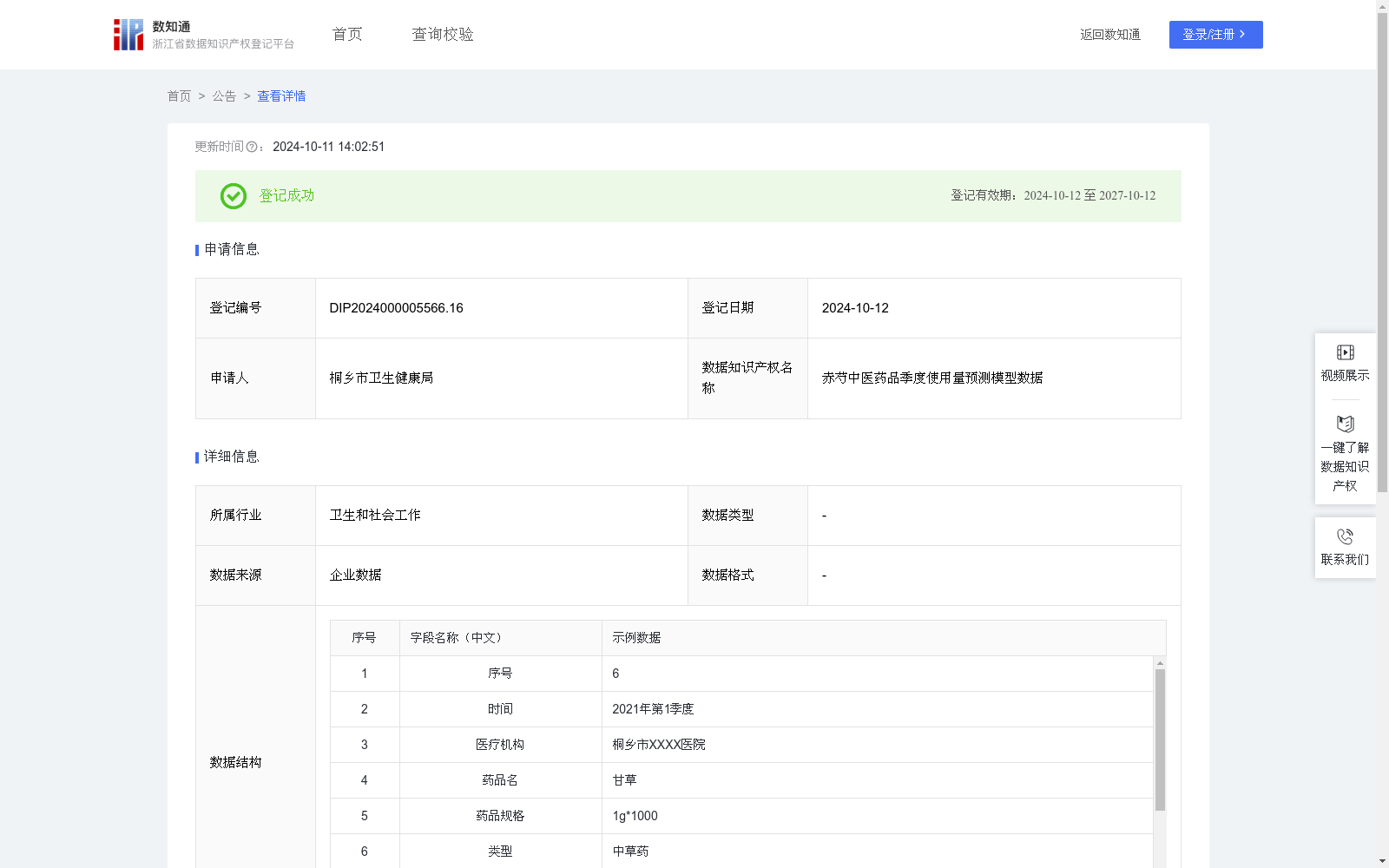
赤芍中医药品季度使用量预测模型数据
收藏浙江省数据知识产权登记平台2024-10-11 更新2024-10-12 收录
下载链接:
https://www.zjip.org.cn/home/announce/trends/69394
下载链接
链接失效反馈官方服务:
资源简介:
通过分析桐乡市医疗机构季度赤芍中药材使用量,可以预测下个季度赤芍中药材的使用量,从而合理安排库存,避免库存积压或短缺。这有助于减少药品过期浪费,通过对医疗机构每季度中药材使用量的分析,可以了解不同地区、不同医疗机构之间中药材使用情况的差异。这有助于政府和相关部门在制定医疗资源配置政策时更加科学合理,促进医疗资源的合理配置和有效利用。
1. 数据采集:收集医疗机构的赤芍中药材的季度库存和使用数据,包括季度入库量、季度使用量等。 2. 数据预处理:对中药材的库存和使用数据进行清洗,去除异常值,平滑数据,以确保数据的准确性和可用性。 3. 特征工程:生成基于时间的特征,季节性变化系数SC(t),表示第t季度的使用量变化;生成计算库存周转率ITR(t) = Total_Incoming(t) / Total_Used(t),其中Total_Incoming(t)是第t季度的入库总量,Total_Used(t)是第t季度的使用总量。 4. 季节性模型构建: 季度模型: S(t)=ω1 * U(t-1) + ω2* U(t-2)+…+β1 * SC(t) +β2 * ITR(t),其中U(t-k)代表第t-k季度的实际使用量,ω1和ω2是时间序列权重,β1和β2是特征权重。 季度的模型考虑了季节性影响和历史使用数据,以及库存周转率,确保了预测的精确性和适用性。通过这种方式,医疗机构可以更精准地预测和调整中药材的库存,以保障医疗服务的连续性和效率。
By analyzing the quarterly usage volume of Chishao (Paeoniae Radix Rubra, a commonly used traditional Chinese medicine, TCM) in medical institutions across Tongxiang City, stakeholders can predict the usage volume in the following quarter, thereby arranging inventory reasonably and avoiding overstock or stockout. This practice helps reduce waste from expired pharmaceuticals. Furthermore, analyzing quarterly TCM usage data across different medical institutions can uncover disparities in TCM utilization between various regions and healthcare facilities. This insight enables governments and relevant departments to formulate more scientific and rational medical resource allocation policies, promoting the proper deployment and efficient utilization of medical resources.
1. Data Collection: Collect quarterly inventory and usage data of Chishao from medical institutions, including quarterly incoming stock volume and total quarterly usage volume.
2. Data Preprocessing: Clean and preprocess the collected TCM inventory and usage data by removing outliers and smoothing the dataset, to ensure data accuracy and usability.
3. Feature Engineering: Generate time-based features: the seasonal variation coefficient SC(t), which indicates the change in usage volume in quarter t; calculate the inventory turnover ratio ITR(t) = Total_Incoming(t) / Total_Used(t), where Total_Incoming(t) is the total stock volume incoming in quarter t, and Total_Used(t) is the total usage volume in quarter t.
4. Seasonal Model Construction:
Quarterly forecasting model: $S(t) = omega_1 cdot U(t-1) + omega_2 cdot U(t-2) + dots + eta_1 cdot SC(t) + eta_2 cdot ITR(t)$, where $U(t-k)$ represents the actual usage volume in the $(t-k)$-th quarter, $omega_1$ and $omega_2$ are time series weights, and $eta_1$ and $eta_2$ are feature weights. This quarterly model incorporates seasonal effects, historical usage data and inventory turnover ratio, ensuring the accuracy and applicability of the prediction. Through this framework, medical institutions can precisely predict and adjust their TCM inventory, thus safeguarding the continuity and efficiency of medical services.
提供机构:
桐乡市卫生健康局
创建时间:
2024-08-13
搜集汇总
数据集介绍
特点
该数据集包含14992条记录,每季度更新,记录了桐乡市医疗机构赤芍中药材的季度使用量、入库量等信息,用于预测下季度使用量并优化库存管理。应用场景包括减少药品浪费和促进医疗资源合理配置。算法规则结合季节性变化和库存周转率进行预测。
以上内容由遇见数据集搜集并总结生成



