CuAu
收藏资源简介:
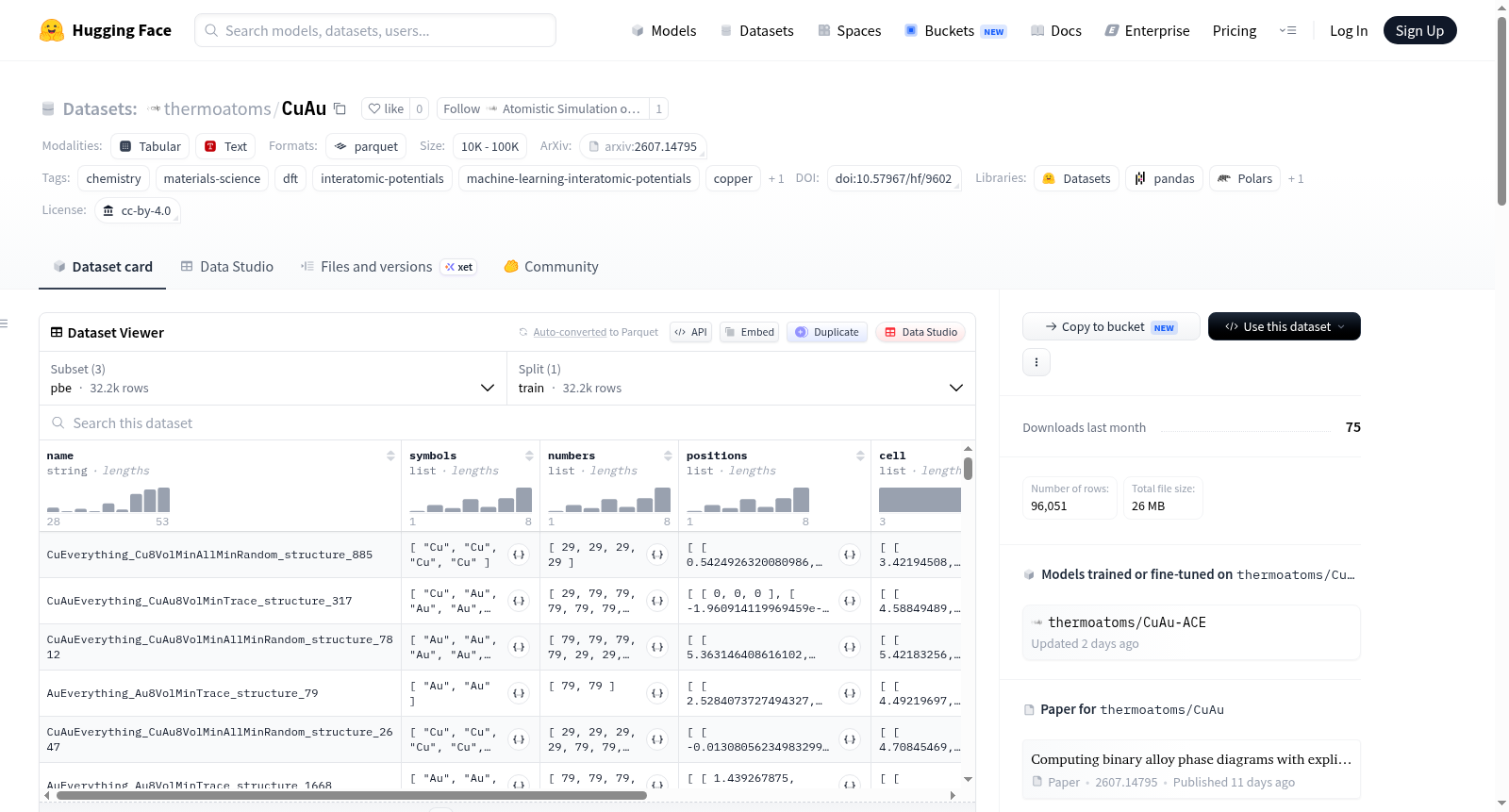
Cu-Au DFT训练数据是一个用于机器学习原子间势(MLIPs)训练和基准测试的材料科学数据集。它包含约96,000个小型(每个晶胞含1-8个原子)的周期性铜、金和铜-金合金结构。每个结构都提供了通过密度泛函理论计算的总能量(以电子伏特eV为单位)和原子力(以eV/Å为单位)。数据集的独特之处在于,基于相同的结构生成协议,提供了使用三种不同交换关联泛函(PBE、LDA和R2SCAN)进行计算的结果,形成了三个独立的子集(配置)。这些子集(pbe、lda、r2scan)分别包含约32,000个结构,总计约53万个原子数据点。结构覆盖了从纯铜、纯金到铜-金混合的各种组成,并特意包含了高度畸变和高能量的构型,以确保训练的原子间势具有鲁棒性。每个数据样本包含结构标识符、化学符号列表、原子序数列表、原子笛卡尔坐标(单位Å)、晶胞向量(单位Å)、DFT总能(单位eV)、原子力(单位eV/Å)和原子数。所有计算均使用VASP软件完成,平面波截断能为550eV。该数据集适用于开发、训练和评估针对铜、金及其合金的机器学习原子间势模型,也可用于比较不同DFT泛函对计算结果的影响。
Cu-Au DFT Training Data is a materials science dataset for training and benchmarking machine-learned interatomic potentials (MLIPs). It contains approximately 96,000 small (1-8 atoms per unit cell) periodic structures of copper (Cu), gold (Au), and copper-gold (Cu-Au) alloys. For each structure, the dataset provides total energy (in electron volts, eV) and atomic forces (in eV/Å) calculated using density functional theory (DFT). The uniqueness of this dataset lies in its provision of results computed with three different exchange-correlation functionals (PBE, LDA, and R2SCAN) based on the same structural generation protocol, forming three independent subsets (configurations). These subsets (pbe, lda, r2scan) each contain approximately 32,000 structures, totaling about 530,000 atomic data points. The structures cover compositions ranging from pure Cu and pure Au to Cu-Au mixtures, and intentionally include highly distorted and high-energy configurations to ensure the robustness of trained interatomic potentials. Each data sample includes the following fields: structure identifier (name), list of chemical symbols (symbols), list of atomic numbers (numbers), atomic Cartesian coordinates (positions, in Å), unit cell vectors (cell, in Å), DFT total energy (energy, in eV), atomic forces (forces, in eV/Å), and number of atoms (number_of_atoms). All calculations were performed using the VASP software with a plane-wave cutoff energy of 550 eV. This dataset is suitable for developing, training, and evaluating machine-learned interatomic potential models for copper, gold, and their alloys, and can also be used to compare the effects of different DFT functionals on computational results.
数据集概述
数据集名称: Cu-Au DFT Training Data
许可协议: CC-BY-4.0
标签: 化学、材料科学、密度泛函理论(DFT)、原子间势、机器学习原子间势、铜、金
数据规模: 10K < n < 100K(约96,000个结构)
数据集内容
该数据集包含约96,000个小周期性Cu、Au和Cu-Au结构(每晶胞1–8个原子)的DFT总能和原子受力,使用三种交换关联泛函计算。旨在作为机器学习原子间势的训练/参考数据。
每种泛函对应一个独立的子集(配置):
pbe(默认)ldar2scan
所有子集使用相同的结构生成协议,仅在参考计算所用的泛函上不同。
子集统计
| 配置 | 结构数 | 总原子数 | Cu-only | Au-only | Cu-Au | 每原子能量范围 (eV) |
|---|---|---|---|---|---|---|
pbe |
32,228 | 178,269 | 8,844 | 8,971 | 14,413 | −3.73 … +6.64 |
lda |
31,931 | 176,630 | 8,736 | 8,928 | 14,267 | −4.69 … +5.43 |
r2scan |
31,892 | 176,358 | 8,728 | 8,923 | 14,241 | −4.25 … +6.10 |
所有结构均为全周期(pbc = TTT),具有一般三斜晶胞。数据集中有意包含强扭曲和高能构型,以进行稳健的势拟合。
计算细节
- 平面波截断能:550 eV
- k点间距:0.1/Å
- 收敛标准:至少10⁻⁶ eV
- 展宽方法:Methfessel-Paxton,宽度0.2 eV
- 计算软件:VASP
数据字段
| 字段名 | 类型 | 描述 |
|---|---|---|
name |
字符串 | 结构标识符,编码成分和生成族,如 CuEverything_Cu8VolMinAllMinRandom_structure_885 |
symbols |
列表[字符串] | 化学符号,长度 N |
numbers |
列表[整数] | 原子序数(29 = Cu, 79 = Au) |
positions |
列表[列表[浮点数]] | 笛卡尔坐标,单位 Å,形状 (N, 3) |
cell |
列表[列表[浮点数]] | 以行为单位的晶胞向量,单位 Å,形状 (3, 3) |
energy |
浮点数 | DFT总能,单位 eV |
forces |
列表[列表[浮点数]] | 原子受力,单位 eV/Å,形状 (N, 3) |
number_of_atoms |
整数 | 原子数 N(1–8) |
使用示例
加载数据集
python from datasets import load_dataset
ds = load_dataset("thermoatoms/CuAu", "pbe", split="train") # 或 "lda", "r2scan" row = ds[0]
重建ASE Atoms对象
python from ase import Atoms
atoms = Atoms( numbers=row["numbers"], positions=row["positions"], cell=row["cell"], pbc=True, ) energy = row["energy"] # eV forces = row["forces"] # eV/Å
结构生成方法
采用ASSYST方法生成结构:对称性随机候选晶胞(最多8个原子),跨越空间群采样(841个Cu样品、841个Au样品、1335个Cu-Au样品)。经过连续体积弛豫和全弛豫后,通过随机抖动(σ = 0.5 Å)和静水/剪切应变变体增强,以获得振动和弹性采样。结构族编码在 name 字段中(例如 VolMinAllMinRandom、VolMinTrace、VolMinAllMinTrace)。小晶胞设计使得使用多个泛函重新标记同一结构池变得高效,这也是三个子集的获取方式。
引用信息
若使用该数据集,请引用:
@misc{Menon2026, title={Computing binary alloy phase diagrams with explicit configurational and vibrational entropy}, author={Sarath Menon and Marvin Poul and Tilmann Hickel and Jörg Neugebauer and Ralf Drautz}, year={2026}, eprint={2607.14795}, archivePrefix={arXiv}, primaryClass={cond-mat.mtrl-sci}, url={https://arxiv.org/abs/2607.14795}, }