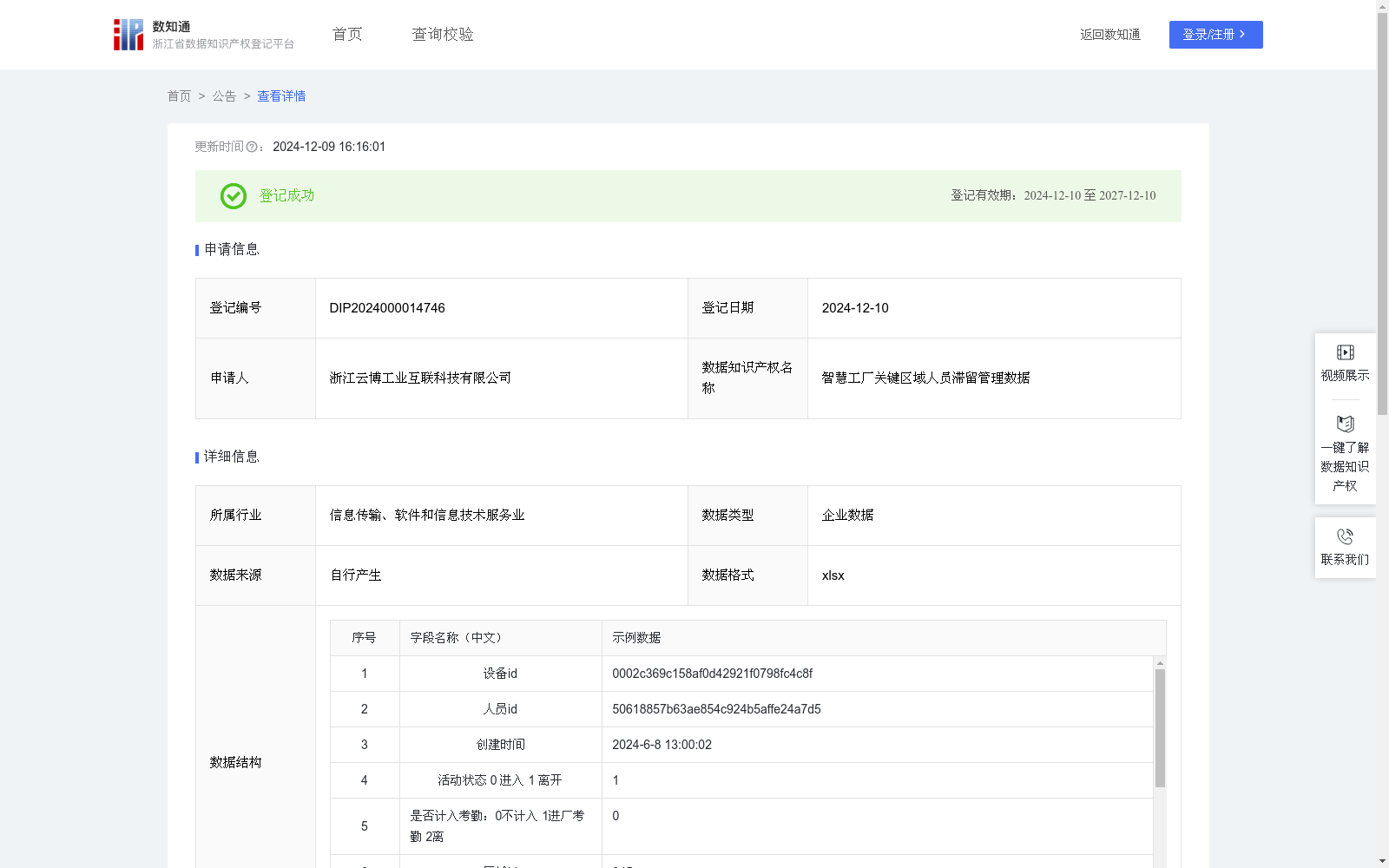
智慧工厂关键区域人员滞留管理数据
收藏资源简介:
所有工厂可以使用,通过工人的读卡记录,管理人员掌握工人的行动轨迹。通过采集各个区域的人员数据,了解工厂各个区域的人员滞留情况(在此区域超过合理时间算滞留,用户自定义此时间),对于工厂的管理和安全至关重要,在紧急情况下,如火灾、地震或其他自然灾害,了解人员滞留情况可以帮助救援人员迅速定位受困人员,实施有效的救援行动。在危机情况下,如化学泄漏或其它需要紧急疏散的情况,了解哪个区域有多少人可以迅速制定疏散计划,减少风险。1、数据收集:在工厂的各个关键区域安装读卡器,读卡器能够识别工人的身份和功能信息。当工人经过读卡器时,读卡器会实时捕捉并发送他们的信息,这些信息通常包括工人ID、打卡时间戳和所在位置。 2、数据清洗:对收集到的数据需要进行清洗以确保数据的质量和准确性。清洗过程包括去除空格、转换数据格式、验证数据完整性,以及处理缺失或错误的值。对于不符合协议的数据进行修正或剔除。 3、数据修正:对于读卡器漏读的信息,比如只检测到了进入某个区域,离开时没读到信息,系统采用一定的算法补充漏读信息。 4、数据存储:清洗后的数据需要存储在数据库中,以便进行长期存储和快速检索。数据存储时将用户的敏感信息进行了加密,确保用户数据的隐私和安全,确保敏感信息得到保护。 5、数据算法:人员在进入船坞或泊位时会触发RFID无缘感知系统进行读取进入时间,人员完工后出船坞或泊位再次触发读取离开时间,从而形成进入和离开的闭环数据;用户自定义滞留时间阈值,如人员进入后停留时间超过此阈值,则提醒管理人员某个区域有人员异常滞留,需要查看人员情况,从而更加有效的对人员安全起到一个监管的作用。例如高危区域人员不可长时间停留,这时可通过系统对该区域进行设置滞留时间,通过进入时间和滞留时间去判断进入人员是否有在规定时间内离开,如规定时间已离开则不触发提醒,“是否滞留”字段置为0;规定时间内未离开这时候触发提醒“是否滞留”字段置为1,提醒方式有两种平台预警和短信提醒;收到提醒的人去核对未离开人员当前情况并进行反馈,从而对此人员的数据形成闭环。 6、数据展示:收集和清洗好的数据通过可视化工具和仪表板展示给管理人员。包括包括工人分布地图、各区域实时人数统计,各区域人员进出记录等,帮助管理人员实时了解工厂运营状况及各区域的人员分布情况。
Applicable to all factories: Managers can grasp workers' movement trajectories through their card swiping records. By collecting personnel data from various areas, the overstay situation of personnel in each area of the factory can be understood (overstay is defined as staying in an area beyond a user-defined reasonable duration), which is crucial for factory management and safety. In emergency situations such as fires, earthquakes or other natural disasters, understanding the overstay status can help rescuers quickly locate trapped personnel and carry out effective rescue operations. In crisis situations such as chemical leaks or other scenarios requiring emergency evacuation, knowing the number of people in each area can allow rapid formulation of evacuation plans to reduce risks. 1. Data Collection: Card readers are installed in all key areas of the factory, which can identify workers' identity and functional information. When workers pass through the card readers, the readers will capture and send their information in real time, which usually includes worker ID, check-in timestamp and location. 2. Data Cleaning: The collected data needs to be cleaned to ensure data quality and accuracy. The cleaning process includes removing spaces, converting data formats, verifying data integrity, and handling missing or erroneous values. Data that does not comply with the protocol will be corrected or eliminated. 3. Data Correction: For information missed by card readers (for example, only the entry into a certain area is detected, but no information is read when leaving), the system uses certain algorithms to supplement the missed information. 4. Data Storage: The cleaned data needs to be stored in a database for long-term storage and rapid retrieval. Sensitive user information is encrypted during data storage to ensure the privacy and security of user data and protect sensitive information. 5. Data Algorithms: When personnel enter the dock or berth, the RFID passive perception system will be triggered to read the entry time. When personnel leave the dock or berth after completing their work, the system will be triggered again to read the exit time, thus forming closed-loop entry and exit data. Users can define a custom overstay time threshold: if a person stays beyond the threshold after entering, the manager will be alerted that there is abnormal overstay of personnel in a certain area and needs to check the personnel's situation, so as to more effectively supervise personnel safety. For example, personnel in high-risk areas are not allowed to stay for a long time. At this time, the overstay time can be set for the area through the system. Whether the entering personnel leave within the specified time is judged based on the entry time and overstay time. If the person leaves within the specified time, the "whether overstay" field is set to 0; if the person does not leave within the specified time, an alert will be triggered and the "whether overstay" field is set to 1. There are two alert methods: platform early warning and SMS alert. The person who receives the alert will check the current status of the personnel who have not left and give feedback, thus forming a closed loop for this personnel's data. 6. Data Display: The collected and cleaned data is displayed to managers through visualization tools and dashboards, including worker distribution maps, real-time population statistics of each area, personnel entry and exit records of each area, etc., helping managers real-time understand factory operation status and personnel distribution in each area.