midas/ldkp10k
收藏资源简介:
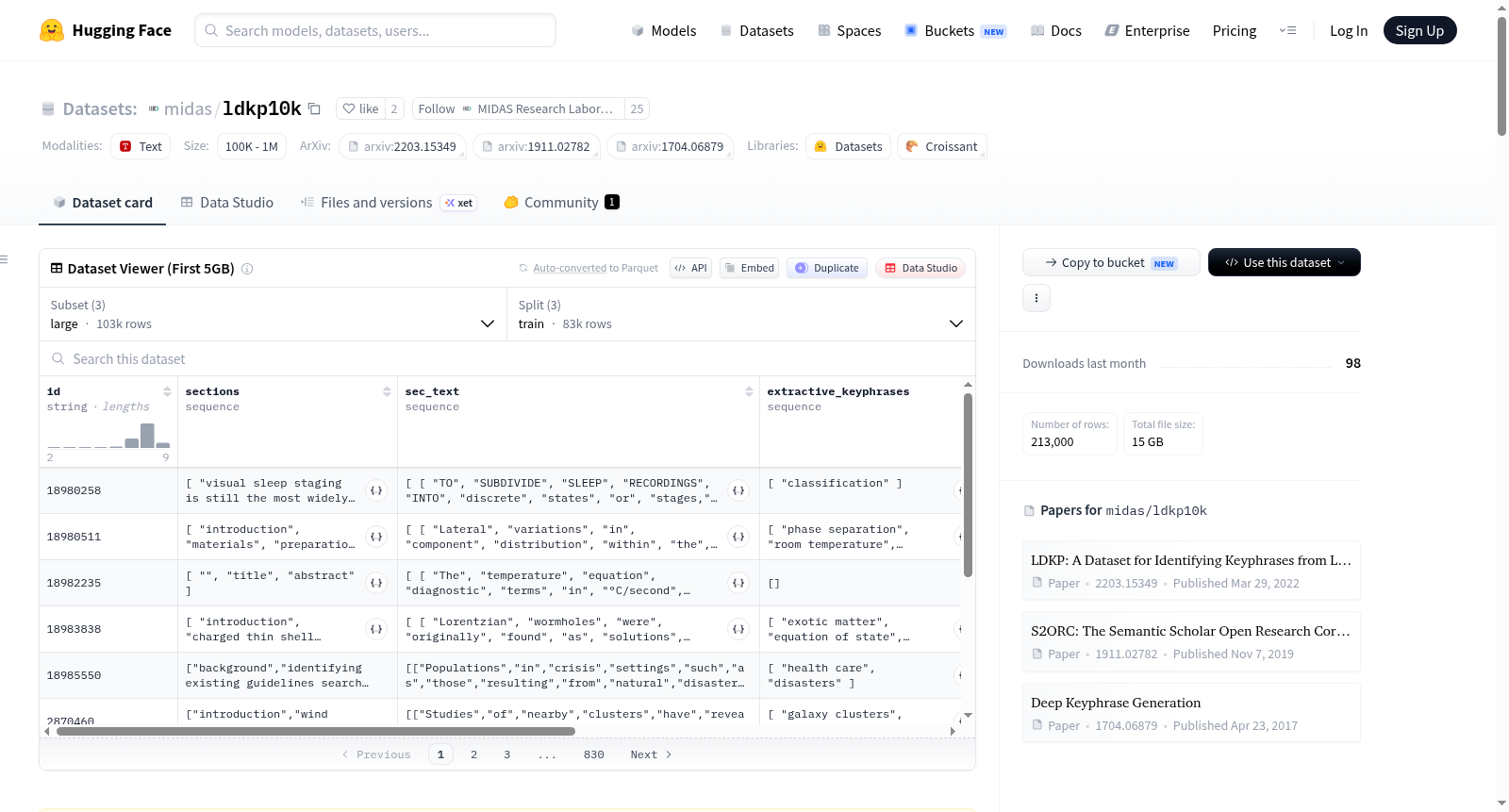
A dataset for benchmarking keyphrase extraction and generation techniques from long document English scientific papers. For more details about the dataset please refer the original paper - [](). Data source - []() ## Dataset Summary ## Dataset Structure ### Data Fields - **id**: unique identifier of the document. - **sections**: list of all the sections present in the document. - **sec_text**: list of white space separated list of words present in each section. - **sec_bio_tags**: list of BIO tags of white space separated list of words present in each section. - **extractive_keyphrases**: List of all the present keyphrases. - **abstractive_keyphrase**: List of all the absent keyphrases. ### Data Splits |Split| #datapoints | |--|--| | Train-Small | 20,000 | | Train-Medium | 50,000 | | Train-Large | 1,296,613 | | Test | 10,000 | | Validation | 10,000 | ## Usage ### Small Dataset ```python from datasets import load_dataset # get small dataset dataset = load_dataset("midas/ldkp10k", "small") def order_sections(sample): """ corrects the order in which different sections appear in the document. resulting order is: title, abstract, other sections in the body """ sections = [] sec_text = [] sec_bio_tags = [] if "title" in sample["sections"]: title_idx = sample["sections"].index("title") sections.append(sample["sections"].pop(title_idx)) sec_text.append(sample["sec_text"].pop(title_idx)) sec_bio_tags.append(sample["sec_bio_tags"].pop(title_idx)) if "abstract" in sample["sections"]: abstract_idx = sample["sections"].index("abstract") sections.append(sample["sections"].pop(abstract_idx)) sec_text.append(sample["sec_text"].pop(abstract_idx)) sec_bio_tags.append(sample["sec_bio_tags"].pop(abstract_idx)) sections += sample["sections"] sec_text += sample["sec_text"] sec_bio_tags += sample["sec_bio_tags"] return sections, sec_text, sec_bio_tags # sample from the train split print("Sample from train data split") train_sample = dataset["train"][0] sections, sec_text, sec_bio_tags = order_sections(train_sample) print("Fields in the sample: ", [key for key in train_sample.keys()]) print("Section names: ", sections) print("Tokenized Document: ", sec_text) print("Document BIO Tags: ", sec_bio_tags) print("Extractive/present Keyphrases: ", train_sample["extractive_keyphrases"]) print("Abstractive/absent Keyphrases: ", train_sample["abstractive_keyphrases"]) print("\n-----------\n") # sample from the validation split print("Sample from validation data split") validation_sample = dataset["validation"][0] sections, sec_text, sec_bio_tags = order_sections(validation_sample) print("Fields in the sample: ", [key for key in validation_sample.keys()]) print("Section names: ", sections) print("Tokenized Document: ", sec_text) print("Document BIO Tags: ", sec_bio_tags) print("Extractive/present Keyphrases: ", validation_sample["extractive_keyphrases"]) print("Abstractive/absent Keyphrases: ", validation_sample["abstractive_keyphrases"]) print("\n-----------\n") # sample from the test split print("Sample from test data split") test_sample = dataset["test"][0] sections, sec_text, sec_bio_tags = order_sections(test_sample) print("Fields in the sample: ", [key for key in test_sample.keys()]) print("Section names: ", sections) print("Tokenized Document: ", sec_text) print("Document BIO Tags: ", sec_bio_tags) print("Extractive/present Keyphrases: ", test_sample["extractive_keyphrases"]) print("Abstractive/absent Keyphrases: ", test_sample["abstractive_keyphrases"]) print("\n-----------\n") ``` **Output** ```bash ``` ### Medium Dataset ```python from datasets import load_dataset # get medium dataset dataset = load_dataset("midas/ldkp10k", "medium") ``` ### Large Dataset ```python from datasets import load_dataset # get large dataset dataset = load_dataset("midas/ldkp10k", "large") ``` ## Citation Information Please cite the works below if you use this dataset in your work. ``` @article{mahata2022ldkp, title={LDKP: A Dataset for Identifying Keyphrases from Long Scientific Documents}, author={Mahata, Debanjan and Agarwal, Naveen and Gautam, Dibya and Kumar, Amardeep and Parekh, Swapnil and Singla, Yaman Kumar and Acharya, Anish and Shah, Rajiv Ratn}, journal={arXiv preprint arXiv:2203.15349}, year={2022} } ``` ``` @article{lo2019s2orc, title={S2ORC: The semantic scholar open research corpus}, author={Lo, Kyle and Wang, Lucy Lu and Neumann, Mark and Kinney, Rodney and Weld, Dan S}, journal={arXiv preprint arXiv:1911.02782}, year={2019} } ``` ``` @inproceedings{ccano2019keyphrase, title={Keyphrase generation: A multi-aspect survey}, author={{\c{C}}ano, Erion and Bojar, Ond{\v{r}}ej}, booktitle={2019 25th Conference of Open Innovations Association (FRUCT)}, pages={85--94}, year={2019}, organization={IEEE} } ``` ``` @article{meng2017deep, title={Deep keyphrase generation}, author={Meng, Rui and Zhao, Sanqiang and Han, Shuguang and He, Daqing and Brusilovsky, Peter and Chi, Yu}, journal={arXiv preprint arXiv:1704.06879}, year={2017} } ``` ## Contributions Thanks to [@debanjanbhucs](https://github.com/debanjanbhucs), [@dibyaaaaax](https://github.com/dibyaaaaax), [@UmaGunturi](https://github.com/UmaGunturi) and [@ad6398](https://github.com/ad6398) for adding this dataset
本数据集用于基准测试面向英文长学术论文的关键词短语(keyphrase)抽取与生成(keyphrase generation)技术。如需了解该数据集的更多细节,请参阅原始论文 - []()。 数据来源 - []() ## 数据集概述 ## 数据集结构 ### 数据字段 - **id**:文档的唯一标识符。 - **sections**:文档中所有章节的列表。 - **sec_text**:每个章节内以空格分隔的单词列表组成的集合。 - **sec_bio_tags**:每个章节内空格分隔单词对应的BIO标注标签(BIO tags)列表组成的集合。 - **extractive_keyphrases**:所有存在于原文中的抽取式关键词短语列表。 - **abstractive_keyphrase**:所有未在原文中出现的生成式关键词短语列表。 ### 数据划分 | 数据划分 | 数据点数量 | |--|--| | 小训练集(Train-Small) | 20,000 | | 中训练集(Train-Medium) | 50,000 | | 大训练集(Train-Large) | 1,296,613 | | 测试集(Test) | 10,000 | | 验证集(Validation) | 10,000 | ## 使用方法 ### 小数据集 python from datasets import load_dataset # 获取小数据集 dataset = load_dataset("midas/ldkp10k", "small") def order_sections(sample): """ 修正文档中各章节的显示顺序,最终顺序为:标题、摘要、正文其余章节 """ sections = [] sec_text = [] sec_bio_tags = [] if "title" in sample["sections"]: title_idx = sample["sections"].index("title") sections.append(sample["sections"].pop(title_idx)) sec_text.append(sample["sec_text"].pop(title_idx)) sec_bio_tags.append(sample["sec_bio_tags"].pop(title_idx)) if "abstract" in sample["sections"]: abstract_idx = sample["sections"].index("abstract") sections.append(sample["sections"].pop(abstract_idx)) sec_text.append(sample["sec_text"].pop(abstract_idx)) sec_bio_tags.append(sample["sec_bio_tags"].pop(abstract_idx)) sections += sample["sections"] sec_text += sample["sec_text"] sec_bio_tags += sample["sec_bio_tags"] return sections, sec_text, sec_bio_tags # 训练集样本示例 print("训练集样本示例") train_sample = dataset["train"][0] sections, sec_text, sec_bio_tags = order_sections(train_sample) print("样本包含的字段: ", [key for key in train_sample.keys()]) print("章节名称: ", sections) print("分词后的文档: ", sec_text) print("文档BIO标注标签: ", sec_bio_tags) print("抽取式/存在于原文的关键词短语: ", train_sample["extractive_keyphrases"]) print("生成式/未在原文出现的关键词短语: ", train_sample["abstractive_keyphrases"]) print(" ----------- ") # 验证集样本示例 print("验证集样本示例") validation_sample = dataset["validation"][0] sections, sec_text, sec_bio_tags = order_sections(validation_sample) print("样本包含的字段: ", [key for key in validation_sample.keys()]) print("章节名称: ", sections) print("分词后的文档: ", sec_text) print("文档BIO标注标签: ", sec_bio_tags) print("抽取式/存在于原文的关键词短语: ", validation_sample["extractive_keyphrases"]) print("生成式/未在原文出现的关键词短语: ", validation_sample["abstractive_keyphrases"]) print(" ----------- ") # 测试集样本示例 print("测试集样本示例") test_sample = dataset["test"][0] sections, sec_text, sec_bio_tags = order_sections(test_sample) print("样本包含的字段: ", [key for key in test_sample.keys()]) print("章节名称: ", sections) print("分词后的文档: ", sec_text) print("文档BIO标注标签: ", sec_bio_tags) print("抽取式/存在于原文的关键词短语: ", test_sample["extractive_keyphrases"]) print("生成式/未在原文出现的关键词短语: ", test_sample["abstractive_keyphrases"]) print(" ----------- ") **输出** bash ### 中数据集 python from datasets import load_dataset # 获取中数据集 dataset = load_dataset("midas/ldkp10k", "medium") ### 大数据集 python from datasets import load_dataset # 获取大数据集 dataset = load_dataset("midas/ldkp10k", "large") ## 引用信息 若您在研究工作中使用本数据集,请引用以下文献: @article{mahata2022ldkp, title={LDKP: A Dataset for Identifying Keyphrases from Long Scientific Documents}, author={Mahata, Debanjan and Agarwal, Naveen and Gautam, Dibya and Kumar, Amardeep and Parekh, Swapnil and Singla, Yaman Kumar and Acharya, Anish and Shah, Rajiv Ratn}, journal={arXiv preprint arXiv:2203.15349}, year={2022} } @article{lo2019s2orc, title={S2ORC: The semantic scholar open research corpus}, author={Lo, Kyle and Wang, Lucy Lu and Neumann, Mark and Kinney, Rodney and Weld, Dan S}, journal={arXiv preprint arXiv:1911.02782}, year={2019} } @inproceedings{ccano2019keyphrase, title={Keyphrase generation: A multi-aspect survey}, author={c{C}}ano, Erion and Bojar, Ondv{r}}ej}, booktitle={2019 25th Conference of Open Innovations Association (FRUCT)}, pages={85--94}, year={2019}, organization={IEEE} } @article{meng2017deep, title={Deep keyphrase generation}, author={Meng, Rui and Zhao, Sanqiang and Han, Shuguang and He, Daqing and Brusilovsky, Peter and Chi, Yu}, journal={arXiv preprint arXiv:1704.06879}, year={2017} } ## 贡献致谢 感谢[@debanjanbhucs](https://github.com/debanjanbhucs)、[@dibyaaaaax](https://github.com/dibyaaaaax)、[@UmaGunturi](https://github.com/UmaGunturi)与[@ad6398](https://github.com/ad6398)为本数据集的收录提供支持。
数据集概述
数据集目的
用于评估从长篇英文科学论文中提取和生成关键词的技术。
数据集结构
数据字段
- id: 文档的唯一标识符。
- sections: 文档中所有部分的列表。
- sec_text: 每个部分中单词的列表,以空格分隔。
- sec_bio_tags: 每个部分中单词的BIO标签列表,以空格分隔。
- extractive_keyphrases: 当前存在的所有关键词列表。
- abstractive_keyphrase: 当前不存在的所有关键词列表。
数据分割
| 分割 | 数据点数量 |
|---|---|
| Train-Small | 20,000 |
| Train-Medium | 50,000 |
| Train-Large | 1,296,613 |
| Test | 10,000 |
| Validation | 10,000 |
使用方法
- Small Dataset: 示例代码展示了如何加载和处理小型数据集。
- Medium Dataset: 示例代码展示了如何加载中型数据集。
- Large Dataset: 示例代码展示了如何加载大型数据集。
引用信息
- Mahata, Debanjan et al. "LDKP: A Dataset for Identifying Keyphrases from Long Scientific Documents." arXiv preprint arXiv:2203.15349 (2022).
- Lo, Kyle et al. "S2ORC: The semantic scholar open research corpus." arXiv preprint arXiv:1911.02782 (2019).
- Çano, Erion and Bojar, Ondřej. "Keyphrase generation: A multi-aspect survey." 2019 25th Conference of Open Innovations Association (FRUCT) (2019).
- Meng, Rui et al. "Deep keyphrase generation." arXiv preprint arXiv:1704.06879 (2017).