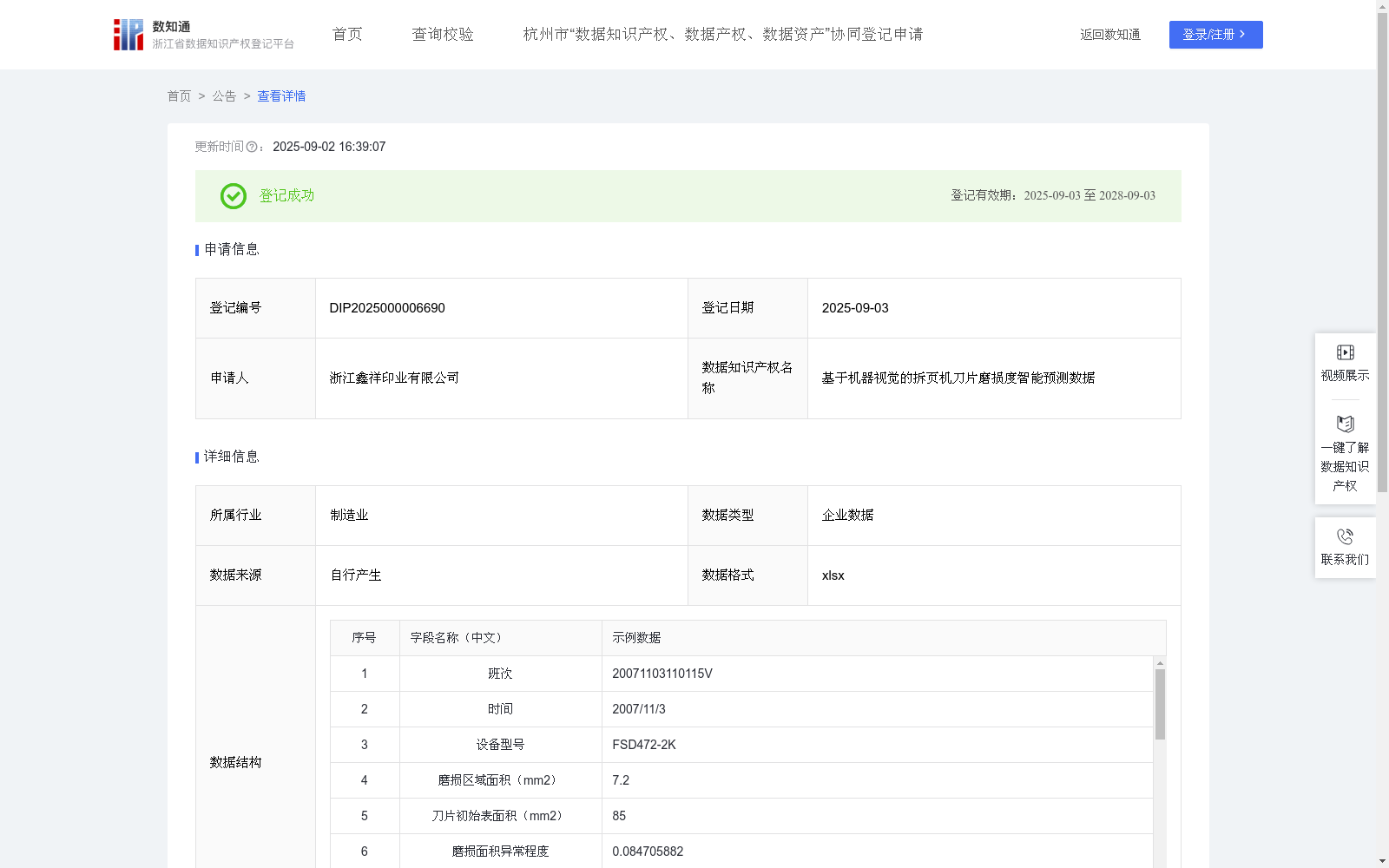
基于机器视觉的拆页机刀片磨损度智能预测数据
收藏资源简介:
拆页机刀片磨损度指刀片表面因长期机械摩擦导致的材料损耗程度,直接影响刀片质量和设备寿命。基于机器视觉的磨损度检测,是通过高分辨率工业相机采集刀片表面图像,结合图像处理技术量化磨损区域的特征,建立磨损状态的数字化表征模型。本监测数据有以下应用场景在企业内部,1. 通过磨损度预测数据与设备历史运行记录结合,建立刀片健康档案,优化设备更换周期决策。2. 将磨损度预测结果反馈至刀片参数调节系统,实现“磨损补偿算法”。3. 积累的异常阈值参数和系数权重可形成企业设备健康评估标准库,为后续设备选型、工艺改进提供数据支撑。在企业外部,1. 向拆页机制造商输出磨损度预测算法接口,助其升级设备智能诊断系统。2. 该模型经系数调整后可适配80%以上切割类设备。3. 设备故障指数数据与工业互联网平台对接后,可衍生设备租赁保险定价、供应链金融风控等增值服务。1、数据收集:数据采集来源于工业相机、边缘检测算法和加速度传感器,每日实时采集拆页机磨损区域面积、刀片初始表面积和裂纹长度等运行参数,对拆页机设备采集到的数据进行降噪、清洗、加工后进行处理。 2、数据处理:磨损面积异常程度=磨损区域面积/刀片初始表面积,裂纹长度异常程度=最长裂纹长度/裂纹长度阈值,颜色差异异常程度=现表面颜色/初始表面颜色,振动频率异常程度=刀片振动频率/振动基准频率,磨损度=磨损面积异常程度*磨损面积系数+裂纹长度异常程度*裂纹长度系数+颜色差异异常程度*颜色差异系数+振动频率异常程度*振动频率系数,四个系数需通过机器学习训练确定,总和为1。3、磨损度越小,表明设备越健康。磨损度大于等于 2.3,这代表了设备状态为故障,应立即停机检修;磨损度小于等于 1.8,这代表了设备状态为正常,应维持常规运维计划;磨损度在1.8至2.3范围内,这代表了设备状态为预警,应加强巡检频次。
The wear degree of sheet separating machine blades refers to the material loss on the blade surface caused by long-term mechanical friction, which directly affects the blade quality and equipment service life. Machine vision-based wear degree detection collects blade surface images via high-resolution industrial cameras, quantifies the features of wear areas with image processing technologies, and establishes a digital characterization model for wear states. This monitoring data has the following application scenarios: ### Internal Enterprise Scenarios 1. Combine wear degree prediction data with historical equipment operation records to establish blade health files and optimize equipment replacement cycle decisions. 2. Feed back the wear degree prediction results to the blade parameter adjustment system to realize the "wear compensation algorithm". 3. The accumulated abnormal threshold parameters and coefficient weights can form an enterprise equipment health evaluation standard library, providing data support for subsequent equipment selection and process improvement. ### External Enterprise Scenarios 1. Provide wear degree prediction algorithm interfaces to sheet separating machine manufacturers to help them upgrade their equipment intelligent diagnosis systems. 2. After coefficient adjustment, this model can be adapted to more than 80% of cutting equipment. 3. After docking equipment fault index data with the Industrial Internet Platform, value-added services such as equipment leasing insurance pricing and supply chain financial risk control can be derived. #### 1. Data Collection Data is collected from industrial cameras, edge detection algorithms, and acceleration sensors. Real-time collection of operating parameters such as the wear area of the sheet separating machine, the initial surface area of the blade, and the crack length is carried out daily. The data collected by the sheet separating machine is processed after denoising, cleaning and preprocessing. #### 2. Data Processing Wear area abnormality degree = Wear area / Initial blade surface area Crack length abnormality degree = Maximum crack length / Crack length threshold Color difference abnormality degree = Current surface color / Initial surface color Vibration frequency abnormality degree = Blade vibration frequency / Vibration reference frequency Wear degree = Wear area abnormality degree * Wear area coefficient + Crack length abnormality degree * Crack length coefficient + Color difference abnormality degree * Color difference coefficient + Vibration frequency abnormality degree * Vibration frequency coefficient The four coefficients need to be determined through machine learning training, with a total sum of 1. The smaller the wear degree, the healthier the equipment. When the wear degree is greater than or equal to 2.3, the equipment is in a fault state and should be shut down for maintenance immediately; when the wear degree is less than or equal to 1.8, the equipment is in a normal state and the routine operation and maintenance plan should be maintained; when the wear degree is in the range of 1.8 to 2.3, the equipment is in a pre-warning state and the frequency of inspections should be increased.