
ESA Land Cover Climate Change Initiative (Land_Cover_cci): Global Plant Functional Types (PFT) Dataset, v2.0.8
收藏DataCite Commons2024-12-29 更新2025-04-16 收录
下载链接:
https://catalogue.ceda.ac.uk/uuid/26a0f46c95ee4c29b5c650b129aab788
下载链接
链接失效反馈官方服务:
资源简介:
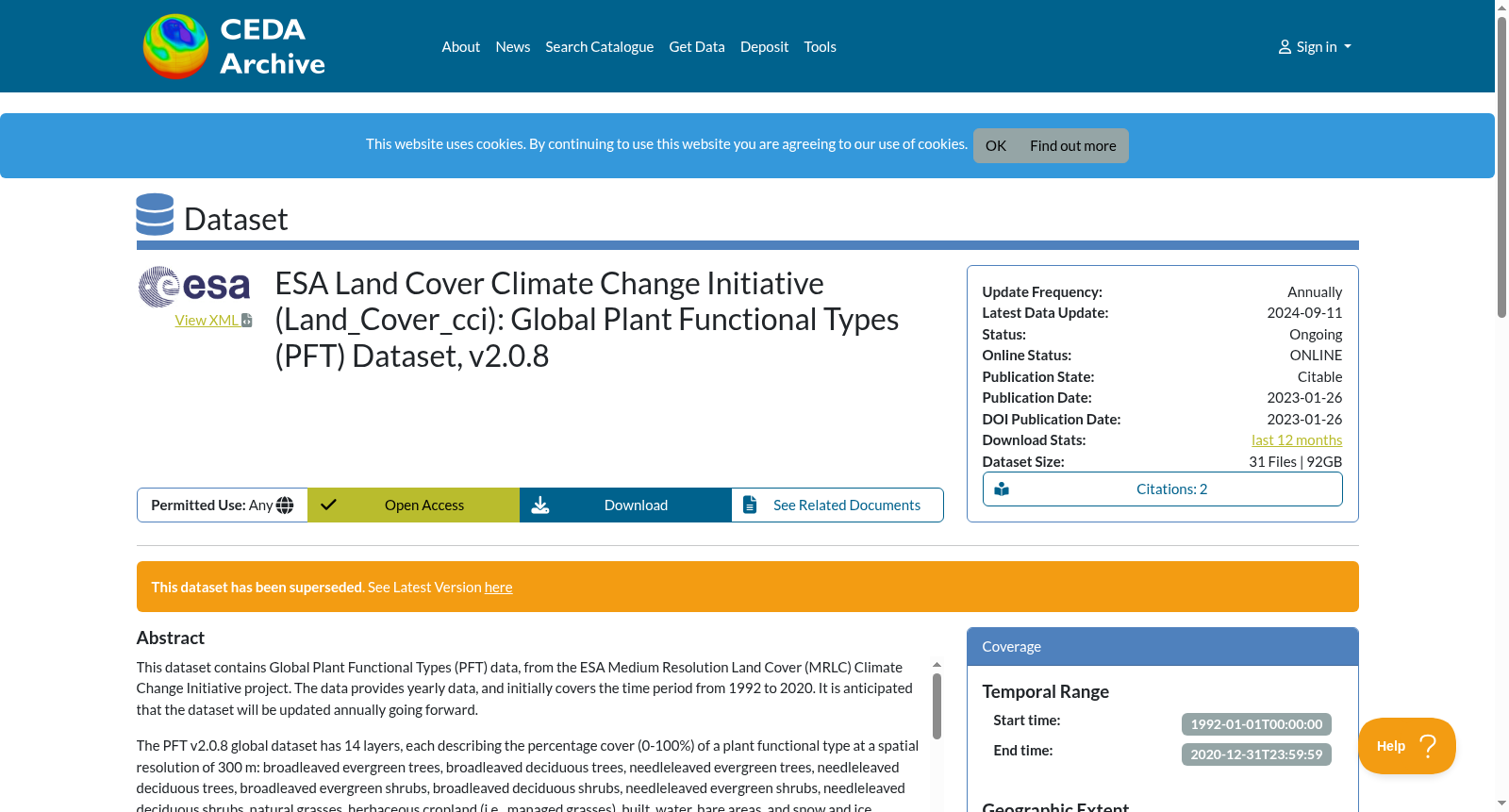
This dataset contains Global Plant Functional Types (PFT) data, from the ESA Medium Resolution Land Cover (MRLC) Climate Change Initiative project. The data provides yearly data, and initially covers the time period from 1992 to 2020. It is anticipated that the dataset will be updated annually going forward. The PFT v2.0.8 global dataset has 14 layers, each describing the percentage cover (0-100%) of a plant functional type at a spatial resolution of 300 m: broadleaved evergreen trees, broadleaved deciduous trees, needleleaved evergreen trees, needleleaved deciduous trees, broadleaved evergreen shrubs, broadleaved deciduous shrubs, needleleaved evergreen shrubs, needleleaved deciduous shrubs, natural grasses, herbaceous cropland (i.e., managed grasses), built, water, bare areas, and snow and ice. "Plant Functional Types” (PFTs) refer to globally representative and similarly behaving plant types. PFTs can be related to physiognomy and phenology, climate (which defines the geographical ranges in which a plant type can grow and reproduce under natural conditions, and physiological activity (e.g., C3/C4 photosynthetic pathways). All terrestrial zones of the Earth between the parallels 90°N and 90°S are covered. The PFT dataset has a regular latitude-longitude grid with a grid spacing of 0.002777777777778°, corresponding to ~300 m at the equator and ~200 m in the midlatitudes. The Coordinate Reference System used for the global land cover database is a geographic coordinate system (GCS) based on the World Geodetic System 84 (WGS84) reference ellipsoid. The plant functional type (PFT) distribution was created by combining auxiliary data products with the CCI MRLC map series. The LC classification provides the broad characteristics of the 300 m pixel, including the expected vegetation form(s) (tree, shrub, grass) and/or abiotic land type(s) (water, bare area, snow and ice, built-up) in the pixel. For some classes, the class legend specifies an expected range for the fractional covers of the contributing PFTs and broadly differentiates between natural and cultivated vegetation. We used a quantitative, globally consistent method that fuses the 300-metre MRLC product with a suite of existing high-resolution datasets to develop spatially explicit annual maps of PFT fractional composition at 300 metres. The new PFT product exhibits intraclass spatial variability in PFT fractional cover at the 300-metre pixel level and is complementary to the MRLC maps since the derived PFT fractions maintain consistency with the original LC class legend. This dataset was generated to reduce the cross-walking component of uncertainty by adding spatial variability to the PFT composition within a LC class. This work moved beyond fine-tuning the cross-walking approach for specific LC classes or regions and, instead, separately quantifies the PFT fractional composition for each 300 m pixel globally. The result is a dataset representing the cover fractions of 14 PFTs at 300 m for each year within the time range, consistent with the CCI MRLC LC maps for the corresponding year. This study was carried out with the continued support of the European Space Agency Climate Change Initiative under the contract ESA/No.4000126564 Land_Cover_cci.
本数据集包含全球植物功能型 (Plant Functional Types, PFT) 数据,源自欧洲空间局 (European Space Agency, ESA) 中分辨率土地覆盖 (Medium Resolution Land Cover, MRLC) 气候变化倡议 (Climate Change Initiative, CCI) 项目。该数据集为年度数据,初始覆盖时段为1992年至2020年,预计未来将按年度持续更新。本PFT v2.0.8全球数据集包含14个图层,每个图层以300米的空间分辨率,描述一种植物功能型的覆盖百分比(范围为0-100%):阔叶常绿乔木、阔叶落叶乔木、针叶常绿乔木、针叶落叶乔木、阔叶常绿灌木、阔叶落叶灌木、针叶常绿灌木、针叶落叶灌木、天然草本植物、草本耕地(即人工管理草本)、建成区、水体、裸地区域以及冰雪覆盖区。植物功能型 (Plant Functional Types, PFTs) 指具有全球代表性且生态行为相似的植物类群,其可与植物外貌形态、物候学、气候(决定某类植物在自然条件下生长繁殖的地理分布范围)以及生理活动(例如C3/C4光合途径)相关联。本数据集覆盖地球南北纬90°之间的所有陆地区域。该PFT数据集采用规则经纬度网格,网格间距为0.002777777777778°,在赤道处对应约300米分辨率,中纬度地区对应约200米分辨率。本全球土地覆盖数据库采用的坐标参考系统为基于世界大地测量系统1984 (World Geodetic System 84, WGS84) 参考椭球的地理坐标系 (Geographic Coordinate System, GCS)。该植物功能型分布数据集通过将辅助数据产品与CCI MRLC地图系列融合制作而成。土地覆盖 (Land Cover, LC) 分类给出了300米像元的总体特征,包括该像元内预期的植被类型(乔木、灌木、草本)和/或非生物土地类型(水体、裸地区域、冰雪覆盖区、建成区)。对于部分类别,分类图例明确了对应植物功能型的覆盖占比预期范围,并大致区分了天然植被与栽培植被。本研究采用定量且全球一致的方法,将300米分辨率的MRLC产品与一系列现有高分辨率数据集相融合,生成了空间显式的年度PFT覆盖占比分布图,空间分辨率为300米。这款新型PFT产品在300米像元尺度上展现了PFT覆盖占比的类内空间变异性,且与MRLC地图形成互补——因为推导得到的PFT覆盖占比与原始LC分类图例保持一致。本数据集的制作旨在通过在LC类别内为PFT组成添加空间变异性,降低类别匹配转换带来的不确定性分量。本研究并非仅针对特定LC类别或区域微调类别匹配转换方法,而是在全球范围内对每个300米像元的PFT覆盖占比进行单独量化。最终得到的数据集包含研究时段内各年份、300米分辨率下14种PFT的覆盖占比数据,且与对应年份的CCI MRLC LC地图保持一致。本研究在欧洲空间局气候变化倡议的持续支持下完成,项目合同编号为ESA/No.4000126564 Land_Cover_cci。
提供机构:
NERC EDS Centre for Environmental Data Analysis
创建时间:
2023-01-26
搜集汇总
数据集介绍
背景与挑战
背景概述
该数据集提供了全球植物功能类型(PFT)的年数据,时间跨度为1992年至2020年,包含14个图层,每个图层描述了300米空间分辨率下不同植物功能类型的百分比覆盖。数据采用WGS84参考椭球体的地理坐标系统,覆盖了地球上的所有陆地区域。
以上内容由遇见数据集搜集并总结生成



