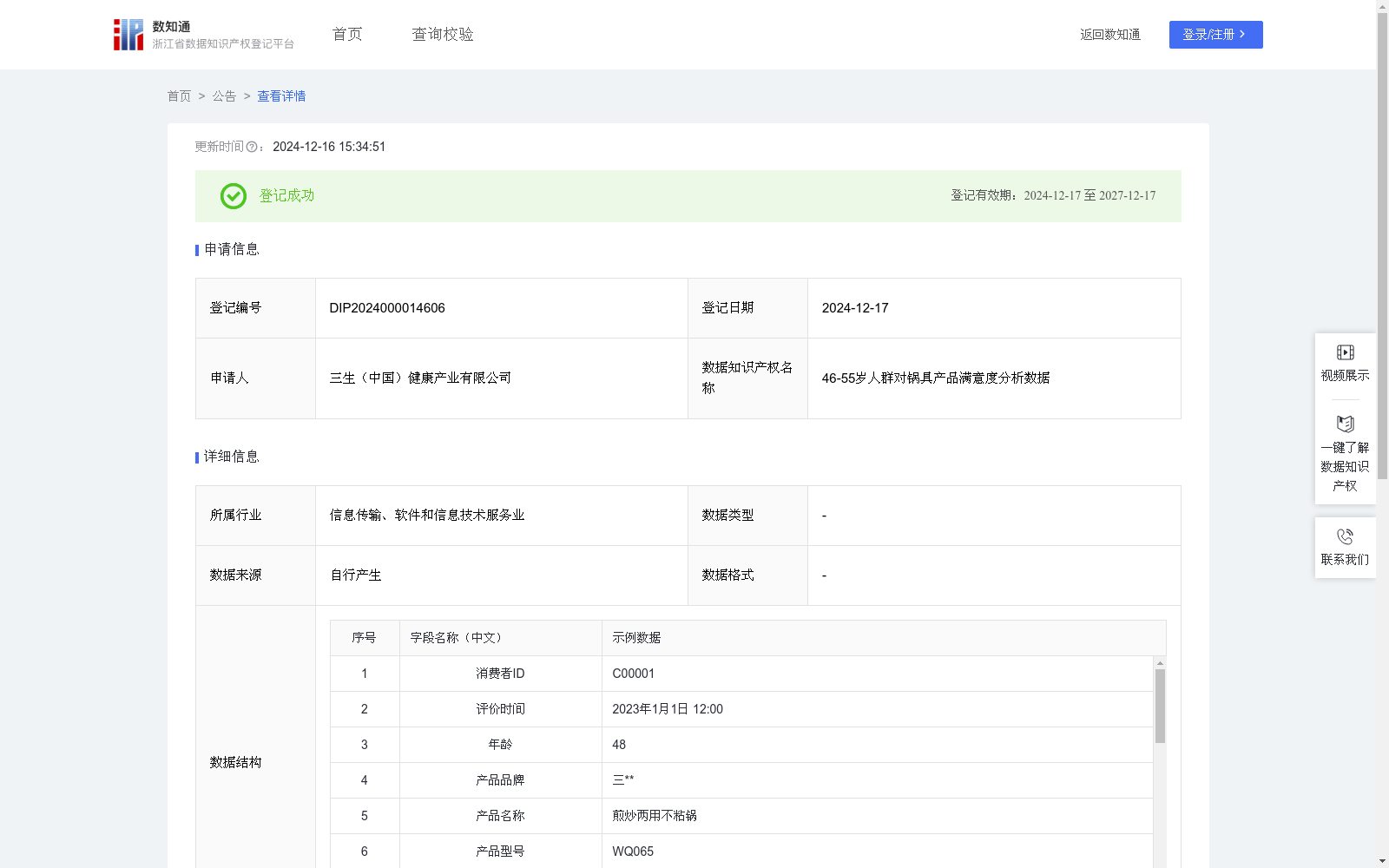
46-55岁人群对锅具产品满意度分析数据
收藏资源简介:
由于不同年龄段消费群体对锅具产品的需求和偏好会存在偏差,本数据是针对46-55岁年龄段人群对不同锅具产品满意度的统计分析数据。 本数据有助于锅具生产商利用满意度分析数据进一步统计分析,识别46-55岁年龄段消费者对不同锅具产品的需求和偏好情况,对产品进行改进,增加创新功能,以满足该年龄段消费者的需求。 本数据有助于锅具销售商利用满意度统计和分析数据对该年龄段消费者制定针对性的营销策略,并为锅具市场的消费者偏好趋势研判提供数据支持。(1)数据收集和预处理: 从公司自营的“有享云商”电商平台的评价系统中收集锅具类产品的46-55岁消费者满意度评价信息数据,包括消费者ID、评价时间、年龄、购买产品名称、产品型号、外包装和外观满意度评分、使用方便度评分、清洗方便度评分、使用功能性评分、锅体重量评分、评价反馈。通过数据清洗去除无效或错误记录,确保数据质量。 (2)情感标签: 使用情感分析模型(基于机器学习的文本分类模型)对评价反馈文本进行情感判断,输出正面、中性或负面的情感标签。 (3)情感得分转换: 将情感标签转换为定量得分:正面反馈10分,中性反馈6分,负面反馈2分。 (4)综合满意度评分计算 按以下公式计算客户综合满意度评分: 综合满意度评分=外包装和外观满意度评分×W1+使用方便度评分×W2+清洗方便度评分×W3+使用功能性评分×W4+锅体重量评分×W5+情感得分×W6,其中,W1、W2、W3、W4、W5、W6是权重系数,按产品消费市场情况经内部专家研判后进行调整设定,W1+W2+W3+W4+W5+W6=1。
Given that consumer groups across different age groups have divergent demands and preferences for cookware products, this dataset is a statistical analysis of the satisfaction of people aged 46–55 with various cookware products. This dataset enables cookware manufacturers to conduct further statistical analysis using the satisfaction data, identify the demands and preferences of consumers aged 46–55 for different cookware products, and improve products by adding innovative functions to meet the needs of this age group. It also helps cookware retailers develop targeted marketing strategies for consumers in this age group using the satisfaction statistics and analysis data, and provides data support for the prediction of consumer preference trends in the cookware market. (1) Data Collection and Preprocessing Satisfaction evaluation data of consumers aged 46–55 for cookware products was collected from the review system of the company's self-operated e-commerce platform "Youxiangyunshang". The collected data includes consumer ID, review time, age, purchased product name, product model, satisfaction scores for packaging and appearance, ease of use, ease of cleaning, functional performance, pot weight, and review feedback. Invalid or erroneous records were removed via data cleaning to ensure data quality. (2) Sentiment Labeling A sentiment analysis model (machine learning-based text classification model) was used to conduct sentiment judgment on the review feedback texts, and output positive, neutral, or negative sentiment labels. (3) Sentiment Score Conversion Sentiment labels were converted into quantitative scores: positive feedback received 10 points, neutral feedback received 6 points, and negative feedback received 2 points. (4) Comprehensive Satisfaction Score Calculation The customer comprehensive satisfaction score is calculated using the following formula: Comprehensive Satisfaction Score = (Packaging and Appearance Satisfaction Score × W1) + (Ease of Use Score × W2) + (Ease of Cleaning Score × W3) + (Functional Performance Score × W4) + (Pot Weight Score × W5) + (Sentiment Score × W6) where W1, W2, W3, W4, W5, and W6 are weight coefficients, which are adjusted and set by internal experts based on the product consumption market conditions, satisfying the constraint that W1 + W2 + W3 + W4 + W5 + W6 = 1.