
<b>Nonlinear Association Between Quercetin Intake and Periodontitis in US Adults: A Cross-Sectional Analysis of NHANES</b>
收藏DataCite Commons2025-07-05 更新2025-09-08 收录
下载链接:
https://figshare.com/articles/dataset/_b_Nonlinear_Association_Between_Quercetin_Intake_and_Periodontitis_in_US_Adults_A_Cross-Sectional_Analysis_of_NHANES_b_/29483423/1
下载链接
链接失效反馈官方服务:
资源简介:
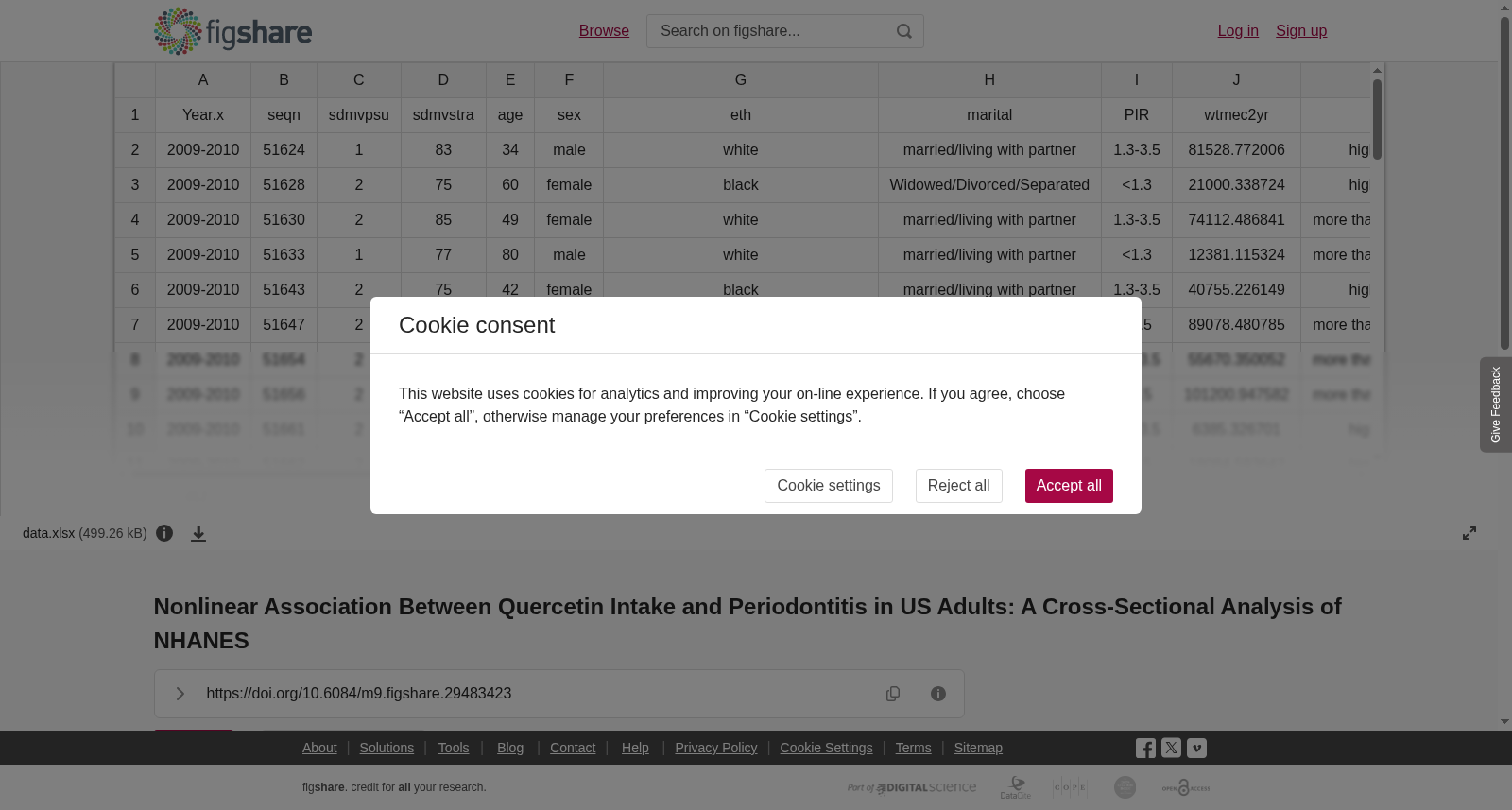
<b><i>Introduction</i></b>: Quercetin, a common dietary flavonol, has been shown in numerous animal studies to possess anti-inflammatory and antioxidative properties. However, its relationship with periodontitis in the general population, particularly regarding potential nonlinear patterns, remains insufficiently explored.<b><i>Methods</i></b>: This cross-sectional study included 2,699 U.S. adults aged ≥30 years from the 2009–2010 National Health and Nutrition Examination Survey (NHANES). Intake of total flavonols and four subclasses (isorhamnetin, kaempferol, myricetin, and quercetin) was estimated based on 24-hour dietary recall. Multivariable logistic regression models were applied to evaluate the associations between flavonol intake (quartiles) and moderate/severe (mod/sev) periodontitis. Nonlinearity was assessed using restricted cubic spline (RCS) regression. Subgroup and sensitivity analyses were performed, and the predictive performance was evaluated using receiver operating characteristic (ROC) curves.<b><i>Results</i></b>: Among total flavonols and their subclasses, only quercetin intake showed a significant association with mod/sev periodontitis. In fully adjusted models, higher quercetin intake was associated with reduced odds of mod/sev periodontitis (Q2 vs Q1: OR = 0.62, 95% CI: 0.39–0.98, <i>P</i> = 0.042; Q3 vs Q1: OR = 0.64, 95% CI: 0.44–0.94, <i>P</i> = 0.026; <i>P</i> for trend = 0.578). Subgroup and sensitivity analyses confirmed the robustness of the findings. RCS regression revealed a significant nonlinear association (<i>P</i> for nonlinearity = 0.003). The inflection points of the RCS curve were aligned with the quartile distribution of quercetin intake. Moreover, quercetin intake demonstrated better predictive ability for mod/sev periodontitis compared to total flavonol and other subclass intakes in ROC analysis.<b><i>Conclusion</i></b>: Quercetin intake shows a nonlinear inverse relationship with mod/sev periodontitis in U.S. adults. These findings suggest that appropriately increasing dietary quercetin may be a promising strategy for periodontal disease prevention.
<b><i>引言</i></b>:槲皮素(Quercetin)是一种常见的膳食黄酮醇,多项动物实验已证实其具备抗炎与抗氧化特性。然而,在普通人群中,其与牙周炎的关联,尤其是潜在的非线性关联模式,仍未得到充分探索。<b><i>方法</i></b>:本横断面研究纳入了2009–2010年美国国家健康与营养调查(National Health and Nutrition Examination Survey, NHANES)中2699名年龄≥30岁的美国成年人。总黄酮醇及4个亚类(异鼠李素、山奈酚、杨梅素和槲皮素)的摄入量通过24小时膳食回顾法进行估算。采用多变量logistic回归模型评估黄酮醇摄入量(四分位组)与中/重度(moderate/severe, mod/sev)牙周炎的关联。使用限制性立方样条(restricted cubic spline, RCS)回归分析非线性关联。此外还进行了亚组分析与敏感性分析,并通过受试者工作特征(receiver operating characteristic, ROC)曲线评估预测性能。<b><i>结果</i></b>:在总黄酮醇及其亚类中,仅槲皮素摄入量与中/重度牙周炎存在显著关联。在完全校正模型中,较高的槲皮素摄入量与中/重度牙周炎的发病风险降低相关(Q2 vs Q1:比值比OR=0.62,95%置信区间CI:0.39–0.98,<i>P</i>=0.042;Q3 vs Q1:OR=0.64,95%CI:0.44–0.94,<i>P</i>=0.026;趋势检验<i>P</i>=0.578)。亚组分析与敏感性分析证实了本研究结果的稳健性。限制性立方样条回归分析显示二者存在显著的非线性关联(非线性检验<i>P</i>=0.003),样条曲线的拐点与槲皮素摄入量的四分位分布相一致。此外,受试者工作特征曲线分析显示,相较于总黄酮醇及其他亚类摄入量,槲皮素摄入量对中/重度牙周炎具有更优的预测能力。<b><i>结论</i></b>:美国成年人中,槲皮素摄入量与中/重度牙周炎呈非线性负相关。本研究结果提示,适当增加膳食槲皮素摄入或可成为预防牙周疾病的潜在有效策略。
提供机构:
figshare创建时间:
2025-07-05
搜集汇总
数据集介绍
以上内容由遇见数据集搜集并总结生成


