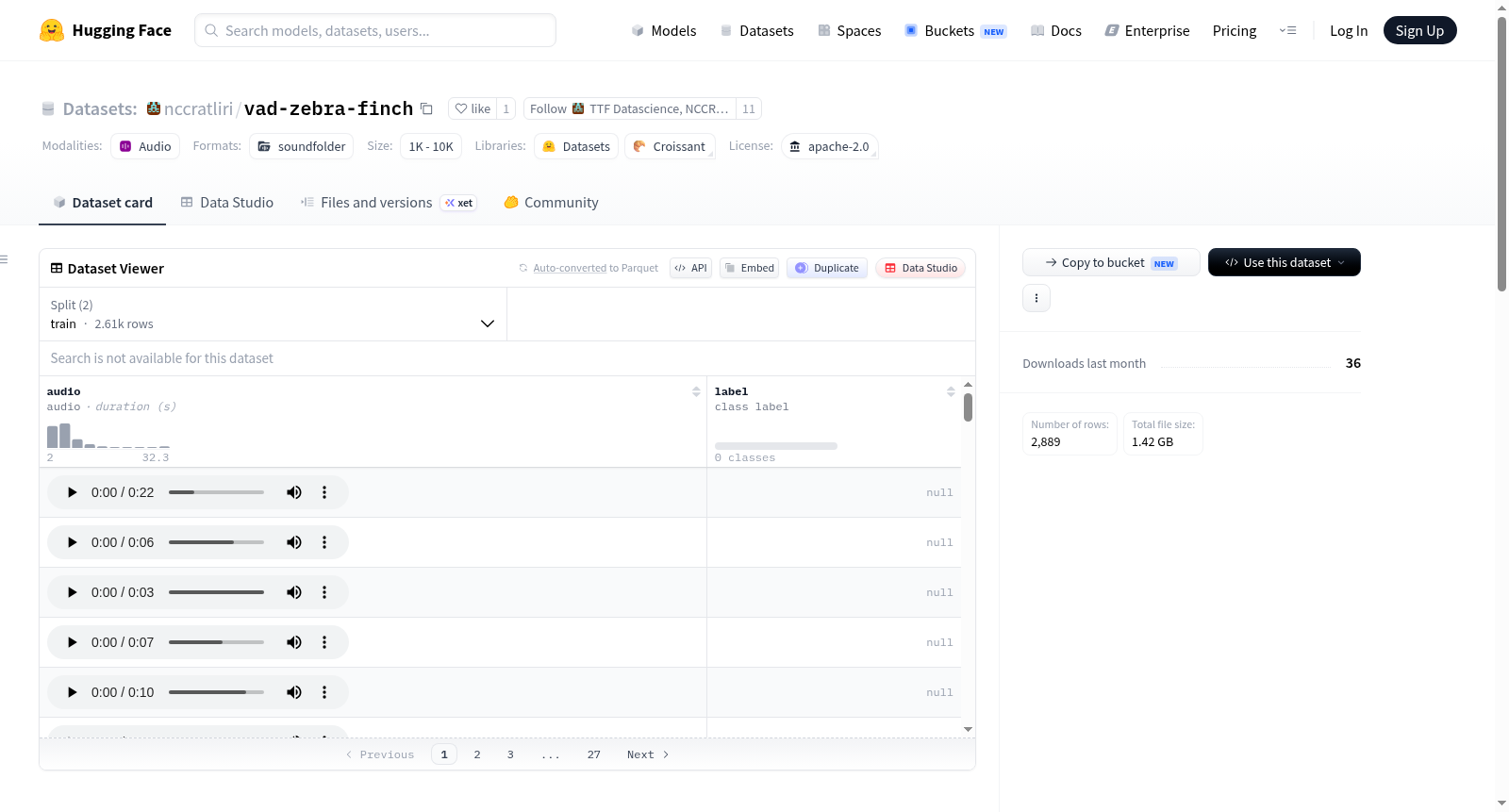
nccratliri/vad-zebra-finch
收藏资源简介:
--- license: apache-2.0 --- # Positive Transfer Of The Whisper Speech Transformer To Human And Animal Voice Activity Detection We proposed WhisperSeg, utilizing the Whisper Transformer pre-trained for Automatic Speech Recognition (ASR) for both human and animal Voice Activity Detection (VAD). For more details, please refer to our paper > > [**Positive Transfer of the Whisper Speech Transformer to Human and Animal Voice Activity Detection**](https://doi.org/10.1101/2023.09.30.560270) > > Nianlong Gu, Kanghwi Lee, Maris Basha, Sumit Kumar Ram, Guanghao You, Richard H. R. Hahnloser <br> > University of Zurich and ETH Zurich This is the Zebra finch dataset customized for Animal Voice Activity Detection (vocal segmentation) in WhisperSeg. ## Download Dataset ```python from huggingface_hub import snapshot_download snapshot_download('nccratliri/vad-zebra-finch', local_dir = "data/zebra-finch", repo_type="dataset" ) ``` For more usage details, please refer to the GitHub repository: https://github.com/nianlonggu/WhisperSeg When using this dataset, please also cite: ``` @article {Tomka2023.09.04.555475, author = {Tomas Tomka and Xinyu Hao and Aoxue Miao and Kanghwi Lee and Maris Basha and Stefan Reimann and Anja T Zai and Richard Hahnloser}, title = {Benchmarking nearest neighbor retrieval of zebra finch vocalizations across development}, elocation-id = {2023.09.04.555475}, year = {2023}, doi = {10.1101/2023.09.04.555475}, publisher = {Cold Spring Harbor Laboratory}, abstract = {Vocalizations are highly specialized motor gestures that regulate social interactions. The reliable detection of vocalizations from raw streams of microphone data remains an open problem even in research on widely studied animals such as the zebra finch. A promising method for finding vocal samples from potentially few labelled examples(templates) is nearest neighbor retrieval, but this method has never been extensively tested on vocal segmentation tasks. We retrieve zebra finch vocalizations as neighbors of each other in the sound spectrogram space. Based on merely 50 templates, we find excellent retrieval performance in adults (F1 score of 0.93 +/- 0.07) but not in juveniles (F1 score of 0.64 +/- 0.18), presumably due to the larger vocal variability of the latter. The performance in juveniles improves when retrieval is based on fixed-size template slices (F1 score of 0.72 +/- 0.10) instead of entire templates. Among the several distance metrics we tested such as the cosine and the Euclidean distance, we find that the Spearman distance largely outperforms all others. We release our expert-curated dataset of more than 50{\textquoteright}000 zebra finch vocal segments, which will enable training of data-hungry machine-learning approaches.Competing Interest StatementThe authors have declared no competing interest.}, URL = {https://www.biorxiv.org/content/early/2023/09/04/2023.09.04.555475}, eprint = {https://www.biorxiv.org/content/early/2023/09/04/2023.09.04.555475.full.pdf}, journal = {bioRxiv} } ``` ``` @article {Gu2023.09.30.560270, author = {Nianlong Gu and Kanghwi Lee and Maris Basha and Sumit Kumar Ram and Guanghao You and Richard Hahnloser}, title = {Positive Transfer of the Whisper Speech Transformer to Human and Animal Voice Activity Detection}, elocation-id = {2023.09.30.560270}, year = {2023}, doi = {10.1101/2023.09.30.560270}, publisher = {Cold Spring Harbor Laboratory}, abstract = {This paper introduces WhisperSeg, utilizing the Whisper Transformer pre-trained for Automatic Speech Recognition (ASR) for human and animal Voice Activity Detection (VAD). Contrary to traditional methods that detect human voice or animal vocalizations from a short audio frame and rely on careful threshold selection, WhisperSeg processes entire spectrograms of long audio and generates plain text representations of onset, offset, and type of voice activity. Processing a longer audio context with a larger network greatly improves detection accuracy from few labeled examples. We further demonstrate a positive transfer of detection performance to new animal species, making our approach viable in the data-scarce multi-species setting.Competing Interest StatementThe authors have declared no competing interest.}, URL = {https://www.biorxiv.org/content/early/2023/10/02/2023.09.30.560270}, eprint = {https://www.biorxiv.org/content/early/2023/10/02/2023.09.30.560270.full.pdf}, journal = {bioRxiv} } ``` ## Contact nianlong.gu@uzh.ch
--- 许可证:Apache-2.0 --- # 将Whisper语音Transformer应用于人类与动物语音活动检测的正向迁移 本研究提出了WhisperSeg模型,将预训练用于自动语音识别(Automatic Speech Recognition, ASR)的Whisper Transformer,同时应用于人类与动物的语音活动检测(Voice Activity Detection, VAD)。更多细节请参阅我们的论文: > > [**将Whisper语音Transformer应用于人类与动物语音活动检测的正向迁移**](https://doi.org/10.1101/2023.09.30.560270) > > 作者:Nianlong Gu, Kanghwi Lee, Maris Basha, Sumit Kumar Ram, Guanghao You, Richard H. R. Hahnloser <br> > 单位:苏黎世大学与苏黎世联邦理工学院 本数据集是为适配WhisperSeg的动物语音活动检测(鸣唱分割)任务定制的斑胸草雀数据集。 ## 数据集下载 python from huggingface_hub import snapshot_download snapshot_download('nccratliri/vad-zebra-finch', local_dir = "data/zebra-finch", repo_type="dataset" ) 更多使用细节请参阅GitHub仓库:https://github.com/nianlonggu/WhisperSeg 使用本数据集时,请同时引用以下文献: @article {Tomka2023.09.04.555475, author = {Tomas Tomka and Xinyu Hao and Aoxue Miao and Kanghwi Lee and Maris Basha and Stefan Reimann and Anja T Zai and Richard Hahnloser}, title = {Benchmarking nearest neighbor retrieval of zebra finch vocalizations across development}, elocation-id = {2023.09.04.555475}, year = {2023}, doi = {10.1101/2023.09.04.555475}, publisher = {Cold Spring Harbor Laboratory}, abstract = {鸣唱是调控社会互动的高度特化运动行为。即便在斑胸草雀这类被广泛研究的动物研究中,从麦克风采集的原始音频流中可靠检测鸣唱片段仍是一项未解决的难题。从少量标注样本(模板)中检索鸣唱样本的一种有效方法是最近邻检索,但该方法尚未在鸣唱分割任务中得到广泛验证。我们在声谱图空间中对斑胸草雀的鸣唱片段进行相互检索。仅基于50个模板,我们在成年个体中获得了优异的检索性能(F1分数为0.93 ± 0.07),但在幼体中表现不佳(F1分数为0.64 ± 0.18),这可能归因于后者更大的鸣唱变异性。当基于固定大小的模板切片而非完整模板进行检索时,幼体的检索性能有所提升(F1分数为0.72 ± 0.10)。在我们测试的多种距离度量(如余弦距离、欧氏距离)中,斯皮尔曼距离的整体表现显著优于其他度量。我们发布了由专家标注的超过50000个斑胸草雀鸣唱片段的数据集,这将支持对数据需求量大的机器学习方法的训练。利益冲突声明:作者声明无相关利益冲突。}, URL = {https://www.biorxiv.org/content/early/2023/09/04/2023.09.04.555475}, eprint = {https://www.biorxiv.org/content/early/2023/09/04/2023.09.04.555475.full.pdf}, journal = {bioRxiv} } @article {Gu2023.09.30.560270, author = {Nianlong Gu and Kanghwi Lee and Maris Basha and Sumit Kumar Ram and Guanghao You and Richard Hahnloser}, title = {Positive Transfer of the Whisper Speech Transformer to Human and Animal Voice Activity Detection}, elocation-id = {2023.09.30.560270}, year = {2023}, doi = {10.1101/2023.09.30.560270}, publisher = {Cold Spring Harbor Laboratory}, abstract = {本文介绍了WhisperSeg模型,将预训练用于自动语音识别(ASR)的Whisper Transformer应用于人类与动物的语音活动检测(VAD)。与传统方法仅从短音频帧中检测人类语音或动物鸣唱并依赖精细的阈值选择不同,WhisperSeg可处理长音频的完整声谱图,并生成语音活动的起始时刻、结束时刻及类型的纯文本表征。借助更大的网络处理更长的音频上下文,仅需少量标注样本即可大幅提升检测精度。我们进一步证明,该模型的检测性能可正向迁移至新的动物物种,使其在数据稀缺的多物种场景中具备实用性。利益冲突声明:作者声明无相关利益冲突。}, URL = {https://www.biorxiv.org/content/early/2023/10/02/2023.09.30.560270}, eprint = {https://www.biorxiv.org/content/early/2023/10/02/2023.09.30.560270.full.pdf}, journal = {bioRxiv} } ## 联系方式 nianlong.gu@uzh.ch
斑马雀语音数据集
数据集概述
该数据集是为WhisperSeg系统定制的斑马雀动物语音活动检测(语音分割)数据集。WhisperSeg利用预训练的Whisper Transformer进行自动语音识别(ASR),用于人类和动物的语音活动检测(VAD)。
数据集下载
python from huggingface_hub import snapshot_download snapshot_download(nccratliri/vad-zebra-finch, local_dir = "data/zebra-finch", repo_type="dataset")
引用信息
在使用此数据集时,请引用以下文献:
@article {Tomka2023.09.04.555475, author = {Tomas Tomka and Xinyu Hao and Aoxue Miao and Kanghwi Lee and Maris Basha and Stefan Reimann and Anja T Zai and Richard Hahnloser}, title = {Benchmarking nearest neighbor retrieval of zebra finch vocalizations across development}, elocation-id = {2023.09.04.555475}, year = {2023}, doi = {10.1101/2023.09.04.555475}, publisher = {Cold Spring Harbor Laboratory}, abstract = {Vocalizations are highly specialized motor gestures that regulate social interactions. The reliable detection of vocalizations from raw streams of microphone data remains an open problem even in research on widely studied animals such as the zebra finch. A promising method for finding vocal samples from potentially few labelled examples(templates) is nearest neighbor retrieval, but this method has never been extensively tested on vocal segmentation tasks. We retrieve zebra finch vocalizations as neighbors of each other in the sound spectrogram space. Based on merely 50 templates, we find excellent retrieval performance in adults (F1 score of 0.93 +/- 0.07) but not in juveniles (F1 score of 0.64 +/- 0.18), presumably due to the larger vocal variability of the latter. The performance in juveniles improves when retrieval is based on fixed-size template slices (F1 score of 0.72 +/- 0.10) instead of entire templates. Among the several distance metrics we tested such as the cosine and the Euclidean distance, we find that the Spearman distance largely outperforms all others. We release our expert-curated dataset of more than 50’000 zebra finch vocal segments, which will enable training of data-hungry machine-learning approaches.Competing Interest StatementThe authors have declared no competing interest.}, URL = {https://www.biorxiv.org/content/early/2023/09/04/2023.09.04.555475}, eprint = {https://www.biorxiv.org/content/early/2023/09/04/2023.09.04.555475.full.pdf}, journal = {bioRxiv} }
@article {Gu2023.09.30.560270, author = {Nianlong Gu and Kanghwi Lee and Maris Basha and Sumit Kumar Ram and Guanghao You and Richard Hahnloser}, title = {Positive Transfer of the Whisper Speech Transformer to Human and Animal Voice Activity Detection}, elocation-id = {2023.09.30.560270}, year = {2023}, doi = {10.1101/2023.09.30.560270}, publisher = {Cold Spring Harbor Laboratory}, abstract = {This paper introduces WhisperSeg, utilizing the Whisper Transformer pre-trained for Automatic Speech Recognition (ASR) for human and animal Voice Activity Detection (VAD). Contrary to traditional methods that detect human voice or animal vocalizations from a short audio frame and rely on careful threshold selection, WhisperSeg processes entire spectrograms of long audio and generates plain text representations of onset, offset, and type of voice activity. Processing a longer audio context with a larger network greatly improves detection accuracy from few labeled examples. We further demonstrate a positive transfer of detection performance to new animal species, making our approach viable in the data-scarce multi-species setting.Competing Interest StatementThe authors have declared no competing interest.}, URL = {https://www.biorxiv.org/content/early/2023/10/02/2023.09.30.560270}, eprint = {https://www.biorxiv.org/content/early/2023/10/02/2023.09.30.560270.full.pdf}, journal = {bioRxiv} }