
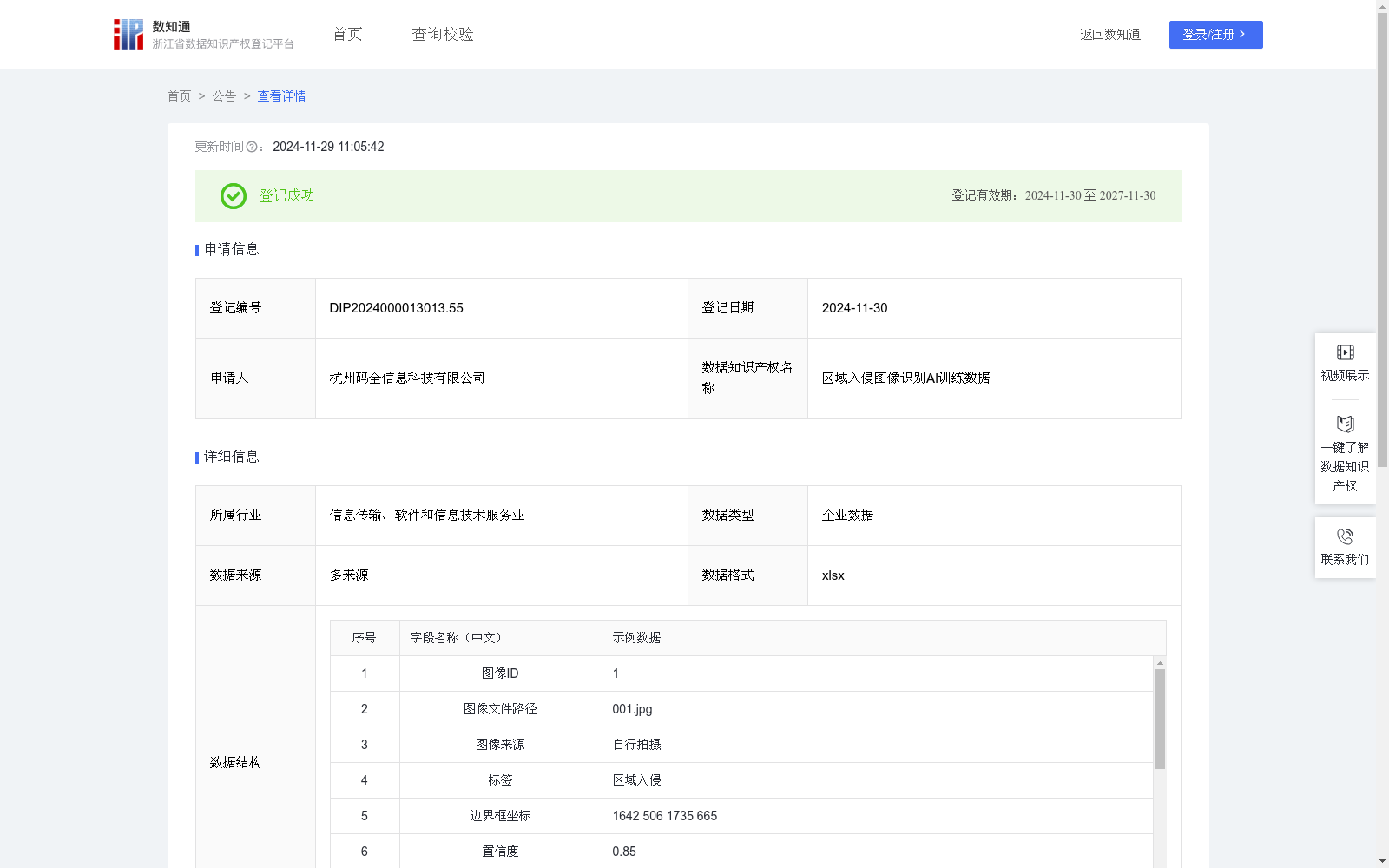
区域入侵图像识别AI训练数据
收藏浙江省数据知识产权登记平台2024-11-29 更新2024-11-30 收录
下载链接:
https://www.zjip.org.cn/home/announce/trends/91246
下载链接
链接失效反馈官方服务:
资源简介:
区域入侵图像识别AI训练数据的应用场景主要包括提升AI模型在实际场景中对区域入侵行为的识别能力和识别准确度。通过这些数据的训练,AI模型可以更准确地识别未授权的入侵者或物体,从而胜任在安全监控系统、边境保护、重要设施安全等领域的应用。此外,训练数据的应用进一步提升了模型的泛化能力和鲁棒性,使得AI模型在处理室外不同光照、天气和背景条件下的区域入侵图像时,具有更好的泛化能力和适应性。步骤1,原始图像数据来源于公开图像数据库、自行拍摄或其他算法生成。在此步骤中,记录每张图像的图像ID和图像文件路径。
步骤2,根据自身项目需求和模型要求,将区域入侵图像数据分类成数据集类型,分为训练集和测试集。对训练集图像进行标注,包括标签和边界框坐标。
步骤3,选择适合区域入侵图像识别的YOLO预训练模型,并初始化模型参数。设置合理的超参数,如学习率、批量大小等,以优化模型的训练过程。记录所使用的模型名称和这些超参数。
步骤4,使用PyTorch深度学习框架加载和初始化模型。将准备好的数据集输入到模型中进行训练。在训练过程中,模型会不断调整权重,以最小化预测框与真实框之间的差值。记录训练的训练时长和训练周期(迭代次数)。训练过程中,模型的置信度将逐渐提升。
步骤5,在训练完成后,使用测试集对模型进行评估。计算模型在不同场景下的精度、召回率、F1分数、以及实时性能评估等性能指标,确保模型的准确性和鲁棒性。
步骤6,将最终训练、测试后得到的模型应用到具体的项目中。在实际应用中,评估模型的实时性能,包括检测的准确性和处理速度,确保满足项目需求。记录模型在实际应用中的实时性能评估。
The application scenarios of the AI training dataset for regional intrusion image recognition primarily aim to enhance the recognition capability and accuracy of AI models in detecting regional intrusion behaviors in real-world scenarios. Trained with such datasets, AI models can accurately identify unauthorized intruders or objects, enabling their deployment in fields such as security monitoring systems, border protection, and critical facility security. Moreover, utilizing this training data further improves the model's generalization ability and robustness, allowing the AI model to achieve better performance when processing regional intrusion images under varying outdoor lighting conditions, weather scenarios, and background environments, with enhanced generalization and adaptability.
Step 1: Original image data is sourced from public image databases, self-collected photographs, or images generated by other algorithms. During this step, the image ID and file path of each individual image shall be recorded.
Step 2: Classify the regional intrusion image data into dataset subsets, namely the training set and test set, based on project requirements and model specifications. Annotate the images in the training set with corresponding labels and bounding box coordinates.
Step 3: Select a YOLO pre-trained model suitable for regional intrusion image recognition, and initialize the model's parameters. Set reasonable hyperparameters such as learning rate and batch size to optimize the model training workflow, and document the selected model name and these hyperparameters.
Step 4: Load and initialize the model using the PyTorch deep learning framework. Input the prepared dataset into the model for training. During the training process, the model will continuously adjust its weights to minimize the discrepancy between predicted bounding boxes and ground-truth bounding boxes. Record the total training duration and the number of training epochs (iterations). The model's confidence score will progressively improve throughout the training phase.
Step 5: Upon completion of training, evaluate the model using the test set. Calculate performance metrics including precision, recall, F1-score, and real-time performance evaluation across different scenarios, to validate the model's accuracy and robustness.
Step 6: Deploy the final trained and tested model into specific practical projects. During actual deployment, evaluate the model's real-time performance, including detection accuracy and processing speed, to confirm that it meets the project's requirements. Document the real-time performance evaluation results of the model in practical applications.
提供机构:
杭州码全信息科技有限公司
创建时间:
2024-11-11
搜集汇总
数据集介绍
特点
区域入侵图像识别AI训练数据集包含13,877条数据,用于训练YOLOv10模型,提升区域入侵行为的识别准确度。数据集详细记录了训练参数和性能指标,适用于安全监控和边境保护等场景。
以上内容由遇见数据集搜集并总结生成


