
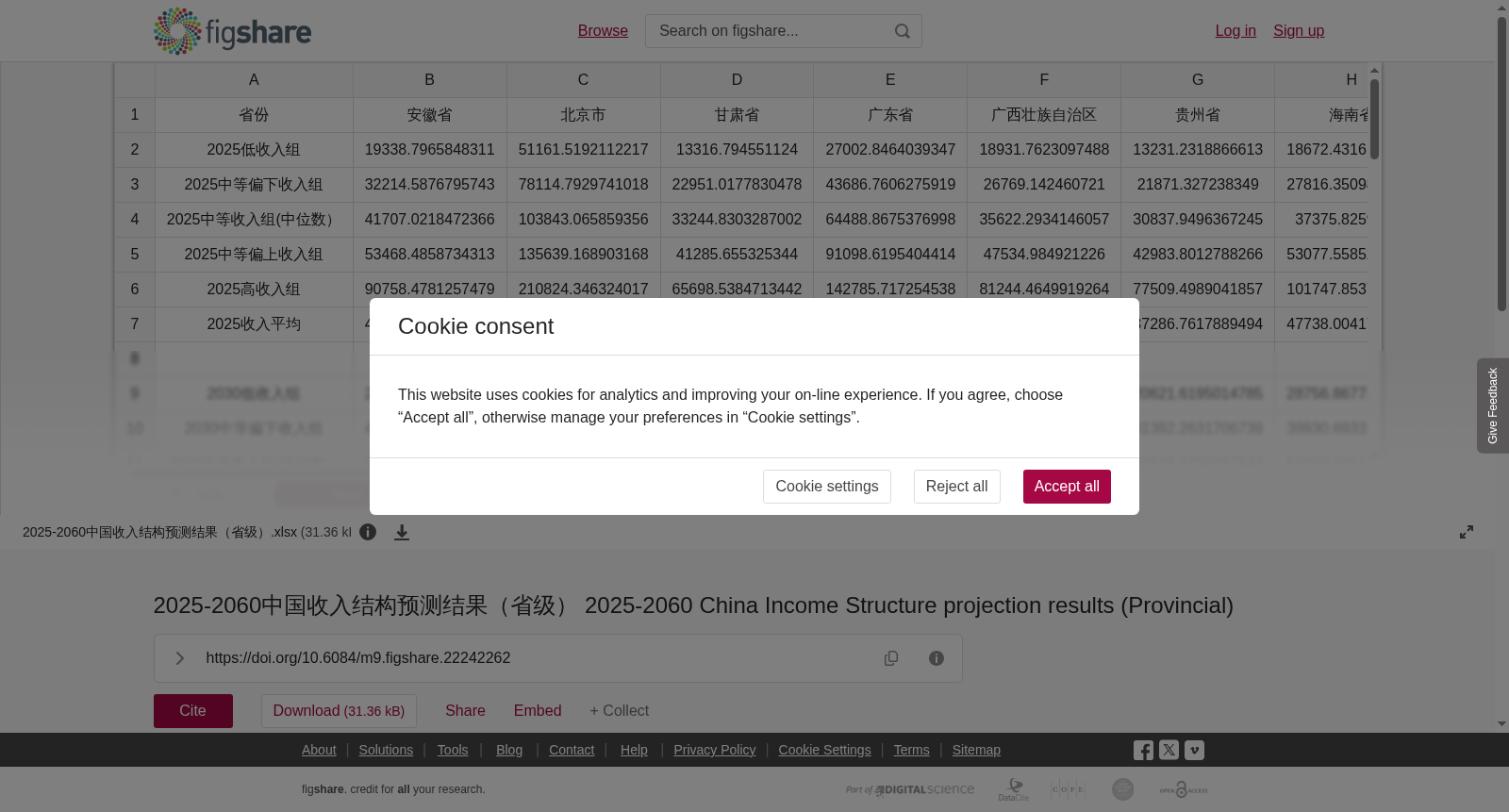
2025-2060中国收入结构预测结果(省级) 2025-2060 China Income Structure projection results (Provincial)
收藏DataCite Commons2025-05-01 更新2024-08-18 收录
下载链接:
https://figshare.com/articles/dataset/2025-2060__2025-2060_China_Income_Structure_projection_results_provincial_/22242262/2
下载链接
链接失效反馈官方服务:
资源简介:
此数据集为2025-2060中国省级收入结构预测结果,格式为xlsx。 This dataset is the results of the 2025-2060 China provincial income structure projections in xlsx format. <br> 当目前人类活动已经成为全球环境变化的主要驱动力。作为世界上人口最多的国家,中国应当在世界的可持续发展与气候变化领域做出更多的贡献。2020年9月22日,国家主席习近平提出了中国的“双碳发展目标”,为中国未来的发展指明了方向。城市是人类生产生活最为集中的区域,中国的城市能源消耗占据了全国能源消耗的85%,因此我们认为中国的低碳转型关键在于城市。进一步,城市的发展关键在于人口的变化,不同年龄结构,不同社会背景的人有着不同的城市管理服务与能源利用的需求,进而影响着未来的城市管理和城市建设。中国正处于城镇化的下半场,在人口老龄化背景下不同区域的人口结构将发生重大变化,如何对未来的人口结构进行判定,进而对未来的社会需求做出判断,以实现未来中国的低碳发展,是非常值得探索的议题。在这样的背景下,能源基金会资助清华大学建筑学院龙瀛团队与中国人民大学环境学院王克团队,针对上述问题开展深入分析。在前期项目中,龙瀛团队基于全球空间人口网格数据和中国政府统计数据,对中国的未来人口分布进行了情景预测。但是人口分布的预测,缺乏人口结构的相关信息,因此不能更精确更量化地判断不同人的需求。 因此在本项目中,项目组希望进一步地完善人口结构方面的预测,同现有人口分布数据相匹配,进而为碳排放、环境治理等研究方向提供更精确更细致的数据支持。 Human activities have now become a major driver of global environmental change. As the world's most populous country, China should make more contributions to the world's sustainable development and climate change. On September 22, 2020, President Xi Jinping proposed China's "Two Carbon Development Goals", which will set the direction for China's future development. Cities are the most concentrated areas of human production and life, so we believe that the key to China's low-carbon transition lies in cities. Further, cities are for people, so human needs determine the energy consumption of the city. People of different age structures and social backgrounds have different needs for urban management services and energy use, which in turn affects future urban management and urban construction. It is worthwhile to explore how to determine the future demographic structure and then make a judgment on the future social needs to realize the future low-carbon development of China. <br>
This dataset contains the projection results of provincial income structure in China from 2025 to 2060, formatted as XLSX. <br> Currently, human activities have emerged as the primary driver of global environmental change. As the most populous country globally, China should make greater contributions to global sustainable development and climate change governance. On September 22, 2020, President Xi Jinping put forward China's "Double Carbon Development Goals", which charted the course for China's future development. Cities are the most concentrated hubs for human production and daily life. Urban energy consumption in China accounts for 85% of the country's total energy use, so we argue that the key to China's low-carbon transition lies in its cities. Furthermore, urban development hinges on demographic shifts. Individuals with varying age structures and social backgrounds have distinct demands for urban management services and energy utilization, which will subsequently shape future urban management and construction. China is currently in the latter stage of urbanization. Against the backdrop of population aging, the demographic structure of different regions will undergo significant transformations. It is a highly worthwhile research topic to forecast future demographic structures, assess subsequent social demands, and thereby achieve China's long-term low-carbon development goals. Against this backdrop, the Energy Foundation has funded the team led by Long Ying from the School of Architecture, Tsinghua University, and the team led by Wang Ke from the School of Environment, Renmin University of China, to conduct in-depth analyses of the aforementioned issues. In a prior project, the Long Ying team conducted scenario-based projections of China's future population distribution using global spatial population grid data and official Chinese government statistical data. However, these population distribution projections lack relevant demographic structure data, making it impossible to accurately and quantitatively evaluate the demands of different demographic groups. Therefore, in this project, the research team aims to further improve demographic structure projections to align with existing population distribution data, thereby providing more accurate and detailed data support for research areas such as carbon emission reduction and environmental governance. <br>
提供机构:
figshare
创建时间:
2023-03-09
搜集汇总
数据集介绍
背景与挑战
背景概述
该数据集提供了2025-2060年中国省级收入结构的预测结果,旨在支持碳排放和环境治理等相关研究。数据集由清华大学和中国人民大学的研究团队合作完成,以xlsx格式提供,属于人口地理学和人口趋势与政策研究领域。
以上内容由遇见数据集搜集并总结生成


