
WHOSAIDIT
收藏资源简介:
WHOSAIDIT是由多邻国研究团队构建的多语言说话者属性分类数据集,旨在解决仅基于文本推断说话者人口统计与个性特征时的跨语言一致性问题。该数据集涵盖英语、西班牙语等11种语言,包含性别、年龄、饮食偏好等9类二元属性标签,其公开子集包含3600条经过精细标注的短文本实例。数据构建采用人机协作的再标注框架,首先利用大语言模型从初始噪声语料中提炼标注理据,再通过专家审核与分歧聚焦采样进行针对性修订,以稳定跨文化语境下的主观标签边界。该数据集主要应用于多语言自然语言处理领域,为说话者属性分类、作者画像等任务提供基准,并探索人机协同标注在工业场景下的实践路径。
WHOSAIDIT is a multilingual speaker attribute classification dataset constructed by the Duolingo Research Team, aiming to address the cross-linguistic consistency issue when inferring speakers’ demographic and personality traits solely based on text. This dataset covers 11 languages including English and Spanish, and contains 9 categories of binary attribute labels such as gender, age, dietary preferences and more. Its public subset comprises 3,600 meticulously annotated short text instances. The dataset construction adopts a human-machine collaborative re-annotation framework: first, large language models (LLMs) are used to extract annotation rationales from the initial noisy corpus, followed by targeted revisions via expert review and disagreement-focused sampling to stabilize subjective label boundaries across cultural contexts. This dataset is primarily applied in the field of multilingual natural language processing, providing benchmarks for tasks such as speaker attribute classification and author profiling, as well as exploring the practical pathways of human-machine collaborative annotation in industrial scenarios.
WhoSaidIt 数据集概述
WhoSaidIt 是一个多语言文本数据集,用于基于文本的说话者属性分类任务。给定一段短文本(句子或对话),模型需预测表示说话者特征的二元标签,如性别、年龄组、父母身份、饮食偏好和性格特质。
数据集基本信息
| 属性 | 值 |
|---|---|
| 语言 | 英语、西班牙语、意大利语、韩语、中文 |
| 标签 | 9 个二元属性 |
| 每个标签的样本数 | 400 |
| 总样本数 | 3,600 |
| 格式 | CSV(每个标签一个文件) |
该数据集的每个标签是独立采样的,因此同一文本可能出现在多个文件中,但各文件不共享同一组文本。
标签定义
| 文件名 | 标签 | 通用定义 |
|---|---|---|
male.csv |
male | 说话者自我认同为男性。 |
female.csv |
female | 说话者自我认同为女性。 |
child.csv |
child | 说话者是儿童或青少年。 |
adult.csv |
adult | 说话者是成年人,或句子涉及成人主题(如饮用酒精或含咖啡因饮料)。 |
elderly.csv |
elderly | 说话者是老年人或被认定为祖父母。 |
parent.csv |
parent | 说话者陈述或暗示有孩子,但不表示是老年人或祖父母(避免与 elderly 标签重叠)。 |
meat-eater.csv |
meat-eater | 说话者食用肉类、禽类、海鲜或鸡蛋(乳制品除外)。 |
vegetarian.csv |
vegetarian | 句子明确陈述或暗示说话者是素食者。 |
serious.csv |
serious | 句子涉及严肃或负面主题,如死亡、疾病、犯罪或悲伤。 |
这些是高级标签定义。实际应用中,每个标签都有额外的具体要求、边界情况和精确率-召回率权衡,详见发布的提示和理由。某些标签存在设计上的依赖关系,例如 parent 和 elderly 与 adult 同时出现,而互斥对(如 male/female、meat-eater/vegetarian、parent/elderly)不应在同一实例中同时标记为 1。
数据格式
每个 CSV 文件包含三列:
| 列名 | 类型 | 描述 |
|---|---|---|
language |
字符串 | 文本的语言(English、Spanish、Italian、Korean、Chinese) |
text |
字符串 | 需要分类的短输入文本 |
true_label |
整数 | 二元标签:1(属性存在)或 0(属性不存在) |
提示文件
prompts/ 目录包含论文中使用的 LLM 分类提示文件,每个标签一个 JSON 文件。每个文件表示用于基准测试的聊天风格提示,包括系统指令和(在适用情况下)手动编写的上下文演示轮次。最终查询使用 {{language}} 和 {{text}} 作为输入语言和文本的占位符。不同标签的提示格式可能略有不同,因为每个标签都有其自己的理由、边界情况、输出格式和精确率-召回率权衡。
数据统计
此发布版本(5 种公开语言)中每个标签的分布:
| 标签 | 正例 (1) | 负例 (0) | 总计 |
|---|---|---|---|
| male | 96 | 304 | 400 |
| female | 69 | 331 | 400 |
| child | 116 | 284 | 400 |
| adult | 199 | 201 | 400 |
| elderly | 93 | 307 | 400 |
| parent | 171 | 229 | 400 |
| meat-eater | 194 | 206 | 400 |
| vegetarian | 91 | 309 | 400 |
| serious | 200 | 200 | 400 |
许可协议
数据集文件和提示文件采用 CC BY-NC 4.0 许可协议。
引用
如需引用,请参考以下 BibTeX 格式:
@misc{gao2026whosaidithumanllmcollaborativeannotation, title={WhoSaidIt: Human-LLM Collaborative Annotation for Text-Based Multilingual Speaker-Attribute Classification}, author={Lingyu Gao and Will Monroe and David Smith and Meghan Jemison and Jackie Lee}, year={2026}, eprint={2605.26070}, archivePrefix={arXiv}, primaryClass={cs.CL}, url={https://arxiv.org/abs/2605.26070}, }
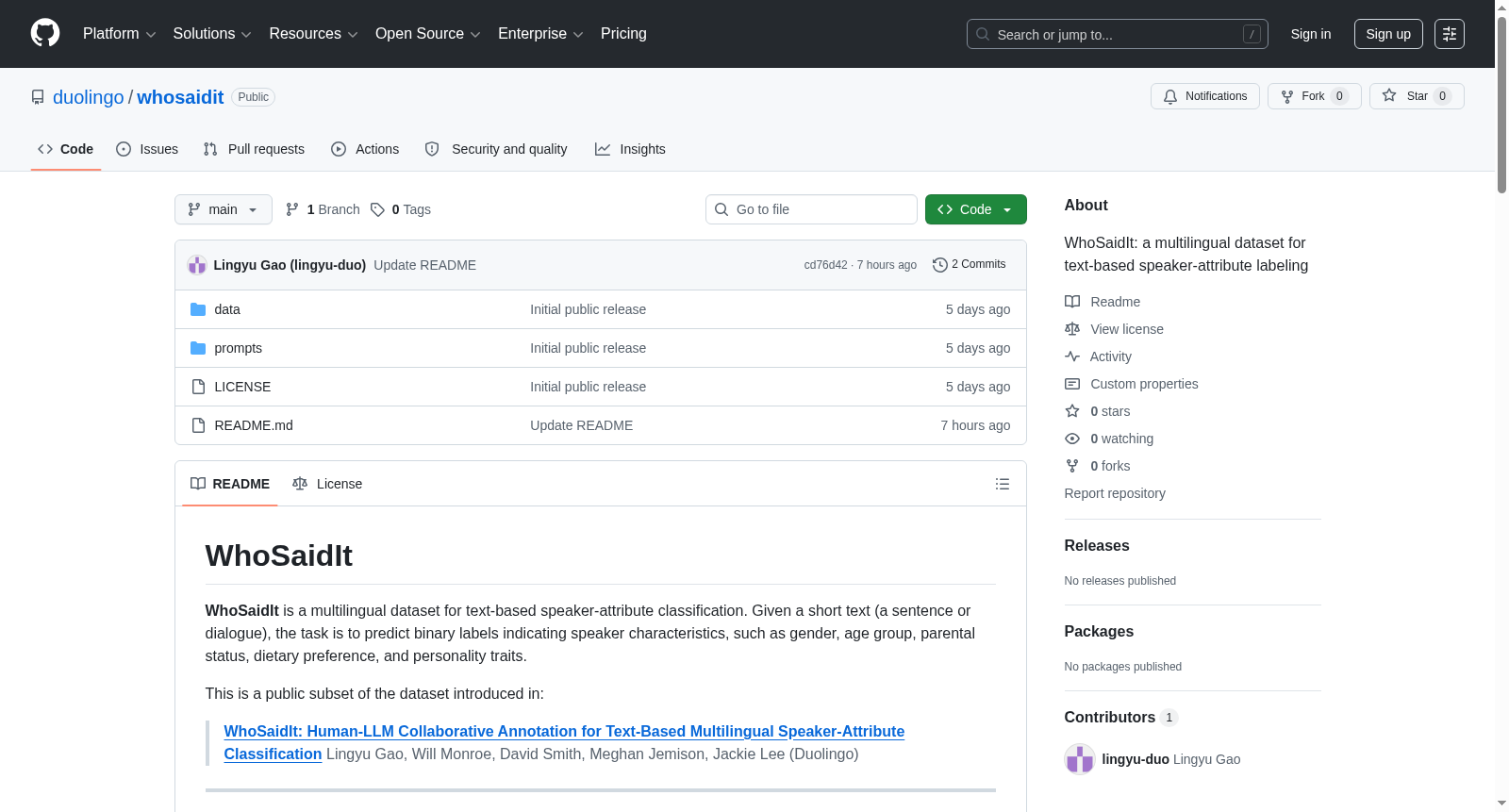
- 1WhoSaidIt: Human-LLM Collaborative Annotation for Text-Based Multilingual Speaker-Attribute Classification多邻国 · 2026年


