Unveiling the effect of interface on torsional behavior of crystalline Al-Al<sub>90</sub>Sm<sub>10</sub> metallic glass nanolaminates
收藏资源简介:
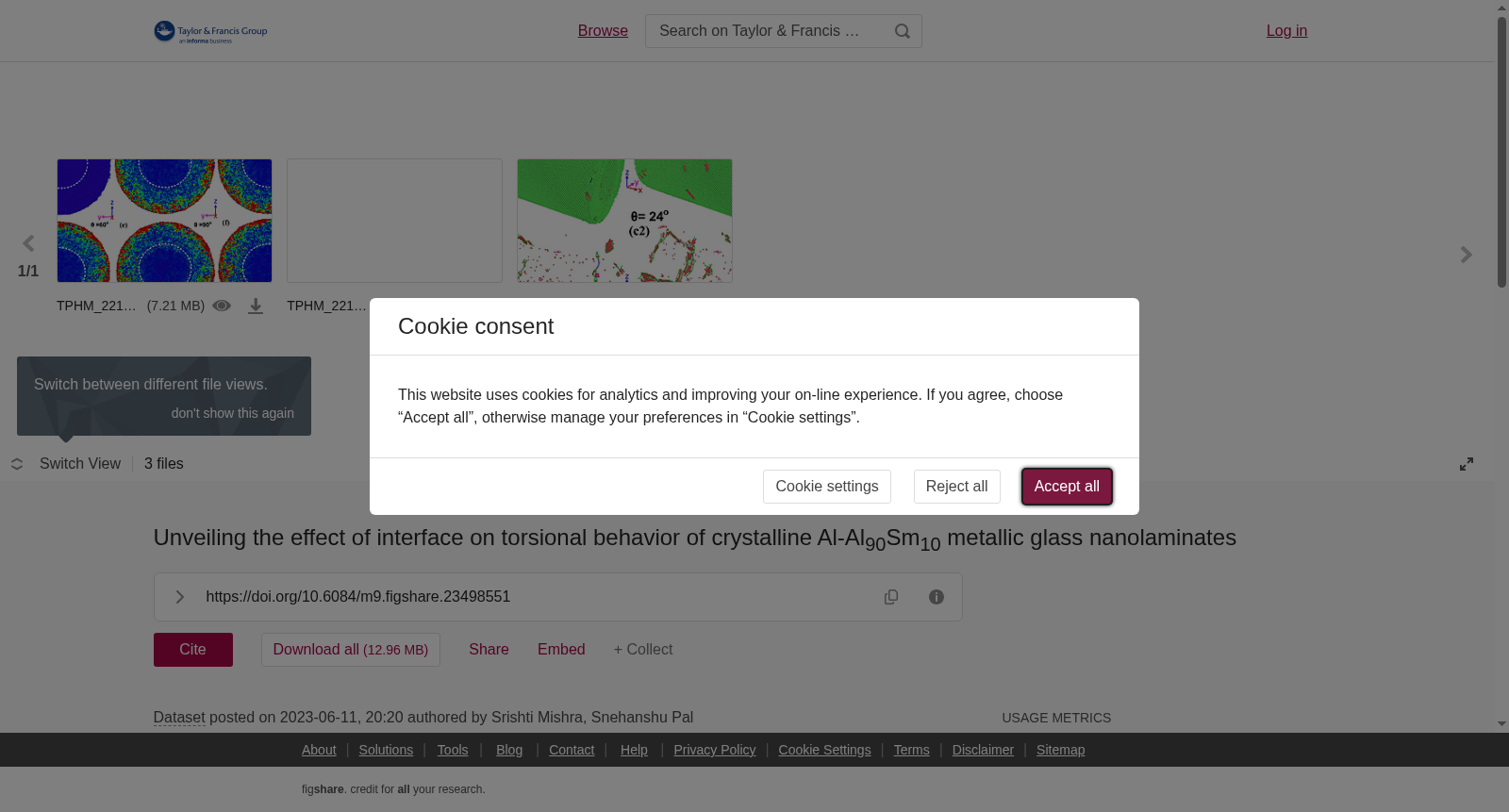
Influence of configurational design of single crystal Al-Al<sub>90</sub>Sm<sub>10</sub> metallic glass nanolaminates on torsion deformation behaviour of Al/Al<sub>90</sub>Sm<sub>10</sub> nanolaminate (Configuration 1) and Al<sub>90</sub>Sm<sub>10</sub>/Al nanolaminate (Configuration 2) from a structural evolution aspect have been analysed by employing Molecular Dynamics for a torsion speed of 1/600 revolution/ps. Adaptive common neighbour (a-CNA) analysis, Dislocation extraction algorithm (DXA), atomic shear strain analysis, and Voronoi Polyhedral (VP) analysis have been carried out to reveal the structural evolution in the nanolaminates specimen subjected to torque. As a consequence of dislocation density localisation under torsional loading in Al/Al<sub>90</sub>Sm<sub>10</sub> nanolaminate high atomic strain gradient is developed in the nanolaminate specimen causing torsional buckling of the Al/Al<sub>90</sub>Sm<sub>10</sub> nanolaminate. The localisation of dislocation density rings induces the formation of dislocation substructure in Al/Al<sub>90</sub>Sm<sub>10</sub> nanolaminate. The crystalline/amorphous interface serves as a free surface and encourages the formation of such dislocation substructure. The collective nucleation, coalescence, and growth of shear transformation zones (STZs) leading to the formation of thick shear bands on either end of Al<sub>90</sub>Sm<sub>10</sub>/Al nanolaminate inducing an almost homogenous atomic strain gradient across the surface of the nanolaminate specimen thereby averting torsional buckling. The C/A interface serves as a nucleation site for the generation STZs in Al<sub>90</sub>Sm<sub>10</sub>/Al nanolaminate. VPs such as <0, 0, 4, 6>, <0, 3, 6, 4>, <0, 3, 6, 5> <0, 2, 8, 2> have the load bearing capacity and are resistant to fragmentation under the subjugation of torsion loading.
本研究从结构演化视角出发,借助分子动力学(Molecular Dynamics)模拟,分析了单晶Al-Al₉₀Sm₁₀金属玻璃纳米叠层的构型设计对两类纳米叠层扭转变形行为的影响:一类为Al/Al₉₀Sm₁₀纳米叠层(构型1),另一类为Al₉₀Sm₁₀/Al纳米叠层(构型2),模拟所用扭转速率为1/600转/皮秒。本研究采用自适应公共近邻(adaptive common neighbour, a-CNA)分析、位错提取算法(Dislocation extraction algorithm, DXA)、原子剪切应变分析以及沃罗诺伊多面体(Voronoi Polyhedral, VP)分析,以揭示受扭矩作用的纳米叠层试样的结构演化过程。在Al/Al₉₀Sm₁₀纳米叠层中,扭转载荷下位错密度发生局域化,使得试样内部产生高原子应变梯度,进而引发该纳米叠层的扭转屈曲。位错密度环的局域化会促使Al/Al₉₀Sm₁₀纳米叠层内部形成位错亚结构,而晶/非晶界面可充当自由表面,进一步促进此类位错亚结构的生成。Al₉₀Sm₁₀/Al纳米叠层两端的剪切转变区(shear transformation zones, STZs)会集体形核、合并并生长,最终形成厚剪切带,使试样表面形成近乎均匀的原子应变梯度,从而避免了扭转屈曲的发生。晶/非晶(C/A)界面可作为Al₉₀Sm₁₀/Al纳米叠层中剪切转变区的形核位点。诸如<0, 0, 4, 6>、<0, 3, 6, 4>、<0, 3, 6, 5>以及<0, 2, 8, 2>的沃罗诺伊多面体具备承载能力,在扭转载荷作用下不易发生碎裂。