---
annotations_creators:
- expert-generated
language:
- ca
license:
- cc-by-nc-4.0
multilinguality:
- monolingual
task_categories:
- text-classification
- token-classification
pretty_name: InToxiCat
tags:
- abusive-language-detection
- abusive-language
- toxic-language-detection
- toxicity-detection
dataset_info:
features:
- name: id
dtype: string
- name: context
dtype: string
- name: sentence
dtype: string
- name: topic
dtype: string
- name: keywords
sequence: string
- name: context_needed
dtype: string
- name: is_abusive
dtype: int64
- name: abusiveness_agreement
dtype: string
- name: target_type
sequence: int64
- name: abusive_spans
struct:
- name: text
sequence: string
- name: index
sequence: string
- name: target_spans
struct:
- name: text
sequence: string
- name: index
sequence: string
- name: is_implicit
dtype: string
splits:
- name: train
num_bytes: 18159422
num_examples: 23847
- name: test
num_bytes: 2276428
num_examples: 2981
- name: validation
num_bytes: 2285701
num_examples: 2981
download_size: 14619803
dataset_size: 22721551
configs:
- config_name: default
data_files:
- split: train
path: data/train-*
- split: test
path: data/test-*
- split: validation
path: data/validation-*
---
# Dataset Card for InToxiCat
## Table of Contents
- [Table of Contents](#table-of-contents)
- [Dataset Description](#dataset-description)
- [Dataset Summary](#dataset-summary)
- [Supported Tasks and Leaderboards](#supported-tasks-and-leaderboards)
- [Languages](#languages)
- [Dataset Structure](#dataset-structure)
- [Data Instances](#data-instances)
- [Example](#example)
- [Data Fields](#data-fields)
- [Data Splits](#data-splits)
- [Dataset Creation](#dataset-creation)
- [Curation Rationale](#curation-rationale)
- [Source Data](#source-data)
- [Annotations](#annotations)
- [Personal and Sensitive Information](#personal-and-sensitive-information)
- [Considerations for Using the Data](#considerations-for-using-the-data)
- [Social Impact of Dataset](#social-impact-of-dataset)
- [Discussion of Biases](#discussion-of-biases)
- [Other Known Limitations](#other-known-limitations)
- [Additional Information](#additional-information)
- [Dataset Curators](#dataset-curators)
- [Licensing Information](#licensing-information)
- [Citation Information](#citation-information)
- [Contributions](#contributions)
## Dataset Description
- **Website:** https://zenodo.org/records/10600606
- **Point of Contact:** langtech@bsc.es
### Dataset Summary
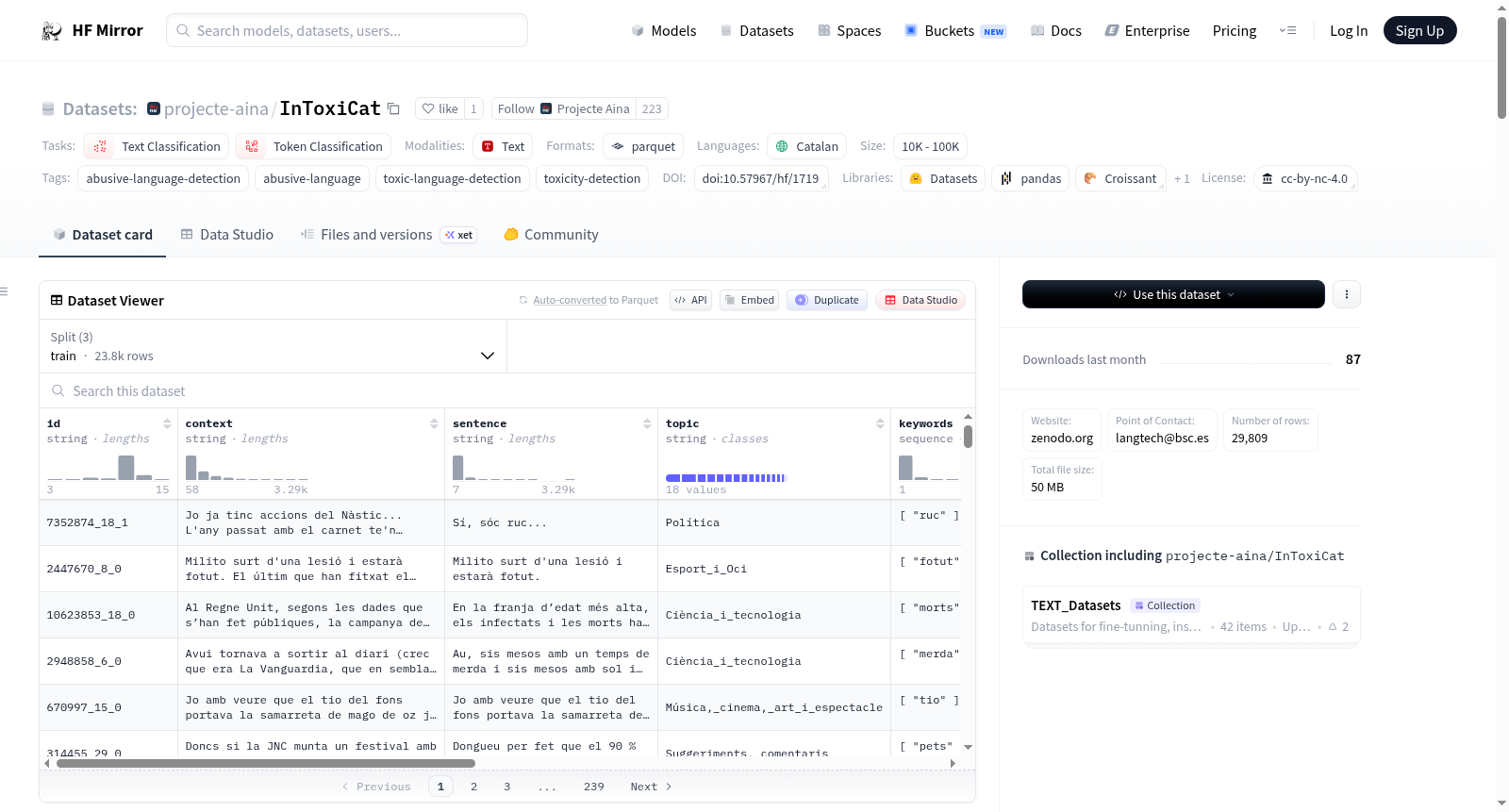
InToxiCat is a dataset for the detection of abusive language (defined by the aim to harm someone, individual, group, etc.) in Catalan, produced by the BSC LangTech unit.
The dataset consists of 29,809 sentences obtained from internet forums annotated as to whether or not they are abusive. The 6047 instances annotated as abusive are further annotated for the following features: abusive span, target span, target type and the implicit or explicit nature of the abusiveness in the message.
The dataset is split, in a balanced abusive/non-abusive distribution, into 23,847 training samples, 2981 validation samples, and 2981 test samples.
### Supported Tasks and Leaderboards
Abusive Language Detection
### Languages
The dataset is in Catalan (`ca-ES`).
## Dataset Structure
### Data Instances
Three JSON files, one for each split.
### Example:
<pre>
{
"id": "9472844_16_0",
"context": "Aquest tiu no té ni puta idea del que és una guerra ni del que s'espera d'un soldat.I què s'empatolla de despeses mèdiques. A veure si li passaré com al Hollande i sortiré la factura del seu perruquer (o taxidermista, no sé)",
"sentence": "Aquest tiu no té ni puta idea del que és una guerra ni del que s'espera d'un soldat.I què s'empatolla de despeses mèdiques.",
"topic": "Internacional",
"key_words": [
"puta"
],
"annotation": {
"is_abusive": "abusive",
"abusiveness_agreement": "full",
"context_needed": "no",
"abusive_spans": [
[
"no té ni puta idea",
"11:29"
]
],
"target_spans": [
[
"Aquest tiu",
"0:10"
]
],
"target_type": [
"INDIVIDUAL"
],
"is_implicit": "yes"
}
}
</pre>
### Data Fields
- ``id`` (a string feature): unique identifier of the instance.
- ``context`` (a string feature): complete text message from the user surrounding the sentence (it can coincide totally or only partially with the sentence).
- ``sentence`` (a string feature): text message where the abusiveness is evaluated.
- ``topic`` (a string feature): category from Racó Català forums where the sentence comes from.
- ``keywords`` (a list of strings): keywords used to select the candidate messages to annotate.
- ``context_needed`` (a string feature): "yes" / "no" if all the annotators consulted / did not consult the context to decide on the sentence's abusiveness, "maybe" if there was not agreement about it.
- ``is_abusive`` (a bool feature): "abusive" or "not_abusive".
- ``abusiveness_agreement`` (a string feature): "full" if the two annotators agreed on the abusiveness/not-abusiveness of the sentence, and "partial" if the abusiveness had to be decided by a third annotator.
- ``abusive_spans`` (a dictionary with field 'text' (list of strings) and 'index' (list of strings)): the sequence of words that attribute to the text's abusiveness.
- ``is_implicit`` (a string): whether the abusiveness is explicit (contains a profanity, slur or threat) or implicit (does not contain a profanity or slur, but is likely to contain irony, sarcasm or similar resources).
- ``target_spans`` (a dictionary with field 'text' (list of strings) and 'index' (list of strings)): if found in the message, the sequence(s) of words that refer to the target of the text's abusiveness.
- ``target_type`` (a dictionary with field 'text' (list of strings) and 'index' (list of strings)): three possible categories. The categories are non-exclusive, as some targets may have a dual identity and more than one target may be detected in a single message.
- ``individual``: a famous person, a named person or an unnamed person interacting in the conversation.
- ``group``: considered to be a unit based on the same ethnicity, gender or sexual orientation, political affiliation, religious belief or something else.
- ``other``; e.g. an organization, a situation, an event, or an issue.
### Data Splits
* train.json: 23847 examples
* dev.json: 2981 examples
* test.json: 2981 examples
## Dataset Creation
### Curation Rationale
We created this dataset to contribute to the development of language models in Catalan, a low-resource language.
### Source Data
#### Initial Data Collection and Normalization
The sentences to be annotated were collected from [Racó Català](https://www.racocatala.cat/forums) forums using a list of keywords (provided in Zenodo). The messages belong to different categories of Racó Català, specified in the "topic" field of the dataset. The length of the messages varies from one sentence to several sentences.
#### Who are the source language producers?
Anonymized users from Racó Català forums.
### Annotations
#### Annotation process
The annotation process was divided into the following two tasks, carried out in sequential order:
Task 1. The sentences (around 30.000) were annotated by two annotators as either abusive or not abusive. In case of ambiguity in the sentence, the annotators had the possibility to consult the context, i.e. the whole message of the user (if the sentence to be annotated was a segment contained in the message). In cases where annotators 1 and 2 disagreed about the abusiveness of a message, it was annotated by a third annotator. As a result, the sentences that are ultimately considered abusive are those that were initially annotated as abusive by both annotators or, in the case of an initial disagreement between them, those that were resolved as abusive by the third annotator.
Task 2. The sentences annotated as abusive (6047) in Task 1 were further annotated by the two main annotators for the following features, explained in the Summary section: abusive spans, implicit/explicit abusiveness, target spans, and target type.
The annotation guidelines are published and available on Zenodo.
#### Who are the annotators?
The annotators were qualified professionals with university education and a demonstrably excellent knowledge of Catalan (minimum level C1 or equivalent).
### Personal and Sensitive Information
No personal or sensitive information included.
## Considerations for Using the Data
### Social Impact of Dataset
We hope this dataset contributes to the development of language models in Catalan, a low-resource language.
### Discussion of Biases
[N/A]
### Other Known Limitations
[N/A]
## Additional Information
### Dataset Curators
Language Technologies Unit at the Barcelona Supercomputing Center (langtech@bsc.es)
This work has been promoted and financed by the Generalitat de Catalunya through the [Aina project](https://projecteaina.cat/).
### Licensing Information
This work is licensed under a [Creative Commons Attribution Non-commercial 4.0 International](https://creativecommons.org/licenses/by-nc/4.0/).
### Citation Information
```
@inproceedings{gonzalez-agirre-etal-2024-building-data,
title = "Building a Data Infrastructure for a Mid-Resource Language: The Case of {C}atalan",
author = "Gonzalez-Agirre, Aitor and
Marimon, Montserrat and
Rodriguez-Penagos, Carlos and
Aula-Blasco, Javier and
Baucells, Irene and
Armentano-Oller, Carme and
Palomar-Giner, Jorge and
Kulebi, Baybars and
Villegas, Marta",
editor = "Calzolari, Nicoletta and
Kan, Min-Yen and
Hoste, Veronique and
Lenci, Alessandro and
Sakti, Sakriani and
Xue, Nianwen",
booktitle = "Proceedings of the 2024 Joint International Conference on Computational Linguistics, Language Resources and Evaluation (LREC-COLING 2024)",
month = may,
year = "2024",
address = "Torino, Italia",
publisher = "ELRA and ICCL",
url = "https://aclanthology.org/2024.lrec-main.231",
pages = "2556--2566",
}
```
[](https://doi.org/10.57967/hf/1719)
### Contributions
[N/A]