Enhancing reflectivity of Mo/Si/C multilayers deposited on inclined substrates by substrate bias voltage
收藏资源简介:
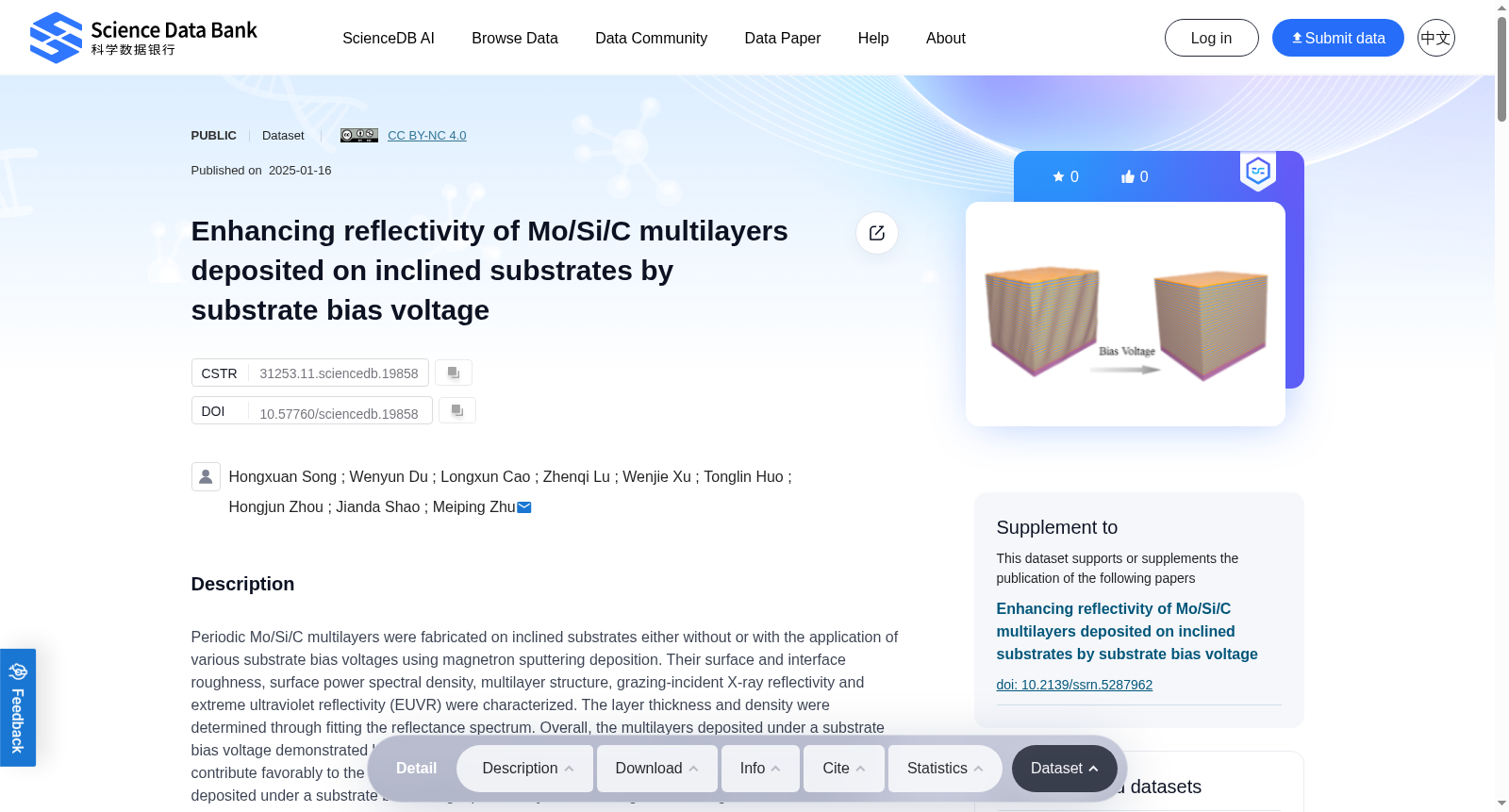
Periodic Mo/Si/C multilayers were fabricated on inclined substrates either without or with the application of various substrate bias voltages using magnetron sputtering deposition. Their surface and interface roughness, surface power spectral density, multilayer structure, grazing-incident X-ray reflectivity and extreme ultraviolet reflectivity (EUVR) were characterized. The layer thickness and density were determined through fitting the reflectance spectrum. Overall, the multilayers deposited under a substrate bias voltage demonstrated lower surface and interface roughness and higher layer density, both of which contribute favorably to the EUVR. However, the multilayers also exhibited greater interface diffusion when deposited under a substrate bias voltage, particularly at bias voltages exceeding -50 V, which has an adverse effect on the EUVR. By selecting an appropriate substrate bias voltage, the occurrence of ripples in multilayers deposited on inclined substrates could be mitigated, resulting in reduced surface and interface roughness, as well as increased layer density, and ultimately achieving higher EUVR. On a substrate with an inclined angle of 39°, we achieved an exciting result with a reflectivity of 67.2% for the Mo/Si/C multilayer.
采用磁控溅射沉积法,在倾斜衬底上制备了周期性Mo/Si/C多层膜:制备过程中分别施加不同衬底偏置电压,或未施加偏置电压。对其表面与界面粗糙度、表面功率谱密度、多层膜结构、掠入射X射线反射率以及极紫外反射率(extreme ultraviolet reflectivity, EUVR)进行了表征。通过拟合反射光谱,确定了各层的厚度与密度。总体而言,施加衬底偏置电压制备的多层膜,其表面与界面粗糙度更低、层密度更高,这两点均对极紫外反射率产生积极影响。但施加偏置电压制备的多层膜同时存在更显著的界面扩散现象,尤其当偏置电压高于-50 V时,该现象会对极紫外反射率产生不利影响。通过选择合适的衬底偏置电压,可抑制倾斜衬底上制备的多层膜出现波纹现象,进而降低表面与界面粗糙度、提升层密度,最终实现更高的极紫外反射率。在倾斜角度为39°的衬底上,我们制备的Mo/Si/C多层膜获得了67.2%的反射率,这一结果令人振奋。