small-models-for-glam/index-card-detection-v3
收藏资源简介:
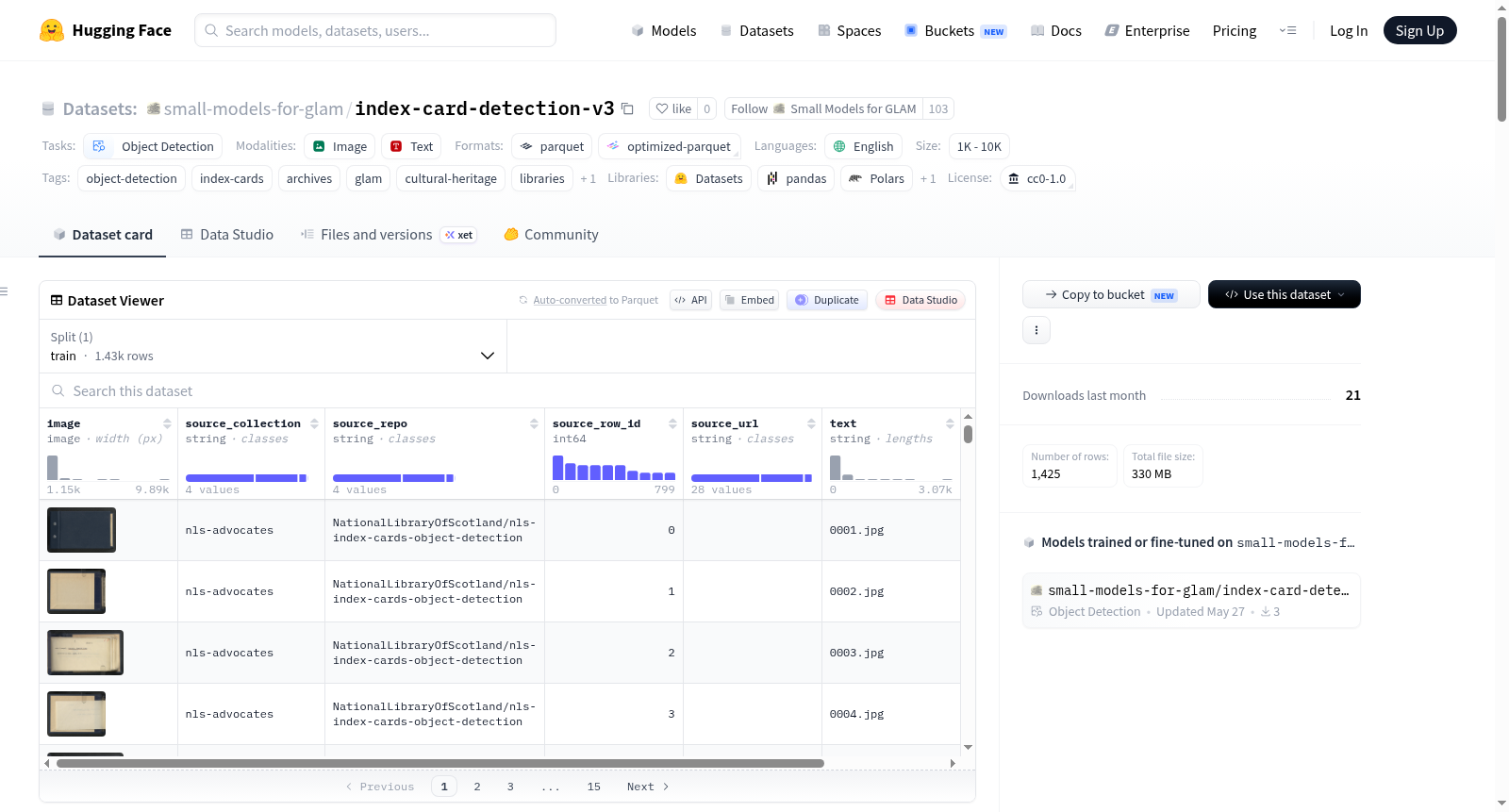
--- language: - en license: cc0-1.0 license_details: "Mixed across collections — see Source Data. NLS data is unrestricted use under NLS terms; navy-nurse-corps is US Government public-domain; bpl-card-catalog and rubenstein-manuscript-catalog are CC0-1.0." tags: - object-detection - index-cards - archives - glam - cultural-heritage - libraries - manuscripts annotations_creators: - machine-generated - expert-generated language_creators: - expert-generated pretty_name: Archival Index Card Detection — mixed collections size_categories: - 1K<n<10K source_datasets: - NationalLibraryOfScotland/nls-index-cards-object-detection - biglam/index-cards-navy-nurse-corps - biglam/bpl-card-catalog - biglam/rubenstein-manuscript-catalog task_categories: - object-detection configs: - config_name: default data_files: - split: train path: data/train-* dataset_info: config_name: default features: - name: image dtype: image - name: source_collection dtype: string - name: source_repo dtype: string - name: source_row_id dtype: int64 - name: source_url dtype: string - name: text dtype: string - name: objects struct: - name: bbox sequence: sequence: float32 length: 4 - name: category sequence: class_label: names: "0": card - name: box_source sequence: string splits: - name: train num_bytes: 330329844 num_examples: 1425 download_size: 330102842 dataset_size: 330329844 --- # Dataset Card for Archival Index Card Detection — mixed collections A training dataset for object detection of index cards in archival scans. Combines four publicly-released collections — NLS Advocates Library single-card pages, US Navy Nurse Corps multi-card biographical sheets, Boston Public Library catalog cards, and Duke Rubenstein manuscript catalog cards — into a single object-detection schema. ## Dataset Details ### Dataset Description 1,425 archival scans across four institutional collections. Constructed to extend the existing single-card NLS detector ([`NationalLibraryOfScotland/archival-index-card-detector`](https://huggingface.co/NationalLibraryOfScotland/archival-index-card-detector)) to handle multi-card scans and pre-cropped single-card images from other institutions, without regressing on the original NLS distribution. - **Curated by:** [Daniel van Strien](https://huggingface.co/davanstrien), Machine Learning Librarian, Hugging Face - **Language(s):** en (card content; English-only) - **License:** Mixed — see Source Data table below. Effectively unrestricted re-use for academic / research / non-commercial purposes; check the source dataset for commercial reuse. ### Dataset Sources - **Repository:** https://huggingface.co/datasets/small-models-for-glam/index-card-detection-v3 - **Trained model:** https://huggingface.co/small-models-for-glam/index-card-detector-v4 - **Demo Space:** https://huggingface.co/spaces/small-models-for-glam/index-card-detector ## Uses ### Direct Use Train an object detector to find archival index cards on: - Full archival page scans with one or more cards (NLS-style multi-card pages) - Multi-card sheets (2–9 cards arranged on a backing sheet, e.g. Navy biographical records) - Pre-cropped single-card images (BPL / Rubenstein style) The accompanying YOLO26n checkpoint at `small-models-for-glam/index-card-detector-v4` is fine-tuned from the NLS v1 baseline on this data. ### Out-of-Scope Use - **Not for OCR.** Detection only — bbox tells you *where* the card is, not *what it says*. Pair with a downstream OCR/VLM model (NuExtract3, Qwen-VL, etc.). - **Not for content classification.** Single class `card` — does not distinguish card type, content, or blank/content. - **English-only.** Cards in other languages may not generalise. - **Not a benchmark dataset.** Train/val split is automatic and stratified per collection; not held back as a community evaluation set. ## Dataset Structure One row per image: | Column | Type | Description | |---|---|---| | `image` | `Image` | RGB scan, original resolution | | `source_collection` | `string` | One of `nls-advocates`, `navy-nurse-corps`, `bpl`, `rubenstein` | | `source_repo` | `string` | Source HF dataset id | | `source_row_id` | `int64` | Index in the source dataset | | `source_url` | `string` | Link to original item (when present in source) | | `text` | `string` | OCR or filename from source (preserved as-is) | | `objects.bbox` | `list[[float, 4]]` | xywh in original pixel coordinates | | `objects.category` | `ClassLabel(["card"])` | Single class; always `0` | | `objects.box_source` | `list[string]` | Provenance per box: `nls-original` \| `sam3+human` \| `auto-full` | Per-collection breakdown: | Collection | Rows | Boxes | Avg boxes/row | Avg image size | |---|---|---|---|---| | nls-advocates | 100 | ~155 | 1.55 (incl. some has_card=False) | ~2900×1800 | | navy-nurse-corps | 25 | ~85 | 3.4 | varied (3K×4K to 10K×6K) | | bpl | 800 | 800 | 1.0 | ~1175×710 | | rubenstein | 500 | 500 | 1.0 | ~1555×1100 | | **Total** | **1,425** | **~1,540** | | | ## Dataset Creation ### Curation Rationale The existing NLS detector (v1) was trained on 100 NLS Advocates Library pages and reached 99.1% mAP@50:95 on that distribution, but had not been tested on multi-card scans or cards from other institutions. This dataset extends v1's training distribution while preserving the NLS samples to prevent catastrophic forgetting. ### Source Data #### Data Collection and Processing Four source collections, all publicly hosted on the Hugging Face Hub: | Collection | Source | n used | Label provenance | License (source) | |---|---|---|---|---| | NLS Advocates Library | `NationalLibraryOfScotland/nls-index-cards-object-detection` | 100 (all) | Original NLS bboxes (10 has_card=False negatives included) | Per source repo | | US Navy Nurse Corps | `biglam/index-cards-navy-nurse-corps` | 25 (all) | SAM3 bootstrap + human review/correction | Public domain (US Govt) | | Boston Public Library | `biglam/bpl-card-catalog` | 800 (first rows) | `bbox = whole image` (auto, pre-cropped) | CC0-1.0 | | Duke Rubenstein | `biglam/rubenstein-manuscript-catalog` | 500 (first rows) | `bbox = whole image` (auto, pre-cropped) | CC0-1.0 | Sloane Catalogues (`biglam/sloane-catalogues`) was considered and **excluded** — those scans are two-page manuscript catalog book spreads, not index cards. #### Who are the source data producers? Original archival cards were created by librarians and archivists at the four source institutions over the late 19th / 20th century. Digitisation by each institution and/or via Internet Archive. ### Annotations #### Annotation process Three different paths into the same object-detection schema: 1. **NLS Advocates (100 imgs):** original bboxes from the NLS detector v1 training set, passed through unchanged. Includes 10 has_card=False pages as negatives. 2. **Navy Nurse Corps (25 imgs):** bootstrap with Meta's SAM3 ([`uv-scripts/sam3`](https://huggingface.co/datasets/uv-scripts/sam3), `--class-name "card" --confidence-threshold 0.15` on an A100). Outputs were reviewed and corrected in a custom single-page HTML bbox editor. One systematic SAM3 failure (an "envelope" box wrapping all cards on tall multi-card scans, ~95–98% image area) was auto-filtered before review. Final per-image: ~3.4 cards on average. 3. **BPL + Rubenstein (1,300 imgs):** auto-labelled `bbox = [1, 1, W-2, H-2]` based on the structural fact that source images are pre-cropped single cards filling the frame. No human review pass. The `objects.box_source` column records which path produced each box. #### Who are the annotators? - NLS: NLS internal team - Navy: [Daniel van Strien](https://huggingface.co/davanstrien) (review and correction over SAM3 bootstrap) - BPL + Rubenstein: rule-based (no human pass) #### Personal and Sensitive Information Cards contain names, addresses, and biographical details of individuals (Navy Nurse Corps records in particular). All source datasets are from publicly-released collections — personal information is in the public archival record by virtue of original institutional release. Downstream users should respect each source institution's usage policies. ## Bias, Risks, and Limitations - **English-only.** Cards in other languages are not represented. - **US/UK archival conventions only.** Card stocks, layouts, and aesthetics outside that tradition (e.g. continental European library catalogs, East Asian indices, hand-coloured cards) are out-of-distribution. - **Multi-card variety concentrated in 25 navy images.** Multi-card scans with very different layouts (e.g., card grids of 12+, severely overlapping cards) may not generalise. - **No true negative non-card examples beyond the 10 NLS background pages.** Newspaper clippings, photographs, and book pages are not in the training set; models trained on this may over-predict on those inputs. Pair with downstream filtering or train v5 with additional negatives. - **BPL + Rubenstein labels are rule-based, not human-verified.** `bbox = whole image` is a reasonable approximation for pre-cropped cards but slight cropping noise around the edges is not captured. Tight pixel-accuracy downstream tasks may want a hand-labelled refresh. ### Recommendations - For tight cropping or pixel-accurate downstream OCR, validate model output on a small held-out set before bulk processing. - For archives mixing cards with other content, add negatives or apply a downstream non-card filter. - For cards in other languages, fine-tune with additional samples from those traditions before deployment. ## Citation **BibTeX:** ```bibtex @dataset{vanstrien_archival_index_cards_v3_2026, author = {van Strien, Daniel}, title = {Archival Index Card Detection — mixed collections (v3)}, year = {2026}, publisher = {Hugging Face}, url = {https://huggingface.co/datasets/small-models-for-glam/index-card-detection-v3} } ``` ## Dataset Card Authors [Daniel van Strien](https://huggingface.co/davanstrien) ## Dataset Card Contact Open an issue on the [dataset repo](https://huggingface.co/datasets/small-models-for-glam/index-card-detection-v3/discussions) or contact [@davanstrien](https://huggingface.co/davanstrien).
A training dataset for object detection of index cards in archival scans. Combines four publicly-released collections — NLS Advocates Library single-card pages, US Navy Nurse Corps multi-card biographical sheets, Boston Public Library catalog cards, and Duke Rubenstein manuscript catalog cards — into a single object-detection schema. 1,425 archival scans across four institutional collections. Constructed to extend the existing single-card NLS detector (NationalLibraryOfScotland/archival-index-card-detector) to handle multi-card scans and pre-cropped single-card images from other institutions, without regressing on the original NLS distribution.