
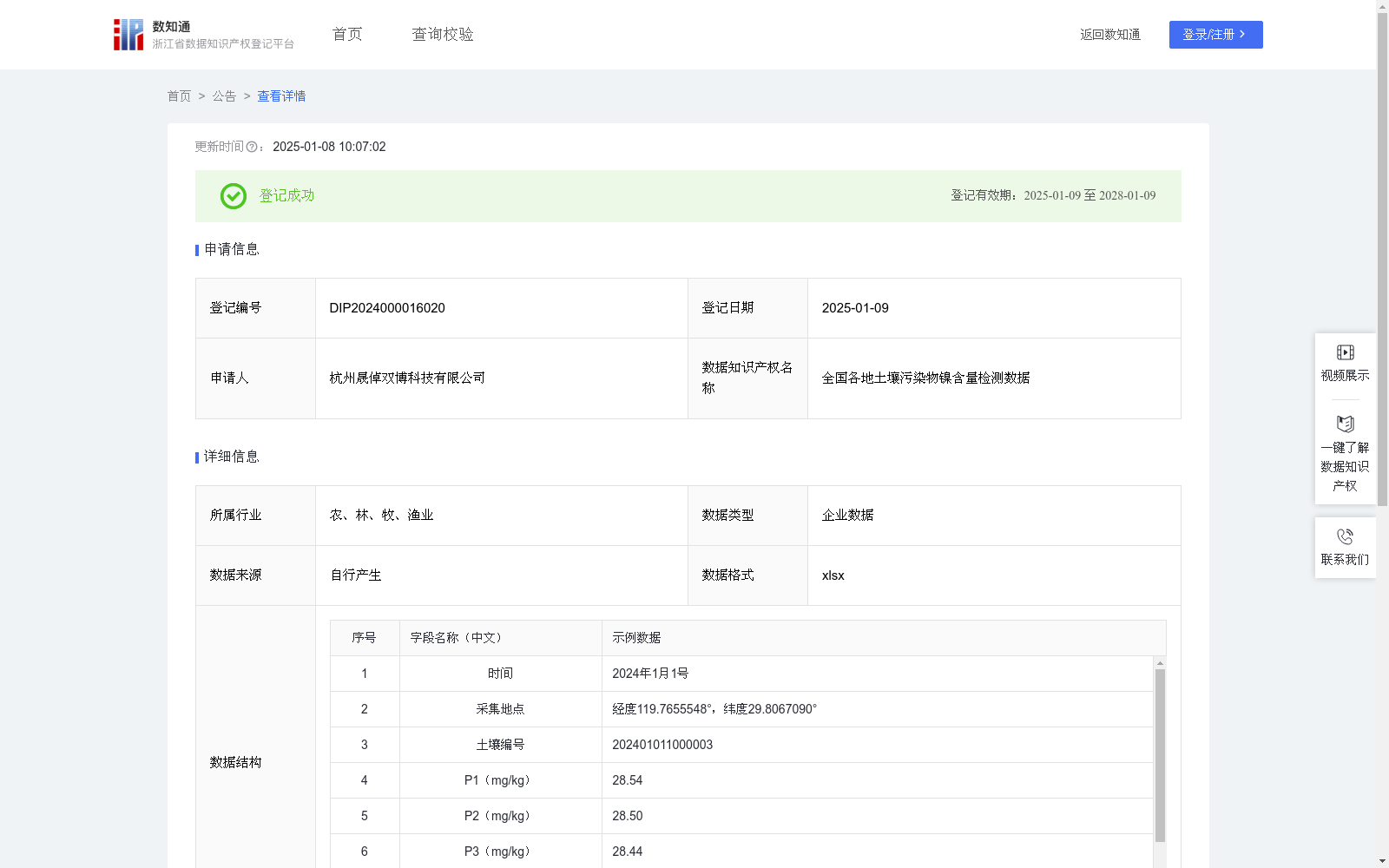
全国各地土壤污染物镍含量检测数据
收藏浙江省数据知识产权登记平台2025-01-08 更新2025-01-09 收录
下载链接:
https://www.zjip.org.cn/home/announce/trends/110576
下载链接
链接失效反馈官方服务:
资源简介:
通过检测数据分析研判,我们可以判断全国各地土壤污染物中镍是否超标,避免因镍持续污染而产生的污染问题,有以下几点作用。一、进行土壤污染治理可以减少农作物中的该有害物质含量,确保食品的质量和安全;二、根据检测结果可有针对的改善士壤质量,提高土壤的生产力,可以为农业发展提供可持续的基础,同时也有利于保护和改善环境。另外可结合地理信息系统(GIS)技术,将各地点的土壤地理数据和镍污染物含量信息进行深度整合和分析,绘制地理位置-污染物含量地图,以直观的可视化形式呈现给用户,增强地理位置与污染物含量关系的理解,构建起一个包含污染源、污染物种类、污染程度、污染扩散路径等多维度信息的地理图谱。这一图谱不仅能够提供实时的监测数据,还能够通过数据之间的关联性,揭示潜在的污染风险和趋势。1数据采集:每天对全国各地的各个地点,在各个地点的方圆1米直径内随机采集3个点的土壤;2数据处理:将数据去噪、优化、补全;3数据加工:通过检测仪设备对3个点的土壤进行镍污染物含量检测,得出3个采样点的土壤镍污染物含量数据,分别为P1、P2和P3,则该地点的土壤镍污染物含量平均值P4=(P1+P2+P3)/3,3个采样点镍的含量方差s^2={(P1-P4)^2+(P2-P4)^2+(P3-P4)^2}/3;4数据应用:根据土壤镍污染物含量平均值P4有助于了解该地区土壤中镍的污染状况和潜在的污染风险趋势,若s^2大于0.0025则该采集地点为异常,否则为不异常,对于异常的采集地点,需重点关注,查找出引起异常的原因。
By analyzing and evaluating detection data, we can determine whether nickel concentrations in soil pollutants across the country exceed regulatory standards, thereby preventing pollution issues caused by sustained nickel contamination. This dataset serves the following purposes:
First, soil pollution remediation can reduce the levels of this hazardous substance in crops, ensuring food quality and safety;
Second, targeted improvements to soil quality can be made based on detection results, enhancing soil productivity and providing a sustainable foundation for agricultural development, while also contributing to environmental protection and improvement.
Additionally, by integrating Geographic Information System (GIS) technology, we can conduct in-depth integration and analysis of soil geographic data and nickel pollutant concentration information from various locations, and generate location-pollutant concentration maps. These maps are presented to users in an intuitive visual format, helping to enhance understanding of the relationship between geographic locations and pollutant concentrations, and construct a geographic knowledge graph that includes multi-dimensional information such as pollution sources, pollutant types, pollution levels, and pollution diffusion paths. This knowledge graph not only provides real-time monitoring data, but also reveals potential pollution risks and trends through the correlation between different datasets.
1. Data Collection: Soil samples are randomly collected from 3 points within a 1-meter diameter circle at each location across the country every day;
2. Data Processing: The collected data is denoised, optimized, and imputed;
3. Data Analysis: The nickel pollutant concentrations of the three soil samples are detected using testing equipment, yielding three sets of data denoted as P1, P2, and P3 respectively. The average nickel concentration of soil samples at this location is calculated as P4 = (P1 + P2 + P3)/3, and the variance of the three sampling points' nickel concentrations is s² = [(P1-P4)² + (P2-P4)² + (P3-P4)²]/3;
4. Data Application: The average nickel concentration P4 helps assess the soil nickel pollution status and potential pollution risk trends in the region. If the variance s² exceeds 0.0025, the sampling location is identified as abnormal; otherwise, it is normal. Abnormal sampling locations require focused attention to identify the causes of the anomalies.
提供机构:
杭州晟倬双博科技有限公司
创建时间:
2024-11-18
搜集汇总
数据集介绍
以上内容由遇见数据集搜集并总结生成



